Clinical Effectiveness Unit, Royal College of Surgeons of England, 38-43 Lincoln's Inn Fields, Holborn, London, WC2A 3PE, UK.
Hull York Medical School, Hull, UK.
J Foot Ankle Res. 2023 Sep 19;16(1):62. doi: 10.1186/s13047-023-00664-6.
Chronic limb-threatening ischaemia (CLTI) is a condition associated with significant risks of lower limb loss and mortality, which increase with delays in management. Guidance recommends urgent referral and assessment, but delays are evident at every stage of the CLTI patient pathway. This study uses qualitative methods to explore hospital clinicians' experiences and perceptions of the existing CLTI pathway.
A qualitative interview study was conducted. Semi-structured interviews were undertaken with 13 clinicians involved in the assessment of patients referred to hospital with suspected CLTI, identified via purposive sampling from English vascular surgery units. Clinicians included podiatrists, vascular specialist nurses and doctors. Reflexive thematic analysis was performed on the data from a critical realist position.
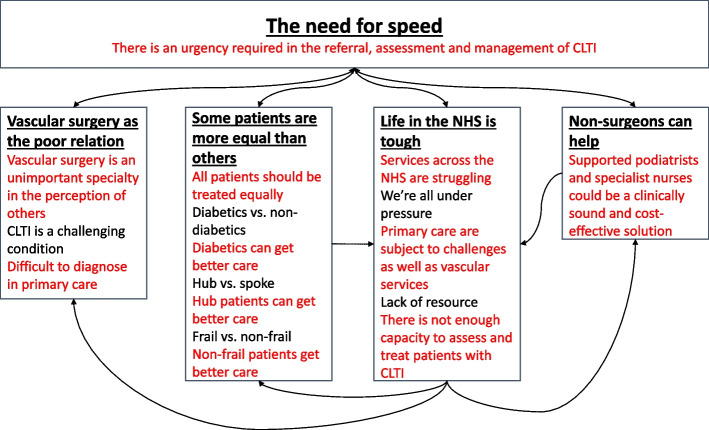
The need for speed was the single overarching theme identified. Four linked underlying themes were also identified; 1. Vascular surgery as the poor relation (compared to cancer and other specialties), with a sub-theme of CLTI being a challenging diagnosis. 2. Some patients are more equal than others, with sub-themes of diabetes vs. non-diabetes, hub vs. spoke and frailty vs. non-frail. 3. Life in the National Health Service (NHS) is tough, with sub-themes of lack of resource and we're all under pressure. 4. Non-surgeons can help.
The underlying themes generated from the rich interview data describe barriers to timely referral, assessment and management of CLTI, as well as the utility of non-surgical roles such as podiatrists and vascular specialist nurses as a potential solution for delays. The overarching theme of the need for speed highlights the meaning given to adverse consequences of delays in management of CLTI by clinicians involved in its assessment. Future improvement projects aimed at the CLTI pathway should take these findings into account.
慢性肢体威胁性缺血(CLTI)是一种与下肢丧失和死亡率显著相关的疾病,随着治疗的延迟,这些风险会增加。指南建议紧急转诊和评估,但在 CLTI 患者路径的每个阶段都存在延迟。本研究使用定性方法探讨了医院临床医生对现有 CLTI 路径的经验和看法。
进行了一项定性访谈研究。通过从英国血管外科单位有目的地抽样,确定了 13 名参与疑似 CLTI 患者评估的临床医生,并对他们进行了半结构化访谈。临床医生包括足病医生、血管专科护士和医生。从批判现实主义的角度对数据进行了反思性主题分析。
速度的必要性是确定的唯一首要主题。还确定了四个相关的基本主题;1. 血管外科是较差的关系(与癌症和其他专业相比),有一个子主题是 CLTI 是一个具有挑战性的诊断。2. 有些患者比其他患者更平等,有糖尿病与非糖尿病、枢纽与分支、脆弱与非脆弱的子主题。3. 国家卫生服务(NHS)的生活很艰难,有资源匮乏和我们都有压力的子主题。4. 非外科医生也能提供帮助。
从丰富的访谈数据中生成的基本主题描述了及时转诊、评估和管理 CLTI 的障碍,以及足病医生和血管专科护士等非外科角色的实用性,作为延迟的潜在解决方案。速度的首要主题突出了参与 CLTI 评估的临床医生对管理延迟的不利后果的意义。未来旨在改善 CLTI 路径的改进项目应考虑到这些发现。