Department of Medicine, Division of Medical Oncology, University of Washington, Seattle, WA, USA.
Clinical Research Division, Fred Hutchinson Cancer Center, Seattle, WA, USA.
Cancer Immunol Immunother. 2023 Nov;72(11):3839-3850. doi: 10.1007/s00262-023-03539-8. Epub 2023 Sep 21.
Optimal duration of treatment (DoT) with immune checkpoint inhibitors (ICI) in metastatic cancers remains unclear. Many patients, especially those without radiologic complete remission, develop progressive disease after ICI discontinuation. Extending DoT with ICI may potentially improve efficacy outcomes but presents major logistical and cost challenges with standard frequency dosing (SFD). Receptor occupancy data supports reduced frequency dosing (RFD) of anti-PD-1 antibodies, which may represent a more practical and economically viable option to extend DoT.
We conducted a retrospective study of patients with metastatic melanoma and Merkel cell carcinoma (MCC), who received ICI at RFD administered every 3 months, after initial disease control at SFD. We evaluated efficacy, safety, and cost-savings of the RFD approach in this cohort.
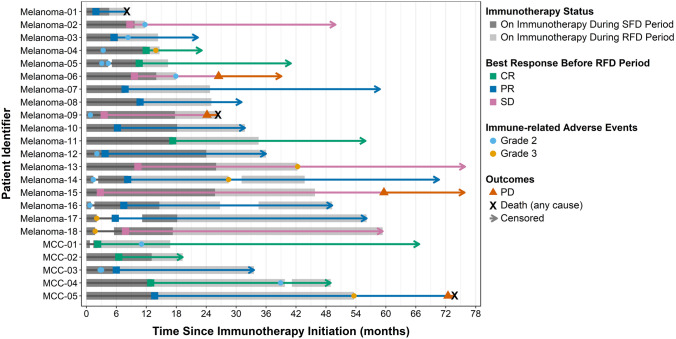
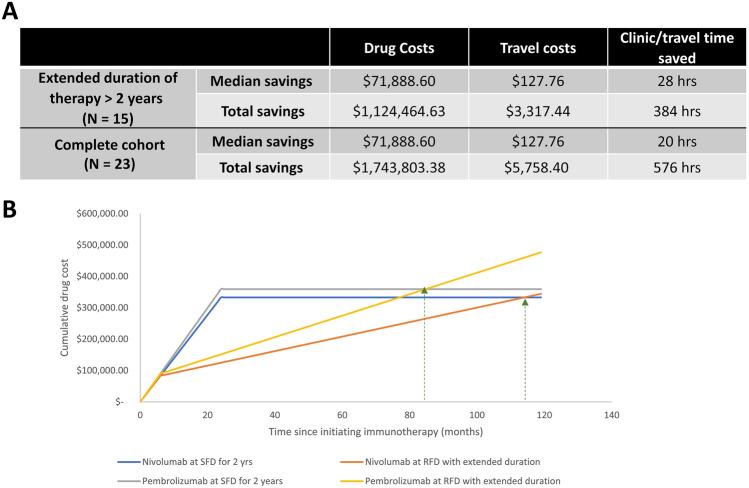
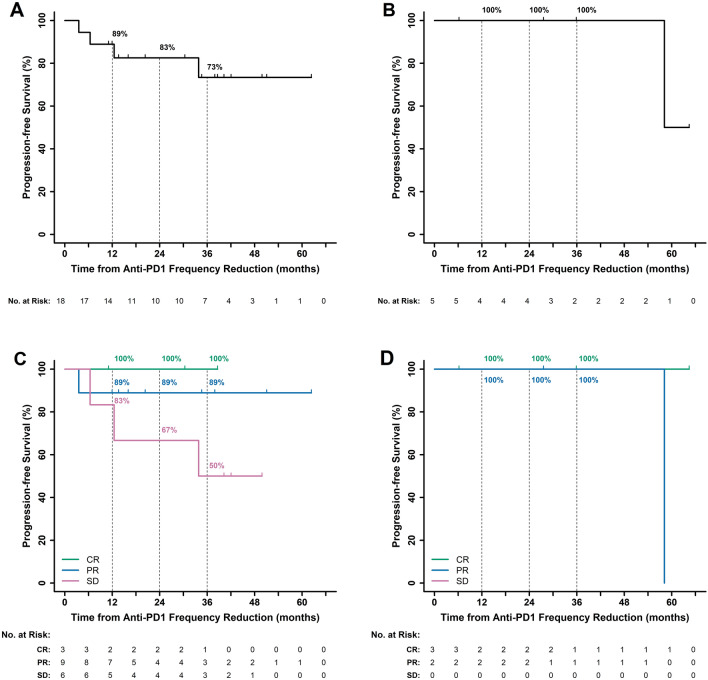
Between 2014 and 2021, 23 patients with advanced melanoma (N = 18) or MCC (N = 5) received anti-PD-1 therapy at RFD. Median DoT was 1.1 years at SFD and 1.2 years at RFD. The 3 year PFS after start of RFD was 73% in melanoma and 100% in MCC patients, which compare favorably to historical control rates. In the subset of 15 patients who received at least 2 years of therapy, total savings amounted to $1.1 million in drug costs and 384 h saved despite the extended DoT (median 3.4 years), as compared to the calculated cost of 2 years at SFD.
ICI administration at RFD can allow extension of treatment duration, while preserving efficacy and reducing logistical and financial burden. RFD approach deserves further exploration in prospective clinical trials.
免疫检查点抑制剂(ICI)在转移性癌症中的最佳治疗持续时间(DoT)仍不清楚。许多患者,尤其是那些没有影像学完全缓解的患者,在 ICI 停药后会出现疾病进展。延长 ICI 的 DoT 可能会提高疗效,但对于标准频率给药(SFD)来说,这在后勤和成本方面带来了重大挑战。受体占有率数据支持减少抗 PD-1 抗体的给药频率(RFD),这可能是延长 DoT 的一种更实用和经济可行的选择。
我们对接受 RFD 治疗的转移性黑色素瘤和 Merkel 细胞癌(MCC)患者进行了回顾性研究,这些患者在 SFD 初始疾病控制后接受了每 3 个月一次的 ICI 治疗。我们评估了该队列中 RFD 方法的疗效、安全性和成本节约。
在 2014 年至 2021 年间,23 例晚期黑色素瘤(N=18)或 MCC(N=5)患者接受了 RFD 抗 PD-1 治疗。SFD 时的中位 DoT 为 1.1 年,RFD 时为 1.2 年。RFD 开始后 3 年的 PFS 为黑色素瘤患者的 73%和 MCC 患者的 100%,与历史对照率相比具有优势。在接受至少 2 年治疗的 15 例患者亚组中,与计算得出的 SFD 2 年成本相比,药物成本总计节省 110 万美元,尽管延长了 DoT(中位 3.4 年),但节省了 384 小时。
RFD 给药可以延长治疗持续时间,同时保持疗效,并减轻后勤和财务负担。RFD 方法值得进一步在前瞻性临床试验中探索。