Rheumatology Unit, Department of Medicine and Surgery, University of Perugia, Perugia, Italy.
Rheumatology Unit, Department of Clinical and Experimental Medicine, University of Pisa, Pisa, Italy.
RMD Open. 2023 Sep;9(3). doi: 10.1136/rmdopen-2023-003365.
Assessment of circulating autoantibodies represents one of the earliest diagnostic procedures in patients with suspected connective tissue disease (CTD), providing important information for disease diagnosis, identification and prediction of potential clinical manifestations. The purpose of this study was to evaluate the ability of multiparametric assay to correctly classify patients with multiple CTDs and healthy controls (HC), independent of clinical features, and to evaluate whether serological status could identify clusters of patients with similar clinical features.
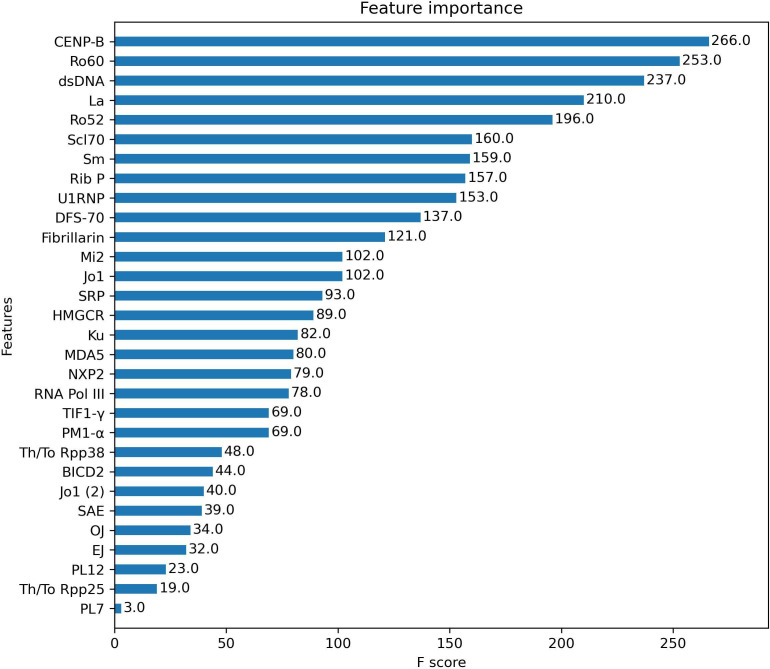
Patients with systemic lupus erythematosus (SLE), systemic sclerosis (SSc), Sjogren's syndrome (SjS), undifferentiated connective tissue disease (UCTD), idiopathic inflammatory myopathies (IIM) and HC were enrolled. Serum was tested for 29 autoantibodies. An XGBoost model, exclusively based on autoantibody titres was built and classification accuracy was evaluated. A hierarchical clustering model was subsequently developed and clinical/laboratory features compared among clusters.
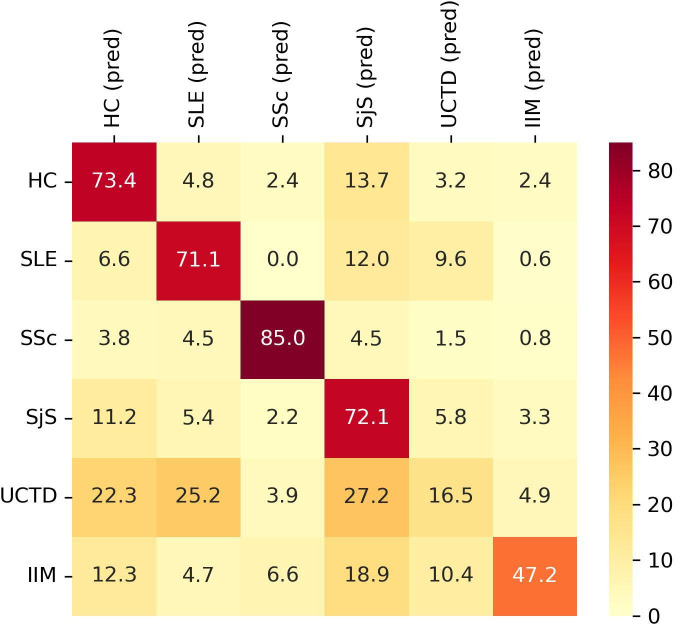
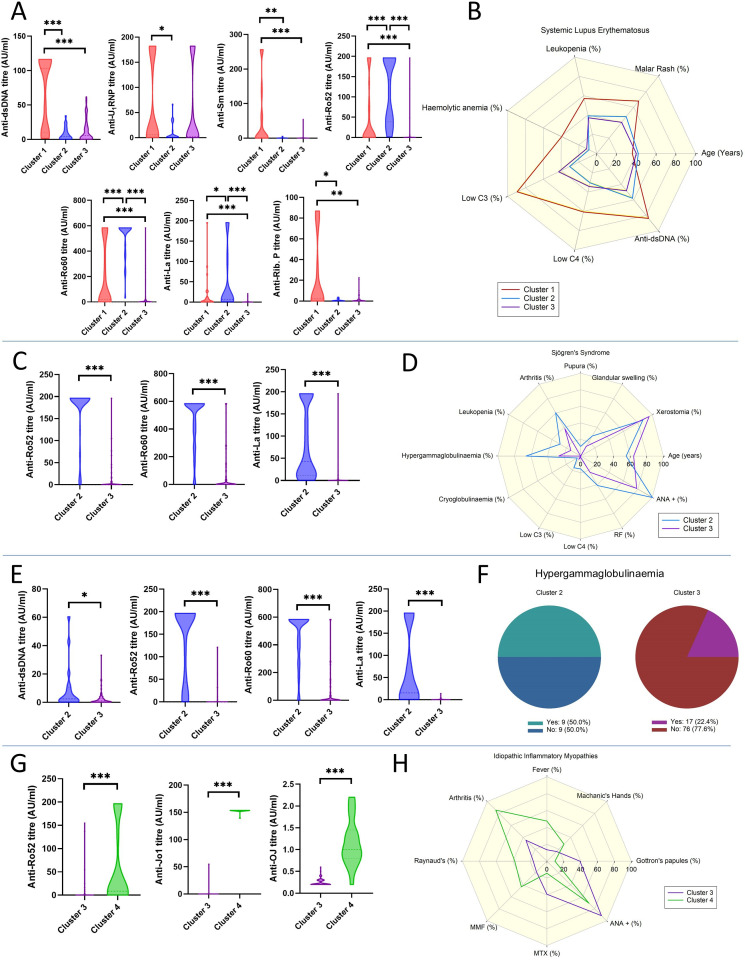
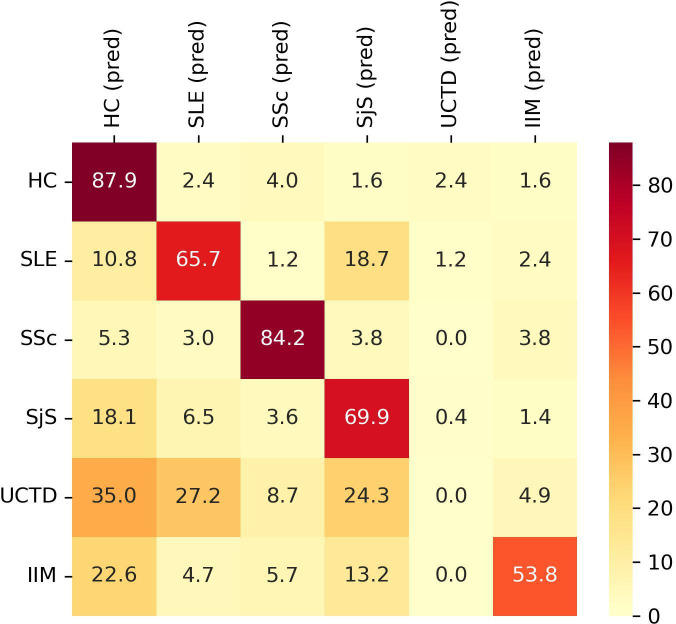
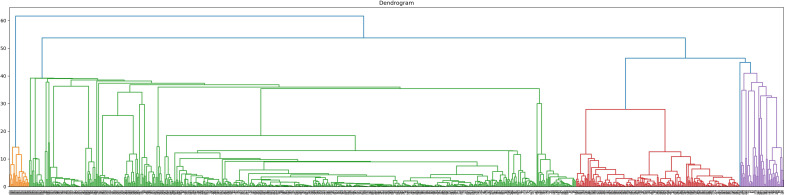
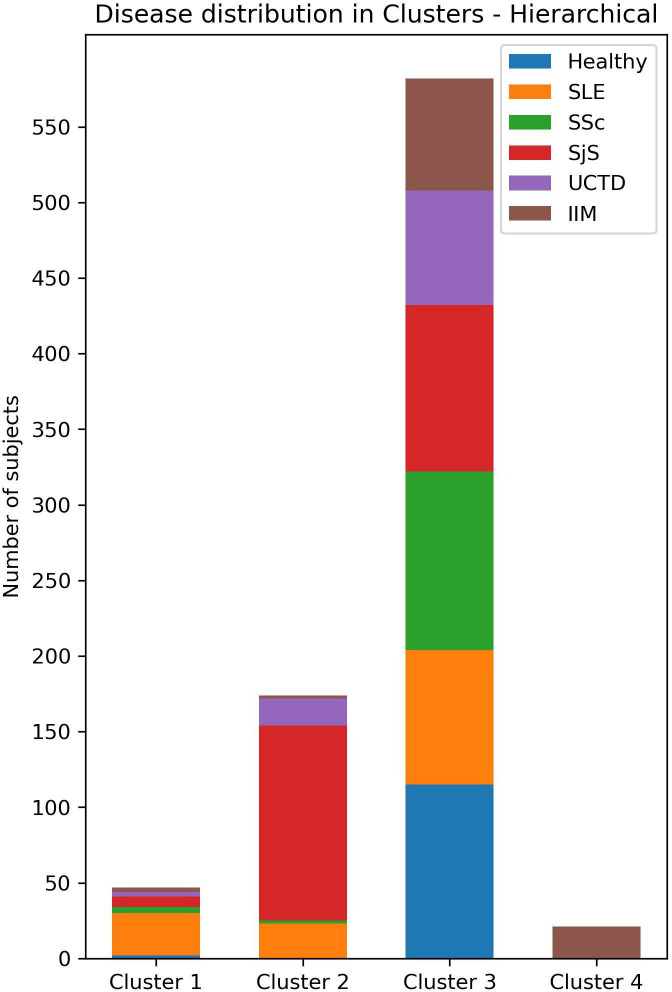
908 subjects were enrolled. The classification model showed a mean accuracy of 60.84±4.05% and a mean area under the receiver operator characteristic curve of 88.99±2.50%, with significant discrepancies among groups. Cluster analysis identified four clusters (CL). CL1 included patients with typical features of SLE. CL2 included most patients with SjS, along with some SLE and UCTD patients with SjS-like features. CL4 included anti-Jo1 patients only. CL3 was the largest and most heterogeneous, including all the remaining subjects, overall characterised by low titre or lower-prevalence autoantibodies.
Extended multiparametric autoantibody assay allowed an accurate classification of CTD patients, independently of clinical features. Clustering according to autoantibody titres is able to identify clusters of CTD subjects with similar clinical features, independently of their final diagnosis.
循环自身抗体的评估是疑似结缔组织病(CTD)患者的最早诊断程序之一,为疾病诊断、识别和潜在临床表现预测提供重要信息。本研究旨在评估多参数检测对多种 CTD 患者和健康对照(HC)的正确分类能力,独立于临床特征,并评估血清学状态是否能识别具有相似临床特征的患者聚类。
纳入系统性红斑狼疮(SLE)、系统性硬皮病(SSc)、干燥综合征(SjS)、未分化结缔组织病(UCTD)、特发性炎性肌病(IIM)和 HC 患者。检测血清 29 种自身抗体。建立了一个仅基于自身抗体滴度的 XGBoost 模型,并评估了分类准确性。随后开发了一个层次聚类模型,并比较了聚类之间的临床/实验室特征。
共纳入 908 例患者。分类模型的平均准确率为 60.84±4.05%,平均接收者操作特征曲线下面积为 88.99±2.50%,各组之间存在显著差异。聚类分析确定了四个聚类(CL)。CL1 包括具有典型 SLE 特征的患者。CL2 包括大多数 SjS 患者,以及一些具有 SjS 样特征的 SLE 和 UCTD 患者。CL4 仅包括抗 Jo1 患者。CL3 是最大和最异质的,包括所有其余的患者,总体特征是低滴度或低流行自身抗体。
扩展的多参数自身抗体检测可在独立于临床特征的情况下对 CTD 患者进行准确分类。根据自身抗体滴度进行聚类能够识别具有相似临床特征的 CTD 患者聚类,而与他们的最终诊断无关。