Department of Neurosurgery, The First Affiliated Hospital of Nanjing Medical University, 210029, Nanjing, China.
Institute for Brain Tumors, Collaborative Innovation Center for Cancer Personalized Medicine, and Center for Global Health, Nanjing Medical University, 211166, Nanjing, China.
Nat Commun. 2023 Sep 22;14(1):5913. doi: 10.1038/s41467-023-41663-2.
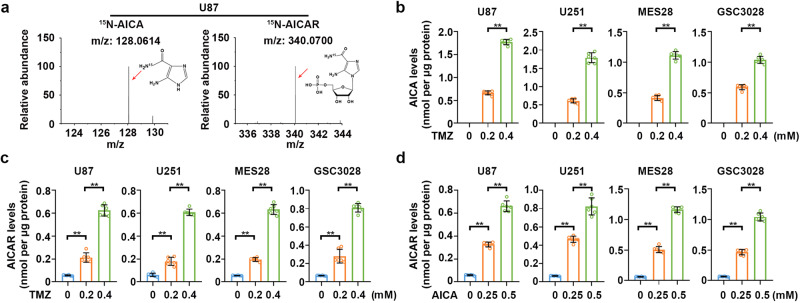
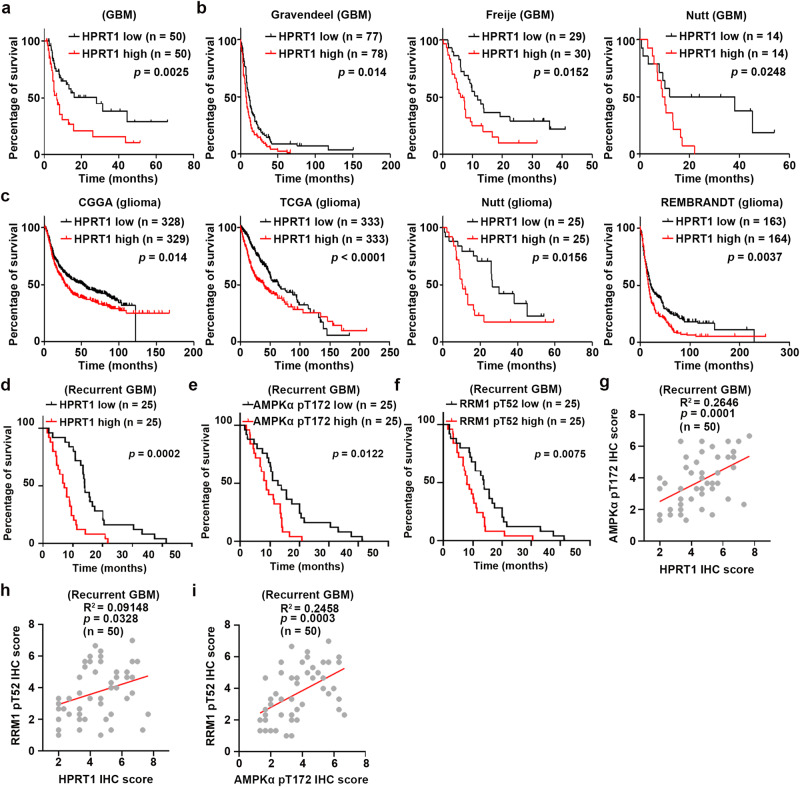
Temozolomide (TMZ) is a standard treatment for glioblastoma (GBM) patients. However, TMZ has moderate therapeutic effects due to chemoresistance of GBM cells through less clarified mechanisms. Here, we demonstrate that TMZ-derived 5-aminoimidazole-4-carboxamide (AICA) is converted to AICA ribosyl-5-phosphate (AICAR) in GBM cells. This conversion is catalyzed by hypoxanthine phosphoribosyl transferase 1 (HPRT1), which is highly expressed in human GBMs. As the bona fide activator of AMP-activated protein kinase (AMPK), TMZ-derived AICAR activates AMPK to phosphorylate threonine 52 (T52) of RRM1, the catalytic subunit of ribonucleotide reductase (RNR), leading to RNR activation and increased production of dNTPs to fuel the repairment of TMZ-induced-DNA damage. RRM1 T52A expression, genetic interruption of HPRT1-mediated AICAR production, or administration of 6-mercaptopurine (6-MP), a clinically approved inhibitor of HPRT1, blocks TMZ-induced AMPK activation and sensitizes brain tumor cells to TMZ treatment in mice. In addition, HPRT1 expression levels are positively correlated with poor prognosis in GBM patients who received TMZ treatment. These results uncover a critical bifunctional role of TMZ in GBM treatment that leads to chemoresistance. Our findings underscore the potential of combined administration of clinically available 6-MP to overcome TMZ chemoresistance and improve GBM treatment.
替莫唑胺(TMZ)是胶质母细胞瘤(GBM)患者的标准治疗方法。然而,由于 GBM 细胞通过机制尚不清楚的化疗耐药性,TMZ 的治疗效果有限。在这里,我们证明 TMZ 衍生的 5-氨基咪唑-4-羧酰胺(AICA)在 GBM 细胞中转化为 AICA 核糖-5-磷酸(AICAR)。这种转化由黄嘌呤磷酸核糖基转移酶 1(HPRT1)催化,HPRT1 在人 GBM 中高度表达。作为 AMP 激活蛋白激酶(AMPK)的真正激活剂,TMZ 衍生的 AICAR 激活 AMPK,使 RRM1 的苏氨酸 52(T52)磷酸化,RRM1 是核糖核苷酸还原酶(RNR)的催化亚基,导致 RNR 激活和 dNTP 的产生增加,为 TMZ 诱导的 DNA 损伤修复提供燃料。RRM1 T52A 表达、遗传中断 HPRT1 介导的 AICAR 产生或 6-巯基嘌呤(6-MP)的给药,6-MP 是一种临床批准的 HPRT1 抑制剂,可阻断 TMZ 诱导的 AMPK 激活,并使脑肿瘤细胞对 TMZ 治疗敏感在小鼠中。此外,HPRT1 表达水平与接受 TMZ 治疗的 GBM 患者的预后不良呈正相关。这些结果揭示了 TMZ 在 GBM 治疗中的关键双重作用,导致化疗耐药性。我们的研究结果强调了联合使用临床可用的 6-MP 来克服 TMZ 耐药性并改善 GBM 治疗的潜力。