
种群基因组分析表明,病原菌玉米尾孢菌最近向东非和南非的玉米种植系统扩散。
Population genomic analyses suggest recent dispersal events of the pathogen Cercospora zeina into East and Southern African maize cropping systems.
机构信息
Department of Biochemistry, Genetics and Microbiology, Forestry and Agricultural Biotechnology Institute, University of Pretoria, Private Bag X20, Hatfield 0028, South Africa.
Environmental Genomics, Christian-Albrechts University of Kiel, Am Botanischen Garten 1-11, Kiel 24118, Germany.
出版信息
G3 (Bethesda). 2023 Nov 1;13(11). doi: 10.1093/g3journal/jkad214.
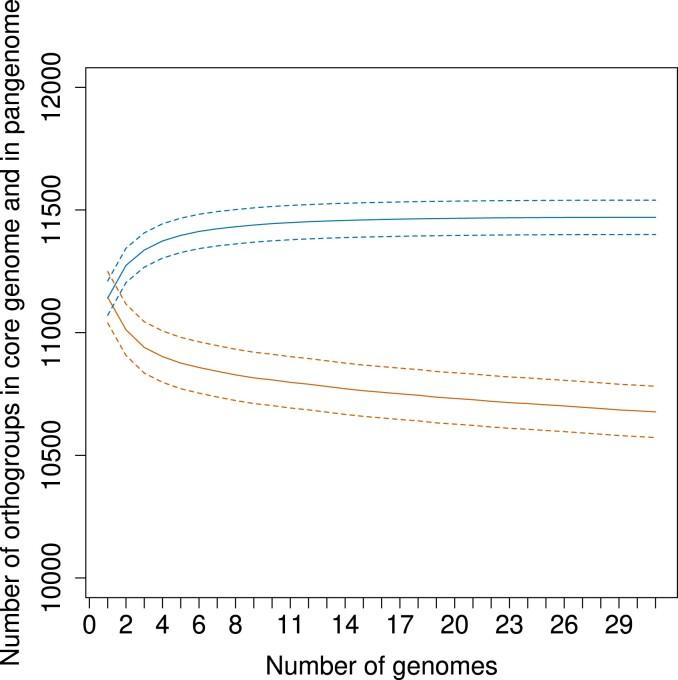
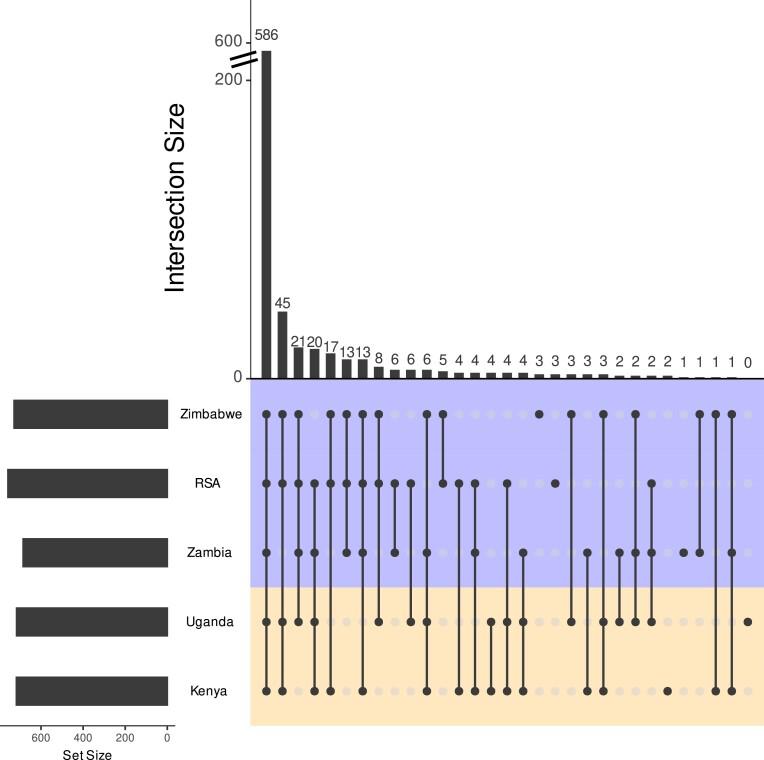
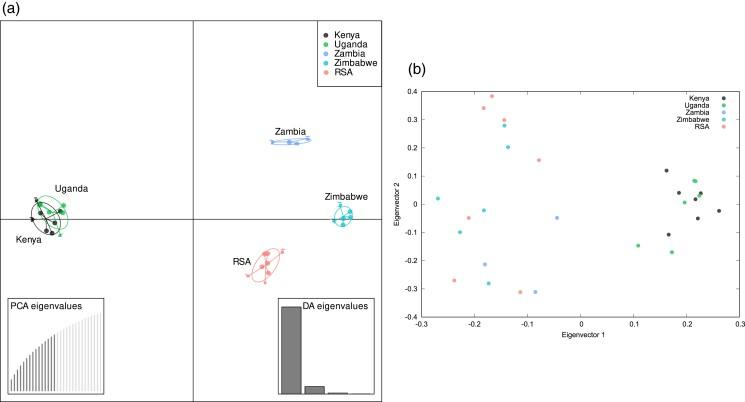
A serious factor hampering global maize production is gray leaf spot disease. Cercospora zeina is one of the causative pathogens, but population genomics analysis of C. zeina is lacking. We conducted whole-genome Illumina sequencing of a representative set of 30 C. zeina isolates from Kenya and Uganda (East Africa) and Zambia, Zimbabwe, and South Africa (Southern Africa). Selection of the diverse set was based on microsatellite data from a larger collection of the pathogen. Pangenome analysis of the C. zeina isolates was done by (1) de novo assembly of the reads with SPAdes, (2) annotation with BRAKER, and (3) protein clustering with OrthoFinder. A published long-read assembly of C. zeina (CMW25467) from Zambia was included and annotated using the same pipeline. This analysis revealed 790 non-shared accessory and 10,677 shared core orthogroups (genes) between the 31 isolates. Accessory gene content was largely shared between isolates from all countries, with a few genes unique to populations from Southern Africa (32) or East Africa (6). There was a significantly higher proportion of effector genes in the accessory secretome (44%) compared to the core secretome (24%). PCA, ADMIXTURE, and phylogenetic analysis using a neighbor-net network indicated a population structure with a geographical subdivision between the East African isolates and the Southern African isolates, although gene flow was also evident. The small pangenome and partial population differentiation indicated recent dispersal of C. zeina into Africa, possibly from 2 regional founder populations, followed by recurrent gene flow owing to widespread maize production across sub-Saharan Africa.
严重阻碍全球玉米生产的一个因素是灰斑病。玉米尾孢菌是其中一种病原体,但对玉米尾孢菌的群体基因组分析还很缺乏。我们对来自肯尼亚和乌干达(东非)以及赞比亚、津巴布韦和南非(南非)的 30 个玉米尾孢菌分离株进行了代表性的全基因组 Illumina 测序。选择这个多样化的分离株集是基于来自更大病原体收集的微卫星数据。通过(1)使用 SPAdes 从头组装读取物,(2)使用 BRAKER 进行注释,以及(3)使用 OrthoFinder 进行蛋白质聚类,对玉米尾孢菌分离株进行了泛基因组分析。还包括并使用相同的管道注释了来自赞比亚的已发表的玉米尾孢菌长读组装体(CMW25467)。该分析揭示了 31 个分离株之间的 790 个非共享辅助和 10677 个共享核心直系同源物(基因)。辅助基因的内容在来自所有国家的分离株之间基本共享,只有少数基因是南非(32 个)或东非(6 个)种群所特有的。与核心分泌组(24%)相比,辅助分泌组中的效应基因比例显著更高(44%)。PCA、ADMIXTURE 和使用邻接网络的系统发育分析表明,存在一个种群结构,东非分离株与南非分离株之间存在地理划分,尽管也存在基因流。小的泛基因组和部分种群分化表明,玉米尾孢菌最近可能从 2 个区域创始种群扩散到非洲,随后由于撒哈拉以南非洲广泛种植玉米,出现了反复的基因流。


 Zotero 插件