Takahashi Hiroki, Umemura Maiko, Ninomiya Akihiro, Kusuya Yoko, Shimizu Masaaki, Urayama Syun-Ichi, Watanabe Akira, Kamei Katsuhiko, Yaguchi Takashi, Hagiwara Daisuke
Medical Mycology Research Center, Chiba University, Chiba, Japan.
Molecular Chirality Research Center, Chiba University, Chiba, Japan.
Front Fungal Biol. 2021 Apr 16;2:656751. doi: 10.3389/ffunb.2021.656751. eCollection 2021.
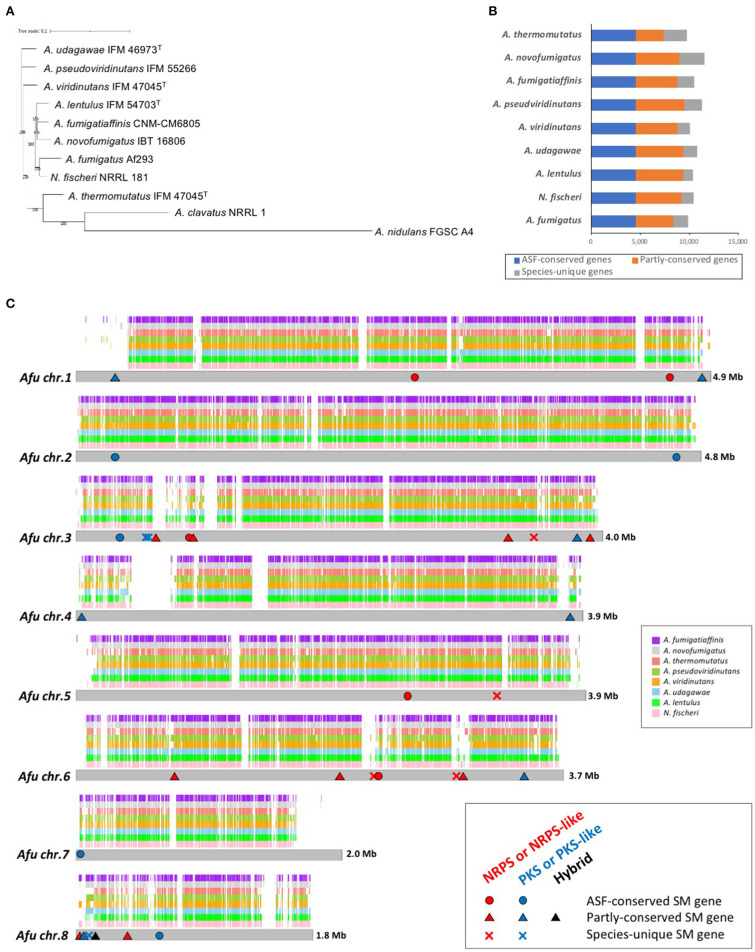
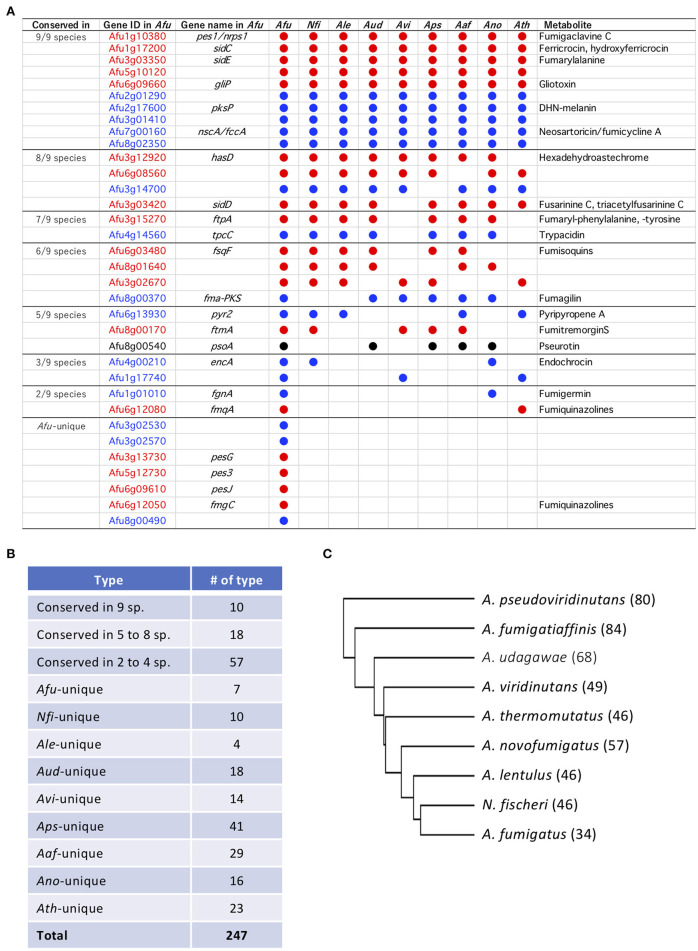
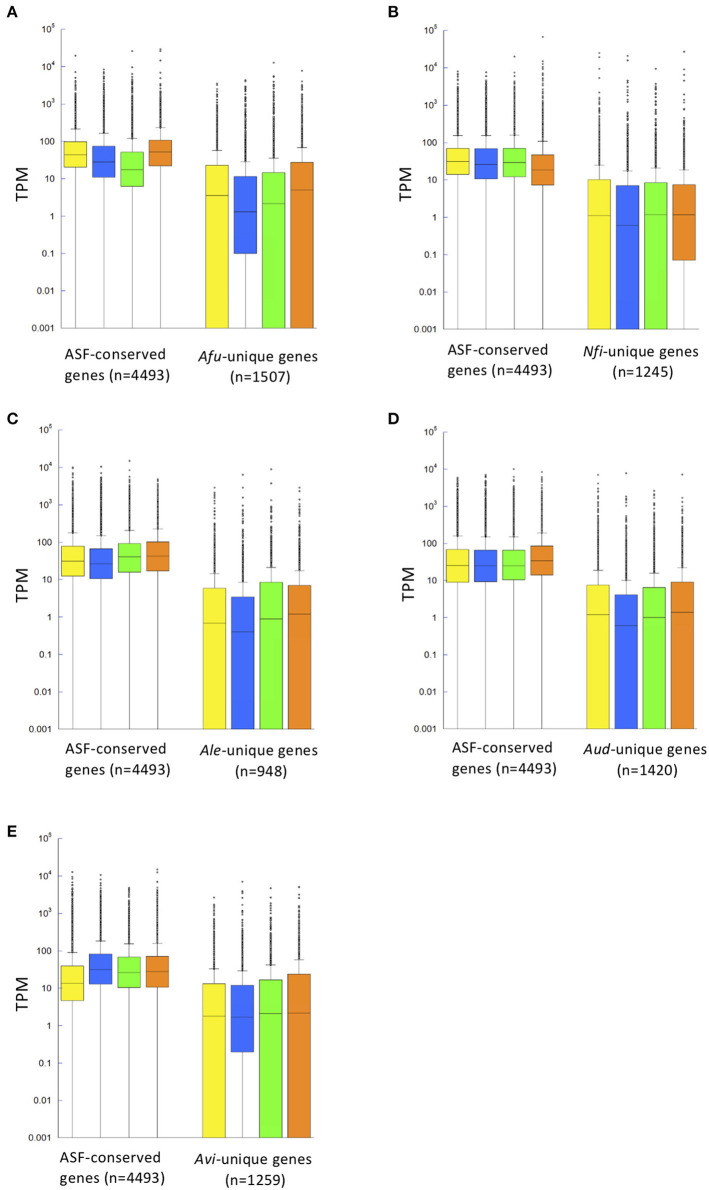
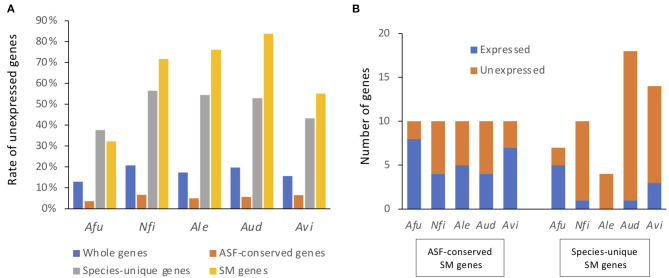
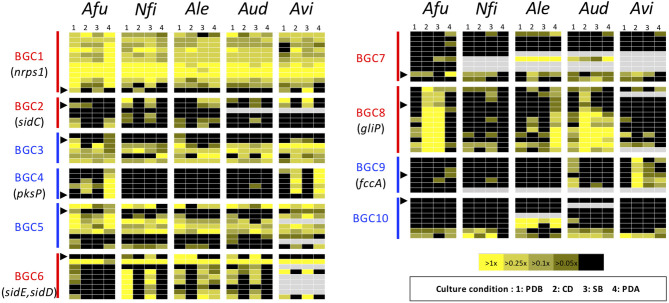
Filamentous fungi produce various bioactive compounds that are biosynthesized by sets of proteins encoded in biosynthesis gene clusters (BGCs). For an unknown reason, many BGCs are transcriptionally silent in laboratory conditions, which has hampered the discovery of novel fungal compounds. The transcriptional reactiveness of fungal secondary metabolism is not fully understood. To gain the comprehensive view, we conducted comparative genomic and transcriptomic analyses of nine closely-related species of section (, and ). For expanding our knowledge, we newly sequenced genomes of and , and reassembled and reannotated the previously released genomes of and . Between 34 and 84 secondary metabolite (SM) backbone genes were identified in the genomes of these nine respective species, with 8.7-51.2% being unique to the species. A total of 247 SM backbone gene types were identified in the nine fungi. Ten BGCs are shared by all nine species. Transcriptomic analysis using , and was conducted to compare expression levels of all SM backbone genes in four different culture conditions; 32-83% of SM backbone genes in these species were not expressed in the tested conditions, which reconfirmed that large part of fungal SM genes are hard to be expressed. The species-unique SM genes of the five species were expressed with lower frequency (18.8% in total) than the SM genes that are conserved in all five species (56%). These results suggest that the expression tendency of BGCs is correlated with their interspecies distribution pattern. Our findings increase understanding of the evolutionary processes associated with the regulation of fungal secondary metabolism.
丝状真菌会产生各种生物活性化合物,这些化合物由生物合成基因簇(BGCs)中编码的一组蛋白质进行生物合成。由于未知原因,许多BGCs在实验室条件下转录沉默,这阻碍了新型真菌化合物的发现。真菌次生代谢的转录反应性尚未完全了解。为了获得全面的认识,我们对九个密切相关的种(、和)进行了比较基因组和转录组分析。为了扩展我们的知识,我们新测序了和的基因组,并对先前发布的和的基因组进行了重新组装和重新注释。在这九个物种的基因组中分别鉴定出34至84个次生代谢物(SM)骨干基因,其中8.7-51.2%是每个物种特有的。在这九种真菌中总共鉴定出247种SM骨干基因类型。所有九个物种共有十个BGCs。使用、和进行了转录组分析,以比较所有SM骨干基因在四种不同培养条件下的表达水平;这些物种中32-83%的SM骨干基因在测试条件下未表达,这再次证实了大部分真菌SM基因难以表达。五个物种的物种特异性SM基因的表达频率(总计18.8%)低于在所有五个物种中保守的SM基因(56%)。这些结果表明BGCs的表达趋势与其种间分布模式相关。我们的发现增进了对与真菌次生代谢调控相关的进化过程的理解。