Ullah Rahat, Lee Eun Jeong
Neuroregeneration and Stem Cell Programs, Institute for Cell Engineering, School of Medicine, The Johns Hopkins University, Baltimore, MD 21205, USA.
Department of Neurology, School of Medicine, The Johns Hopkins University, Baltimore, MD 21205, USA.
Exp Neurobiol. 2023 Aug 31;32(4):216-246. doi: 10.5607/en23014.
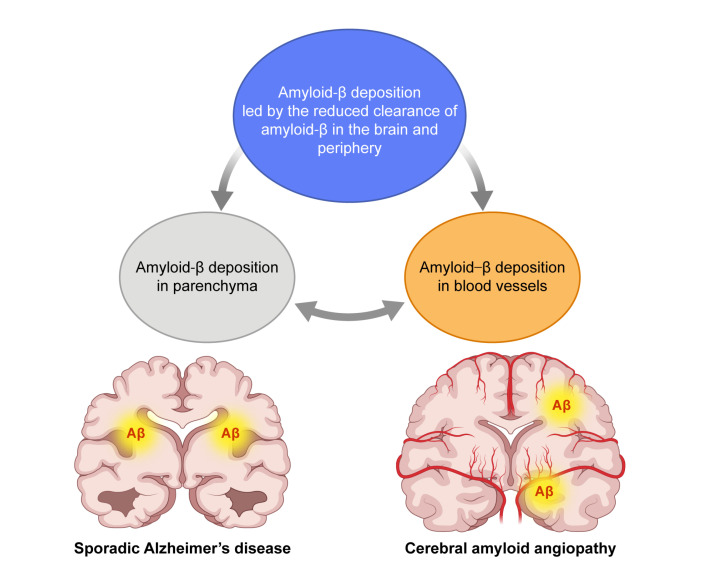
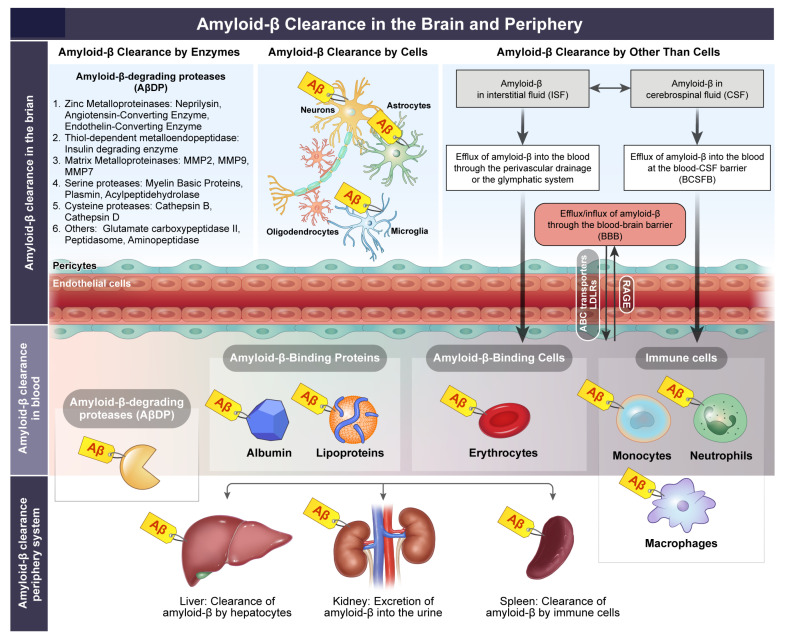
This review examines the role of impaired amyloid-β clearance in the accumulation of amyloid-β in the brain and the periphery, which is closely associated with Alzheimer's disease (AD) and cerebral amyloid angiopathy (CAA). The molecular mechanism underlying amyloid-β accumulation is largely unknown, but recent evidence suggests that impaired amyloid-β clearance plays a critical role in its accumulation. The review provides an overview of recent research and proposes strategies for efficient amyloid-β clearance in both the brain and periphery. The clearance of amyloid-β can occur through enzymatic or non-enzymatic pathways in the brain, including neuronal and glial cells, blood-brain barrier, interstitial fluid bulk flow, perivascular drainage, and cerebrospinal fluid absorption-mediated pathways. In the periphery, various mechanisms, including peripheral organs, immunomodulation/immune cells, enzymes, amyloid-β-binding proteins, and amyloid-β-binding cells, are involved in amyloid-β clearance. Although recent findings have shed light on amyloid-β clearance in both regions, opportunities remain in areas where limited data is available. Therefore, future strategies that enhance amyloid-β clearance in the brain and/or periphery, either through central or peripheral clearance approaches or in combination, are highly encouraged. These strategies will provide new insight into the disease pathogenesis at the molecular level and explore new targets for inhibiting amyloid-β deposition, which is central to the pathogenesis of sporadic AD (amyloid-β in parenchyma) and CAA (amyloid-β in blood vessels).
本综述探讨了淀粉样β蛋白清除受损在大脑和外周淀粉样β蛋白积累中的作用,这与阿尔茨海默病(AD)和脑淀粉样血管病(CAA)密切相关。淀粉样β蛋白积累的分子机制在很大程度上尚不清楚,但最近的证据表明,淀粉样β蛋白清除受损在其积累过程中起着关键作用。该综述概述了近期的研究,并提出了在大脑和外周有效清除淀粉样β蛋白的策略。淀粉样β蛋白的清除可通过大脑中的酶促或非酶促途径发生,包括神经元和神经胶质细胞、血脑屏障、间质液大量流动、血管周围引流以及脑脊液吸收介导的途径。在外周,各种机制,包括外周器官、免疫调节/免疫细胞、酶、淀粉样β蛋白结合蛋白和淀粉样β蛋白结合细胞,都参与了淀粉样β蛋白的清除。尽管最近的研究结果揭示了这两个区域的淀粉样β蛋白清除情况,但在数据有限的领域仍存在机会。因此,强烈鼓励未来通过中枢或外周清除方法或联合使用来增强大脑和/或外周淀粉样β蛋白清除的策略。这些策略将在分子水平上为疾病发病机制提供新的见解,并探索抑制淀粉样β蛋白沉积的新靶点,这是散发性AD(实质中的淀粉样β蛋白)和CAA(血管中的淀粉样β蛋白)发病机制的核心。