Romiti Giulio Francesco, Corica Bernadette, Proietti Marco, Mei Davide Antonio, Frydenlund Juliane, Bisson Arnaud, Boriani Giuseppe, Olshansky Brian, Chan Yi-Hsin, Huisman Menno V, Chao Tze-Fan, Lip Gregory Y H
Liverpool Centre for Cardiovascular Sciences at University of Liverpool, Liverpool John Moores University and Liverpool Heart & Chest Hospital, Liverpool, United Kingdom.
Department of Translational and Precision Medicine, Sapienza - University of Rome, Rome, Italy.
EClinicalMedicine. 2023 Aug 25;63:102039. doi: 10.1016/j.eclinm.2023.102039. eCollection 2023 Sep.
Previous studies suggested potential ethnic differences in the management and outcomes of atrial fibrillation (AF). We aim to analyse oral anticoagulant (OAC) prescription, discontinuation, and risk of adverse outcomes in Asian patients with AF, using data from a global prospective cohort study.
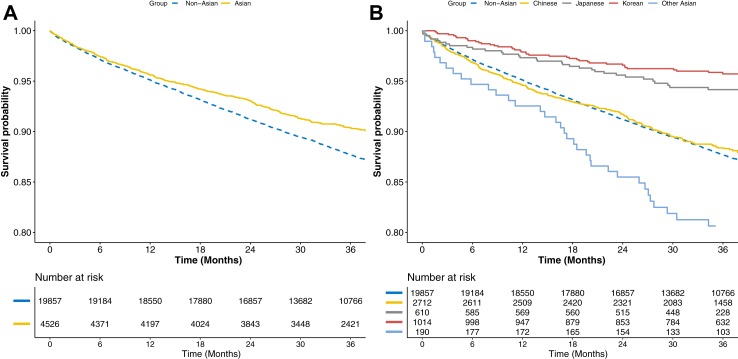
From the GLORIA-AF Registry Phase II-III (November 2011-December 2014 for Phase II, and January 2014-December 2016 for Phase III), we analysed patients according to their self-reported ethnicity (Asian vs. non-Asian), as well as according to Asian subgroups (Chinese, Japanese, Korean and other Asian). Logistic regression was used to analyse OAC prescription, while the risk of OAC discontinuation and adverse outcomes were analysed through Cox-regression model. Our primary outcome was the composite of all-cause death and major adverse cardiovascular events (MACE). The original studies were registered with ClinicalTrials.gov, NCT01468701, NCT01671007, and NCT01937377.
34,421 patients were included (70.0 ± 10.5 years, 45.1% females, 6900 (20.0%) Asian: 3829 (55.5%) Chinese, 814 (11.8%) Japanese, 1964 (28.5%) Korean and 293 (4.2%) other Asian). Most of the Asian patients were recruited in Asia (n = 6701, 97.1%), while non-Asian patients were mainly recruited in Europe (n = 15,449, 56.1%) and North America (n = 8378, 30.4%). Compared to non-Asian individuals, prescription of OAC and non-vitamin K antagonist oral anticoagulant (NOAC) was lower in Asian patients (Odds Ratio [OR] and 95% Confidence Intervals (CI): 0.23 [0.22-0.25] and 0.66 [0.61-0.71], respectively), but higher in the Japanese subgroup. Asian ethnicity was also associated with higher risk of OAC discontinuation (Hazard Ratio [HR] and [95% CI]: 1.79 [1.67-1.92]), and lower risk of the primary composite outcome (HR [95% CI]: 0.86 [0.76-0.96]). Among the exploratory secondary outcomes, Asian ethnicity was associated with higher risks of thromboembolism and intracranial haemorrhage, and lower risk of major bleeding.
Our results showed that Asian patients with AF showed suboptimal thromboembolic risk management and a specific risk profile of adverse outcomes; these differences may also reflect differences in country-specific factors. Ensuring integrated and appropriate treatment of these patients is crucial to improve their prognosis.
The GLORIA-AF Registry was funded by Boehringer Ingelheim GmbH.
先前的研究表明,心房颤动(AF)的管理和结局可能存在种族差异。我们旨在利用一项全球前瞻性队列研究的数据,分析亚洲AF患者的口服抗凝药(OAC)处方、停药情况及不良结局风险。
从GLORIA-AF注册研究的II-III期(II期为2011年11月至2014年12月,III期为2014年1月至2016年12月),我们根据患者自我报告的种族(亚洲人与非亚洲人)以及亚洲亚组(中国人、日本人、韩国人和其他亚洲人)对患者进行分析。采用逻辑回归分析OAC处方情况,通过Cox回归模型分析OAC停药风险和不良结局风险。我们的主要结局是全因死亡和主要不良心血管事件(MACE)的复合结局。原始研究已在ClinicalTrials.gov上注册,注册号为NCT01468701、NCT01671007和NCT01937377。
共纳入34421例患者(年龄70.0±10.5岁,女性占45.1%,6900例(20.0%)为亚洲人:3829例(55.5%)为中国人,814例(11.8%)为日本人,1964例(28.5%)为韩国人,293例(4.2%)为其他亚洲人)。大多数亚洲患者在亚洲招募(n = 6701,97.1%),而非亚洲患者主要在欧洲招募(n = 15449,56.1%)和北美招募(n = 8378,30.4%)。与非亚洲人相比,亚洲患者的OAC和非维生素K拮抗剂口服抗凝药(NOAC)处方率较低(优势比[OR]及95%置信区间[CI]:分别为0.23[0.22 - 0.25]和0.66[0.61 - 0.71]),但在日本亚组中较高。亚洲种族也与OAC停药风险较高相关(风险比[HR]及[95%CI]:1.79[1.67 - 1.92]),而主要复合结局风险较低(HR[95%CI]:0.86[0.76 - 0.96])。在探索性次要结局中,亚洲种族与血栓栓塞和颅内出血风险较高相关,而与大出血风险较低相关。
我们的结果表明,亚洲AF患者的血栓栓塞风险管理欠佳,且具有特定的不良结局风险特征;这些差异也可能反映了国家特定因素的差异。确保对这些患者进行综合、恰当的治疗对改善其预后至关重要。
GLORIA-AF注册研究由勃林格殷格翰公司资助。