Department of Pharmacy Services (L.F.B.), Brigham and Women's Hospital, Boston, MA.
Division of Cardiovascular Medicine, Baylor College of Medicine, Houston, TX (A.A., A.H., V.N., R.C.H., C.M.B.).
Circ Heart Fail. 2023 Nov;16(11):e010849. doi: 10.1161/CIRCHEARTFAILURE.123.010849. Epub 2023 Sep 27.
MMP (matrix metalloproteinase)-2 participates in extracellular matrix regulation and may be involved in heart failure (HF), atrial fibrillation (AF), and coronary heart disease.
Among the 4693 ARIC study (Atherosclerosis Risk in Communities) participants (mean age, 75±5 years; 42% women) without prevalent HF, multivariable Cox proportional hazard models were used to estimate associations of plasma MMP-2 levels with incident HF, HF with preserved ejection fraction (≥50%), HF with reduced ejection fraction (<50%), AF, and coronary heart disease. Mediation of the association between MMP-2 and HF was assessed by censoring participants who developed AF or coronary heart disease before HF. Multivariable linear regression models were used to assess associations of MMP-2 with measures of left ventricular and left atrial structure and function.
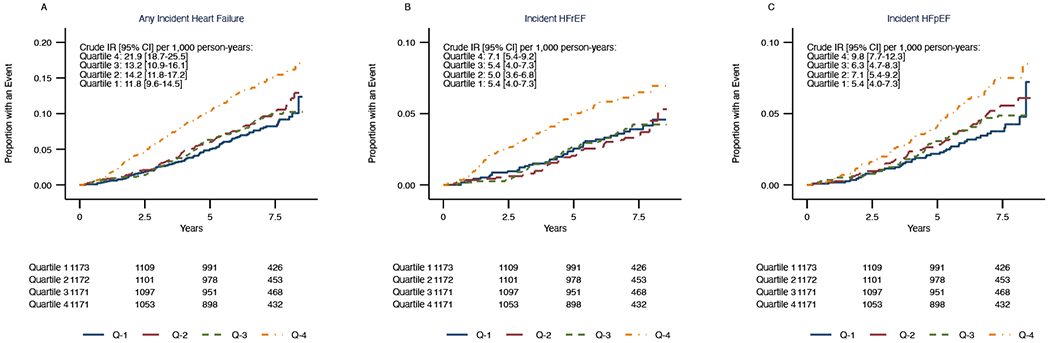
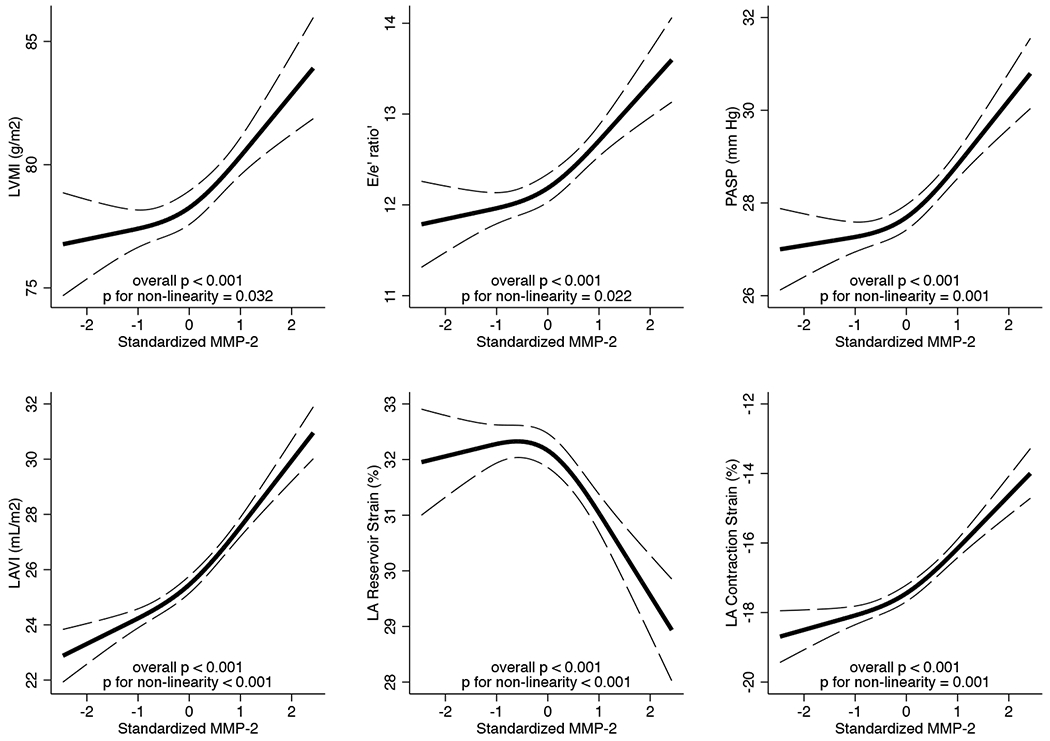
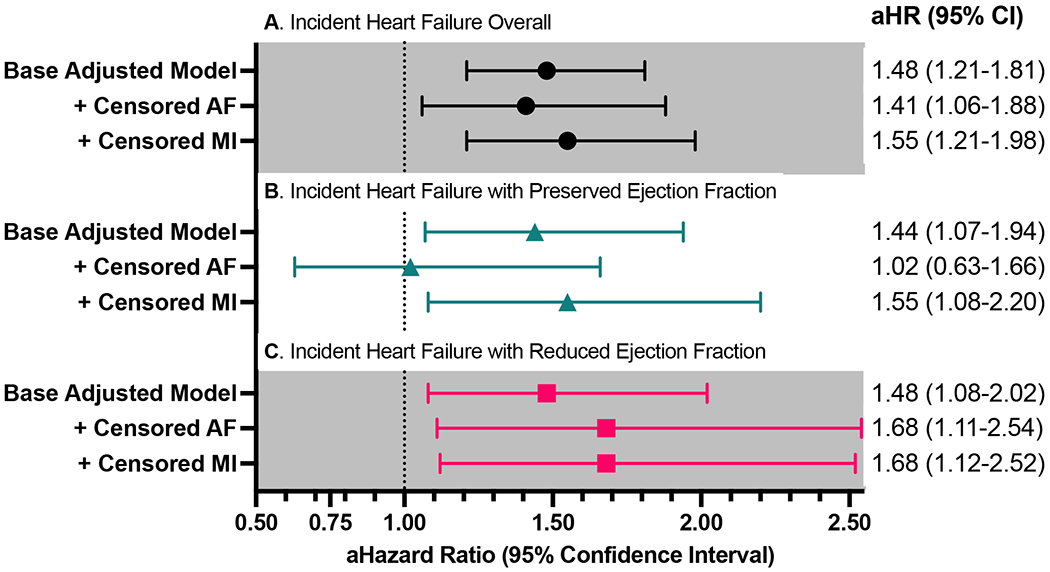
Compared with the 3 lower quartiles, the highest MMP-2 quartile associated with greater risk of incident HF overall (adjusted hazard ratio, 1.48 [95% CI, 1.21-1.81]), incident HF with preserved ejection fraction (1.44 [95% CI, 1.07-1.94]), incident heart failure with reduced ejection fraction (1.48 [95% CI, 1.08-2.02]), and incident AF (1.44 [95% CI, 1.18-1.77]) but not incident coronary heart disease (0.97 [95% CI, 0.71-1.34]). Censoring AF attenuated the MMP-2 association with HF with preserved ejection fraction. Higher plasma MMP-2 levels were associated with larger left ventricular end-diastolic volume index, greater left ventricular mass index, higher E/e' ratio, larger left atrial volume index, and worse left atrial reservoir and contractile strains (all <0.001).
Higher plasma MMP-2 levels associate with diastolic dysfunction, left atrial dysfunction, and a higher risk of incident HF and AF. AF is a mediator of MMP-2-associated HF with preserved ejection fraction risk.
MMP(基质金属蛋白酶)-2 参与细胞外基质的调节,可能与心力衰竭(HF)、心房颤动(AF)和冠心病有关。
在没有明显 HF 的 4693 名 ARIC 研究(社区动脉粥样硬化风险研究)参与者(平均年龄 75±5 岁;42%为女性)中,使用多变量 Cox 比例风险模型来估计血浆 MMP-2 水平与新发 HF、HF 伴射血分数保留(≥50%)、HF 伴射血分数降低(<50%)、AF 和冠心病的相关性。通过在 HF 发生之前发生 AF 或冠心病的参与者进行删失来评估 MMP-2 与 HF 之间关联的中介作用。使用多变量线性回归模型来评估 MMP-2 与左心室和左心房结构和功能测量值的相关性。
与较低的 3 个四分位区间相比,最高的 MMP-2 四分位区间与整体新发 HF 的风险增加相关(调整后的风险比,1.48 [95%CI,1.21-1.81]),HF 伴射血分数保留(1.44 [95%CI,1.07-1.94]),HF 伴射血分数降低(1.48 [95%CI,1.08-2.02])和新发 AF(1.44 [95%CI,1.18-1.77]),但与新发冠心病无关(0.97 [95%CI,0.71-1.34])。删去 AF 后,MMP-2 与 HF 伴射血分数保留的相关性减弱。较高的血浆 MMP-2 水平与更大的左心室舒张末期容积指数、更大的左心室质量指数、更高的 E/e'比值、更大的左心房容积指数以及更差的左心房储备和收缩应变相关(均<0.001)。
较高的血浆 MMP-2 水平与舒张功能障碍、左心房功能障碍以及新发 HF 和 AF 的风险增加相关。AF 是 MMP-2 相关 HF 伴射血分数保留风险的中介。