Pharmacy Department, Vall d'Hebron University Hospital, E-08035 Barcelona, Spain.
Asserta Global Healthcare Solutions, Sant Quirze del Vallés, E-08192 Barcelona, Spain.
Curr Oncol. 2023 Aug 30;30(9):7984-8004. doi: 10.3390/curroncol30090580.
Cancer is one of the leading causes of morbidity and mortality in the world. Its growing incidence and prevalence, as well as the advances in diagnostic and treatment tools, motivate an open debate about the economic burden it may place on health systems and have raised concerns about access to this technological innovation. There is a lack of information on the detailed costs of pharmacological treatment of cancer in our health setting. In this context, it is necessary to know the use of drugs in cancer treatment in conditions of real clinical practice. A real-word, evidence-based retrospective cohort study was conducted at Vall d'Hebron University Hospital (VHUH), the largest hospital complex in Catalonia, Spain, in order to determine the use of drugs and the associated cost in real clinical practice for the treatment of solid tumors in adult patients attended at this institution over 10 years (2010-2019).
This was a single-center retrospective cohort study of adult cancer patients attended in clinical practice at the Medical Oncology Department of VHUH between 1 January 2010 and 31 December 2019. Data of prescription, preparation, and cost of antineoplastic treatments were analyzed by pharmacological class (cytotoxic drugs, immunotherapy, targeted therapy, radiopharmaceuticals, and others), by antineoplastic agent, and by type of tumor. The number of patients and the pharmaceutical expenditure corresponding to all these subgroups were recorded. The cost per patient in each tumor location was also calculated.
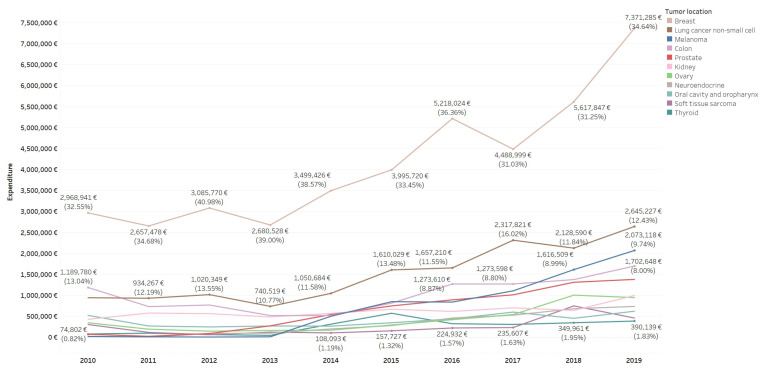
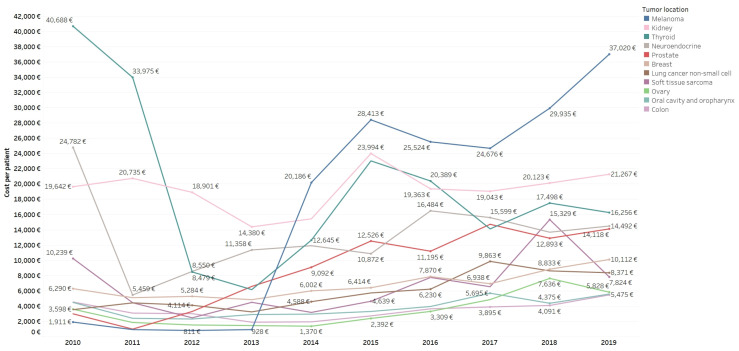
The study population included 13,209 patients with an overall pharmaceutical antineoplastic expenditure of EUR 120,396,097, increasing from 7.67% in relation to the total HUVH pharmaceutical expenditure in 2010 to 12.82% in 2019. By pharmacological class, the specific weight of the cost of targeted therapy is relevant (75.22% of pharmaceutical antineoplastic expenditure, 21.3% of patients) compared to the group of conventional cytotoxics (17.25% of pharmaceutical antineoplastic expenditure, 76.37% of patients), while immunotherapy has represented the largest relative increase, from 5% in 2014 to 12% in 2019. Eight targeted therapy drugs represented 50% of the costs of the targeted therapy drug class (palbociclib, trastuzumab, pertuzumab, bevacizumab, nivolumab, cetuximab, pembrolizumab, and trastuzumab emtansine). Eleven tumor sites accounted for 90% of the expenditure in 71% of all patients. Breast cancer had the highest expenditure during the study period (EUR 34,332,210) and at each individual year. Melanoma showed the highest increase, with 9.7% of total pharmaceutical antineoplastic expenditure in 2019 (2% of patients), representing a paradigm of the rising costs of cancer treatment due to the incorporation of new high-cost therapies. The average annual cost per patient was highly variable depending on the pathology. There was a growing increase in costs per patient in most tumor locations, particularly in patients with melanoma (from EUR 1922 in 2010 to EUR 37,020 in 2019), prostate cancer (from EUR 2992 in 2010 to EUR 14,118 in 2019), and non-small cell lung cancer (from EUR 3545 in 2010 to EUR 8371 in 2019). The relevance of the difference in monthly cost per patient that has been identified for the different intrinsic subtypes in breast cancer patients during 2019 (HER2+ EUR 2661/month, Luminal EUR 881/month, Triple negative EUR 386/month) makes us consider suggesting differentiated reimbursement rates for certain clinical conditions. Finally, support treatment with antiemetic drugs, erythropoietin stimulating agents, granulocyte-colony stimulating factor (G-CSF), and bone resorption inhibitors has involved a cost of EUR 5,751,910, which represents 4.6% of the overall pharmacological cost of cancer treatment.
This study provides detailed insights on the oncological pharmaceutical expenditure for the treatment for solid tumors in the VHUH, based on real cost information from our hospital practice and for all antineoplastic therapies and types of solid tumors. This type of information on all the different types of cancer can be useful to better understand the economic burden of the disease and can be decisive for allocating public resources and funds for research, especially in those areas where information is scarce and therefore where further studies are needed. The contribution to knowledge of the cost of oncology therapy is of great value due to its realism and scope.
癌症是全球发病率和死亡率的主要原因之一。其发病率和患病率的不断增加,以及诊断和治疗工具的进步,促使人们就其可能给卫生系统带来的经济负担展开公开辩论,并对获得这项技术创新的机会表示担忧。在我们的卫生环境中,关于癌症药物治疗的详细成本信息还很缺乏。在这种情况下,有必要了解在真实临床实践中癌症治疗中药物的使用情况。在西班牙加泰罗尼亚最大的医院综合体瓦尔德希伯伦大学医院(Vall d'Hebron University Hospital,VHUH)进行了一项真实世界、基于证据的回顾性队列研究,目的是确定该机构 10 年来(2010-2019 年)治疗成年患者实体瘤的药物使用情况和实际临床实践中的相关成本。
这是一项在 VHUH 肿瘤内科进行的、基于真实世界的成年癌症患者回顾性队列研究,共纳入 13209 名患者。分析了细胞毒性药物、免疫治疗、靶向治疗、放射性药物和其他药物的药理学分类,以及抗肿瘤药物和肿瘤类型的药物使用和成本。记录了所有这些亚组的患者数量和药物支出。还计算了每个肿瘤部位的每位患者的成本。
研究人群包括 13209 名患者,药物总抗肿瘤支出为 12039.607 万欧元,从 2010 年占 VHUH 总药物支出的 7.67%增加到 2019 年的 12.82%。按药理学分类,靶向治疗药物的成本占比(药物抗肿瘤支出的 75.22%,占患者的 21.3%)相对较大,而传统细胞毒性药物的占比(药物抗肿瘤支出的 17.25%,占患者的 76.37%)相对较小,免疫治疗则代表了最大的相对增长,从 2014 年的 5%增加到 2019 年的 12%。八种靶向治疗药物占靶向治疗药物类别的 50%(哌柏西利、曲妥珠单抗、帕妥珠单抗、贝伐珠单抗、纳武利尤单抗、西妥昔单抗、帕博利珠单抗和曲妥珠单抗恩美曲妥珠)。11 个肿瘤部位占所有患者 90%的支出。乳腺癌在研究期间(EUR 34332210)和每年的支出都最高。黑色素瘤的增长幅度最高,2019 年占药物抗肿瘤总支出的 9.7%(占患者的 2%),代表了由于新的高成本治疗方法的加入,癌症治疗成本不断上升的范例。每位患者的平均年度成本因病理而异,差异很大。大多数肿瘤部位的患者成本呈上升趋势,尤其是黑色素瘤(从 2010 年的 EUR 1922 增加到 2019 年的 EUR 37020)、前列腺癌(从 2010 年的 EUR 2992 增加到 2019 年的 EUR 14118)和非小细胞肺癌(从 2010 年的 EUR 3545 增加到 2019 年的 EUR 8371)。2019 年乳腺癌患者不同内在亚型的每月成本差异(HER2+ EUR 2661/月、Luminal EUR 881/月、三阴性 EUR 386/月)每月成本差异显著,这表明对于某些临床情况可能需要考虑差异化的报销率。最后,止吐药物、促红细胞生成素刺激剂、粒细胞集落刺激因子(G-CSF)和骨吸收抑制剂的支持治疗涉及 5751910 欧元的成本,占癌症治疗药物总费用的 4.6%。
本研究根据我们医院的实际情况,对所有抗肿瘤治疗和实体肿瘤类型进行了基于真实成本的信息,提供了 VHUH 治疗实体肿瘤的肿瘤药物支出的详细信息。这种关于所有不同类型癌症的信息可以帮助更好地了解疾病的经济负担,并可以为分配公共资源和资金用于研究提供决策依据,特别是在信息匮乏且因此需要进一步研究的领域。由于其现实性和范围,对肿瘤治疗成本的贡献具有重要价值。