Pedonese Francesca, Fratini Filippo, Copelotti Emma, Marconi Francesca, Carrese Roberto, Mancini Simone
Department of Veterinary Sciences, University of Pisa, Viale delle Piagge 2, 56124 Pisa, Italy.
Interdepartmental Research Center "Nutraceuticals and Food for Health", University of Pisa, Via del Borghetto 80, 56124 Pisa, Italy.
Vet Sci. 2023 Sep 1;10(9):549. doi: 10.3390/vetsci10090549.
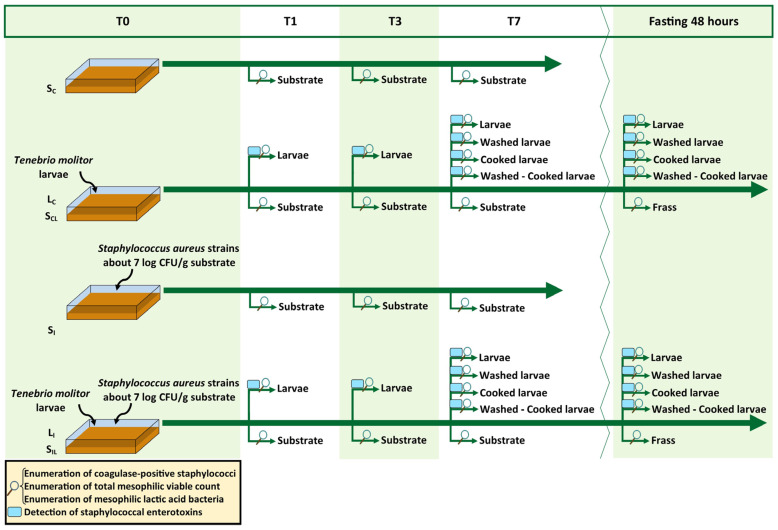
(mealworm) is one of the most promising insect species to produce sustainable feed and food with high nutritional value. Insects may harbour microorganisms both in the gut and on the exoskeleton originating from the rearing environment. is a pathogenic microorganism frequently involved in food poisoning due to its enterotoxin production. This study aimed to evaluate the growth and enterotoxins production following an experimental inoculation into the rearing substrate (about 7 log CFU/g). Analyses on the substrate and larvae were performed over a testing period of seven days. The microbial population dynamics were also evaluated through total viable count and lactic acid bacteria count. The effects of fasting, washing, and cooking on the microbial loads of mealworms were evaluated. The results highlighted that mealworms and substrates can maintain their microbial loads of over the tested period. Moreover, fasting and washing were generally not able to significantly reduce (-value > 0.05) count in mealworms. On the other hand, cooking significantly reduced (-value < 0.001) the microbial load in almost all cases. No production of enterotoxins was revealed during the trial. Therefore, microbiological risks can be reduced by a wise choice of substrate, appropriate control measures, and thermal treatment of larvae.
黄粉虫是最有前景的昆虫物种之一,可用于生产具有高营养价值的可持续饲料和食品。昆虫在肠道和外骨骼中可能携带源自饲养环境的微生物。由于其产生肠毒素,是一种经常导致食物中毒的致病微生物。本研究旨在评估在实验性接种到黄粉虫饲养基质(约7 log CFU/g)后其生长和肠毒素的产生情况。在七天的测试期内对基质和幼虫进行了分析。还通过总活菌数和乳酸菌计数评估了微生物种群动态。评估了禁食、清洗和烹饪对黄粉虫微生物负荷的影响。结果表明,在测试期内黄粉虫和基质能够维持其微生物负荷。此外,禁食和清洗通常不能显著降低(P值>0.05)黄粉虫中的计数。另一方面,烹饪在几乎所有情况下都显著降低了(P值<0.001)微生物负荷。试验期间未发现肠毒素产生。因此,通过明智选择基质、采取适当的控制措施和对幼虫进行热处理,可以降低微生物风险。