Division of Interdisciplinary Medicine and Biotechnology, Beth Israel Deaconess Medical Center, Boston, MA 02215, USA.
Beth Israel Deaconess Medical Center Genomics, Proteomics, Bioinformatics and Systems Biology Center, Boston, MA 02215, USA.
Biomolecules. 2023 Sep 15;13(9):1395. doi: 10.3390/biom13091395.
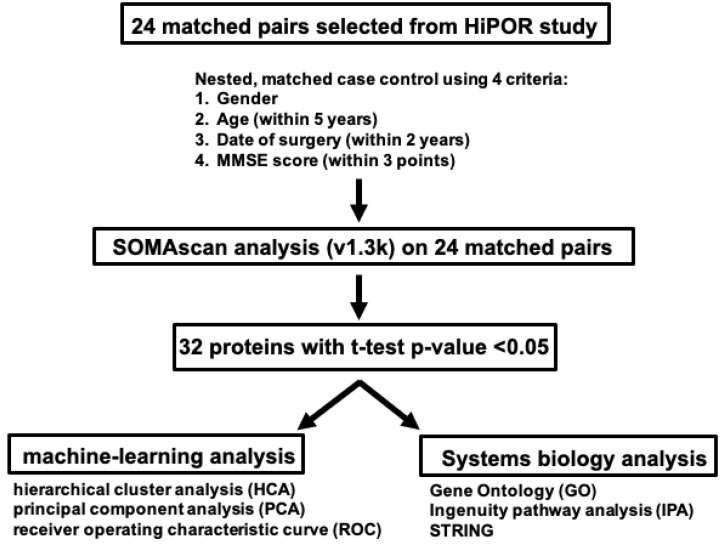
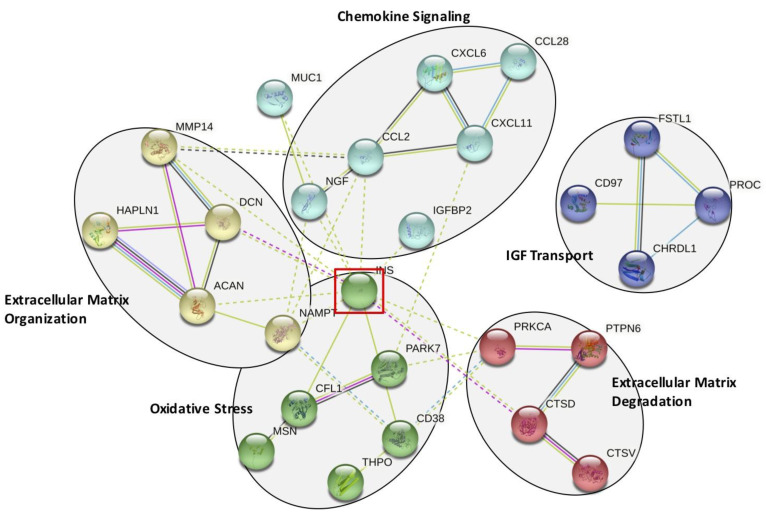
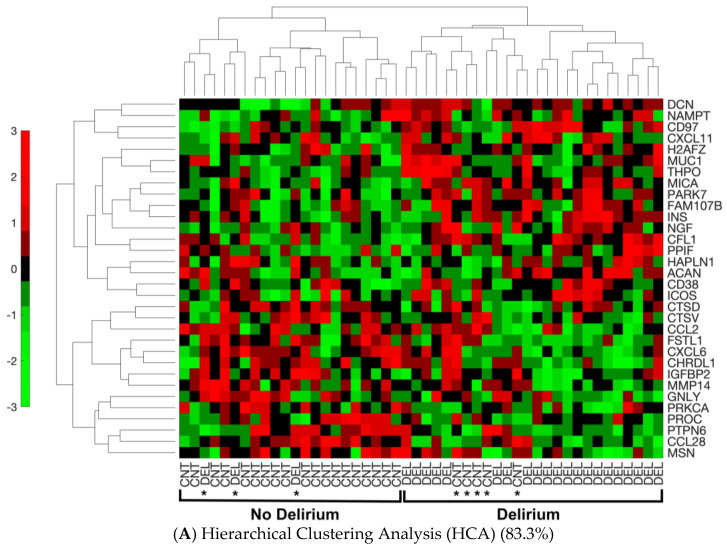
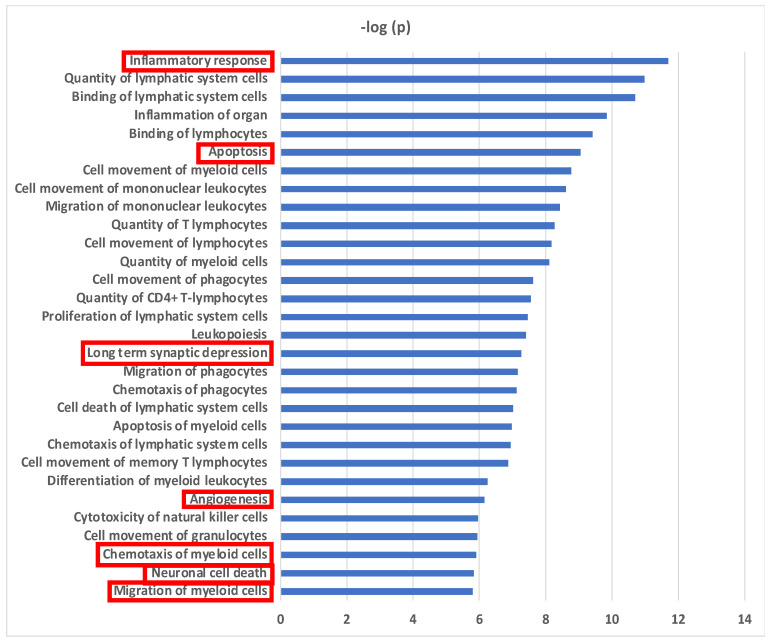
Delirium is a common postoperative complication among older patients with many adverse outcomes. Due to a lack of validated biomarkers, prediction and monitoring of delirium by biological testing is not currently feasible. Circulating proteins in cerebrospinal fluid (CSF) may reflect biological processes causing delirium. Our goal was to discover and investigate candidate protein biomarkers in preoperative CSF that were associated with the development of postoperative delirium in older surgical patients. We employed a nested case-control study design coupled with high multiplex affinity proteomics analysis to measure 1305 proteins in preoperative CSF. Twenty-four matched delirium cases and non-delirium controls were selected from the Healthier Postoperative Recovery (HiPOR) cohort, and the associations between preoperative protein levels and postoperative delirium were assessed using -test statistics with further analysis by systems biology to elucidate delirium pathophysiology. Proteomics analysis identified 32 proteins in preoperative CSF that significantly associate with delirium (-test < 0.05). Due to the limited sample size, these proteins did not remain significant by multiple hypothesis testing using the Benjamini-Hochberg correction and q-value method. Three algorithms were applied to separate delirium cases from non-delirium controls. Hierarchical clustering classified 40/48 case-control samples correctly, and principal components analysis separated 43/48. The receiver operating characteristic curve yielded an area under the curve [95% confidence interval] of 0.91 [0.80-0.97]. Systems biology analysis identified several key pathways associated with risk of delirium: inflammation, immune cell migration, apoptosis, angiogenesis, synaptic depression and neuronal cell death. Proteomics analysis of preoperative CSF identified 32 proteins that might discriminate individuals who subsequently develop postoperative delirium from matched control samples. These proteins are potential candidate biomarkers for delirium and may play a role in its pathophysiology.
谵妄是老年患者术后常见的并发症,有许多不良后果。由于缺乏经过验证的生物标志物,目前无法通过生物检测来预测和监测谵妄。脑脊液 (CSF) 中的循环蛋白可能反映导致谵妄的生物过程。我们的目标是发现和研究术前 CSF 中与老年手术患者术后谵妄发展相关的候选蛋白生物标志物。我们采用巢式病例对照研究设计,结合高多重亲和蛋白质组学分析,测量术前 CSF 中的 1305 种蛋白质。从健康术后恢复 (HiPOR) 队列中选择了 24 对匹配的谵妄病例和非谵妄对照,使用 -检验统计量评估术前蛋白水平与术后谵妄之间的关联,并通过系统生物学进一步分析阐明谵妄的病理生理学。蛋白质组学分析鉴定出术前 CSF 中与谵妄显著相关的 32 种蛋白质 (-检验 <0.05)。由于样本量有限,这些蛋白质在使用 Benjamini-Hochberg 校正和 q 值方法进行的多重假设检验中没有达到显著水平。应用三种算法将谵妄病例与非谵妄对照区分开来。层次聚类正确分类了 40/48 例对照样本,主成分分析分离了 43/48 例。受试者工作特征曲线的曲线下面积 (95%置信区间) 为 0.91 [0.80-0.97]。系统生物学分析确定了几个与谵妄风险相关的关键途径:炎症、免疫细胞迁移、细胞凋亡、血管生成、突触抑制和神经元细胞死亡。术前 CSF 的蛋白质组学分析鉴定出 32 种可能区分随后发生术后谵妄的个体与匹配对照样本的蛋白质。这些蛋白质可能是谵妄的潜在候选生物标志物,并可能在其病理生理学中发挥作用。