García-Marqueta Marta, Vázquez Miriam, Krcek Reinhardt, Kliebsch Ulrike L, Baust Katja, Leiser Dominic, van Heerden Michelle, Pica Alessia, Calaminus Gabriele, Weber Damien C
Center for Proton Therapy, Paul Scherrer Institute, ETH Domain, 5232 Villigen, Switzerland.
Department of Radiation Oncology, Inselspital, Bern University Hospital, University of Bern, 3012 Bern, Switzerland.
Cancers (Basel). 2023 Sep 6;15(18):4447. doi: 10.3390/cancers15184447.
The purpose of this study was to report the clinical and patient-reported outcomes of children and adolescents with intracranial meningioma treated with pencil beam scanning proton therapy (PBS-PT).
Out of a total cohort of 207 intracranial meningioma patients treated with PBS-PT between 1999 and 2022, 10 (4.8%) were children or adolescents aged < 18 years. Median age was 13.9 years (range, 3.2-17.2). Six (60%) children were treated as primary treatment (postoperative PT, n = 4; exclusive PT, n = 2) and four (40%) at the time of tumor recurrence. Acute and late toxicities were registered according to Common Terminology Criteria of Adverse Events (CTCAE). Quality of life (QoL) before PBS-PT was assessed using PEDQOL questionnaires. Educational, functional, and social aspects after PT were assessed through our in-house developed follow-up surveys. Median follow-up time was 71.1 months (range, 2.5-249.7), and median time to last questionnaire available was 37.6 months (range, 5.75-112.6).
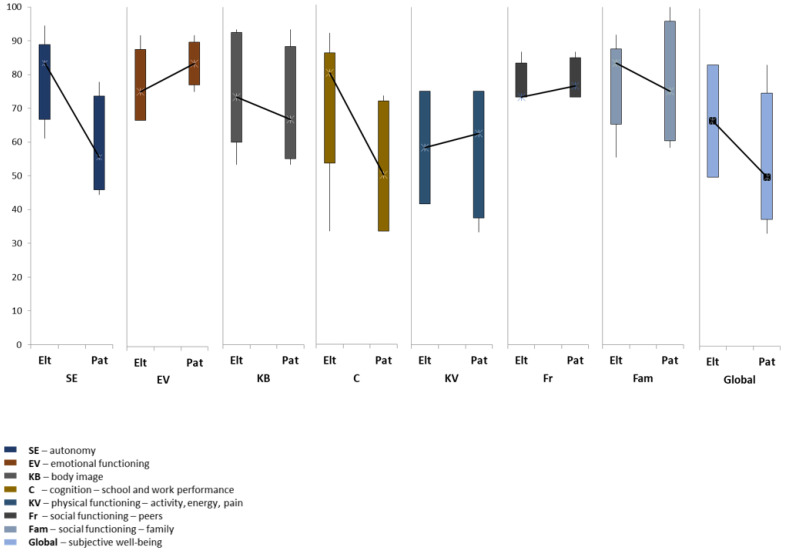
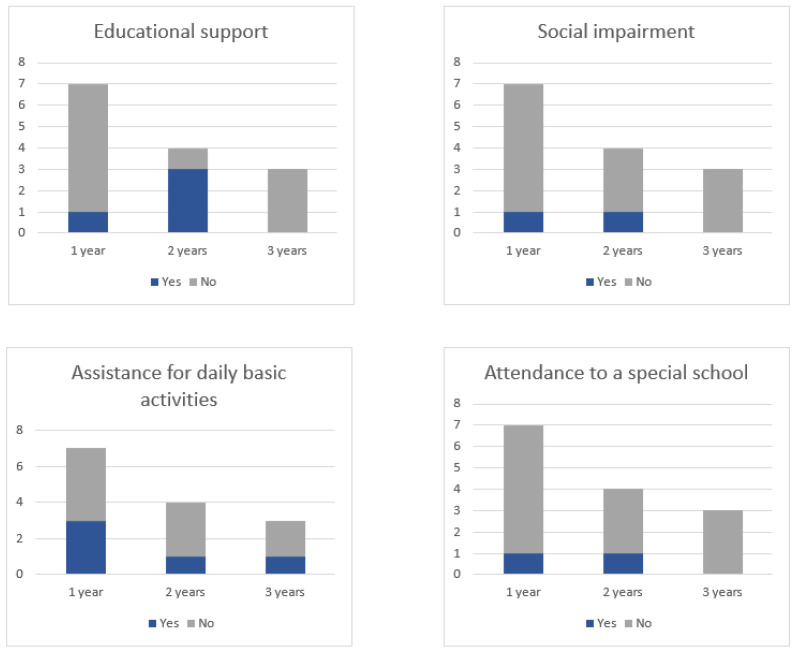
Five (50%) children developed local failure (LF) at a median time of 32.4 months (range, 17.7-55.4) after PBS-PT and four (80%) were considered in-field. One patient died of T-cell lymphoma 127.1 months after PBS-PT. Estimated 5-year local control (LC) and overall survival (OS) rates were 19.4% and 100.0%, respectively. Except for one patient who developed a cataract requiring surgery, no grade ≥3 late toxicities were reported. Before PT, patients rated their QoL lower than their parents in most domains. During the first year after PT, one child required educational support, one needed to attend to a special school, one had social problems and another three children required assistance for daily basic activities (DBA). Three years after PT, only one child required assistance for DBA.
The outcome of children with intracranial meningioma treated with PBS-PT is in line with other centers who have reported results of radiation therapy delivered to this particular patient group. This therapy provides acceptable functional status profiles with no high-grade adverse radiation-induced events.
本研究旨在报告采用笔形束扫描质子治疗(PBS-PT)的儿童和青少年颅内脑膜瘤患者的临床及患者报告结局。
在1999年至2022年间接受PBS-PT治疗的207例颅内脑膜瘤患者队列中,10例(4.8%)为年龄<18岁的儿童或青少年。中位年龄为13.9岁(范围3.2 - 17.2岁)。6例(60%)儿童接受初次治疗(术后质子治疗,4例;单纯质子治疗,2例),4例(40%)在肿瘤复发时接受治疗。根据不良事件通用术语标准(CTCAE)记录急性和晚期毒性反应。使用儿童生活质量问卷(PEDQOL)评估PBS-PT治疗前的生活质量。通过我们内部开发的随访调查评估质子治疗后的教育、功能和社会方面情况。中位随访时间为71.1个月(范围2.5 - 249.7个月),最后一份可用问卷的中位时间为37.6个月(范围5.75 - 112.6个月)。
5例(50%)儿童在PBS-PT治疗后中位32.4个月(范围17.7 - 55.4个月)出现局部复发(LF),其中4例(80%)为野内复发。1例患者在PBS-PT治疗后127.1个月死于T细胞淋巴瘤。估计5年局部控制(LC)率和总生存率(OS)分别为19.4%和100.0%。除1例患者出现需要手术的白内障外,未报告≥3级晚期毒性反应。质子治疗前,患者在大多数领域对生活质量的评分低于其父母。在质子治疗后的第一年,1名儿童需要教育支持,1名需要就读特殊学校,1名有社交问题,另外3名儿童在日常基本活动(DBA)方面需要帮助。质子治疗3年后,只有1名儿童在DBA方面需要帮助。
采用PBS-PT治疗的儿童颅内脑膜瘤患者的结局与其他报告过该特定患者群体放疗结果的中心一致。这种治疗提供了可接受的功能状态概况,且无严重的辐射诱导不良事件。