Koinis Filippos, Zafeiriou Zafeiris, Messaritakis Ippokratis, Katsaounis Panagiotis, Koumarianou Anna, Kontopodis Emmanouil, Chantzara Evangelia, Aidarinis Chrissovalantis, Lazarou Alexandros, Christodoulopoulos George, Emmanouilides Christos, Hatzidaki Dora, Kallergi Galatea, Georgoulias Vassilis, Kotsakis Athanasios
Department of Medical Oncology, University General Hospital of Larissa, 41334 Larisa, Greece.
Faculty οf Medicine, School of Health Sciences, University of Thessaly, 41335 Larissa, Greece.
Cancers (Basel). 2023 Sep 11;15(18):4511. doi: 10.3390/cancers15184511.
Circulating tumor cells (CTCs) appear to be a promising tool for predicting the clinical outcome and monitoring the response to treatment in patients with solid tumors. The current study assessed the clinical relevance of monitoring CTCs in patients with metastatic castration resistant prostate cancer (mCRPC) treated with cabazitaxel.
Patients with histologically confirmed mCRPC who were previously treated with a docetaxel-containing regimen and experienced disease progression were enrolled in this multicenter prospective study. CTC counts were enumerated using the CellSearch system at baseline (before cabazitaxel initiation), after one cabazitaxel cycle (post 1st cycle) and at disease progression (PD). Patients were stratified into predetermined CTC-positive and CTC-negative groups. The phenotypic characterization was performed using double immunofluorescence staining with anti-CKs and anti-Ki67, anti-M30 or anti-vimentin antibodies.
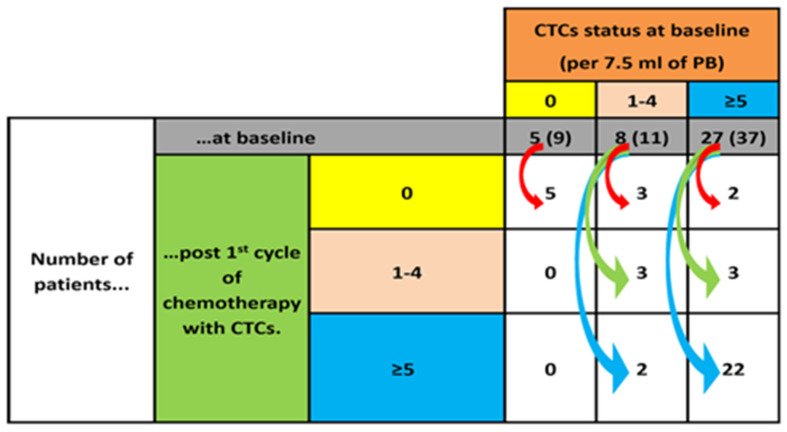
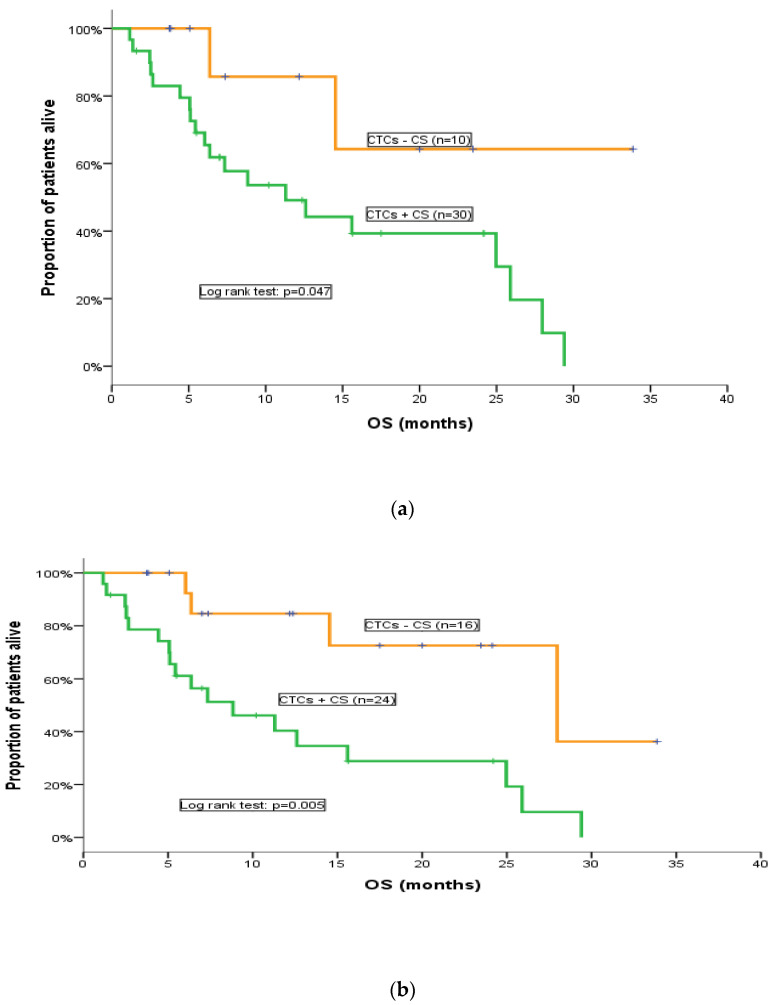
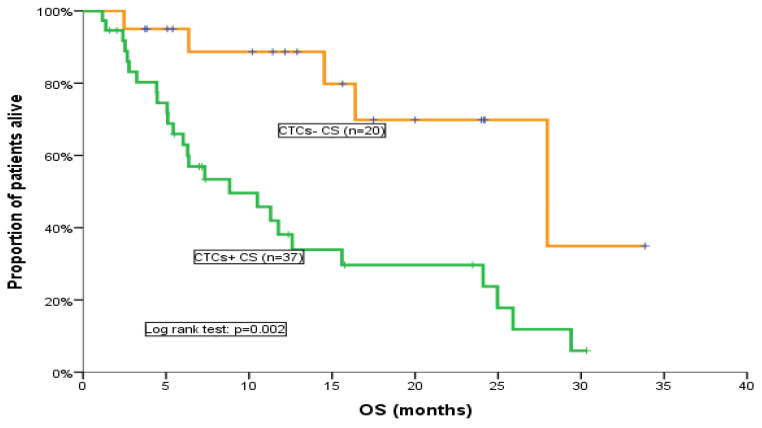
The median PFS and OS were 4.0 (range, 1.0-17.9) and 14.5 (range, 1.2-33.9) months, respectively. At baseline, 48 out of 57 (84.2%) patients had ≥1 CTCs/7.5 mL of peripheral blood (PB) and 37 (64.9%) had ≥5 CTCs/7.5 mL of PB. After one treatment cycle, 30 (75%) out of the 40 patients with available measurements had ≥1 detectable CTC/7.5 mL of PB and 24 (60%) ≥ 5CTCs/7.5 mL of PB; 12.5% of the patients with detectable CTCs at the baseline sample had no detectable CTCs after one treatment cycle. The detection of ≥5CTCs/7.5 mL of PB at baseline and post-cycle 1 was associated with shorter PFS and OS ( = 0.002), whereas a positive CTC status post-cycle 1 strongly correlated with poorer OS irrespective of the CTC cut-off used. Multivariate analysis revealed that the detection of non-apoptotic (CK/M30) CTCs at baseline is an independent predictor of shorter OS ( = 0.005).
In patients with mCRPC treated with cabazitaxel, CTC counts both at baseline and after the first cycle retain their prognostic significance, implying that liquid biopsy monitoring might serve as a valuable tool for predicting treatment efficacy and survival outcomes.
循环肿瘤细胞(CTC)似乎是预测实体瘤患者临床结局和监测治疗反应的一种有前景的工具。本研究评估了在接受卡巴他赛治疗的转移性去势抵抗性前列腺癌(mCRPC)患者中监测CTC的临床相关性。
组织学确诊为mCRPC且先前接受过含多西他赛方案治疗并出现疾病进展的患者纳入了这项多中心前瞻性研究。在基线(卡巴他赛开始前)、一个卡巴他赛周期后(第1周期后)和疾病进展(PD)时,使用CellSearch系统对CTC计数进行枚举。患者被分层为预先确定的CTC阳性和CTC阴性组。使用抗细胞角蛋白(CK)和抗Ki67、抗M30或抗波形蛋白抗体进行双重免疫荧光染色进行表型特征分析。
中位无进展生存期(PFS)和总生存期(OS)分别为4.0(范围1.0 - 17.9)个月和14.5(范围1.2 - 33.9)个月。在基线时,57例患者中有48例(84.2%)外周血(PB)中每7.5 mL有≥1个CTC,37例(64.9%)每7.5 mL有≥5个CTC。在一个治疗周期后,40例有可用测量值的患者中有30例(75%)外周血中每7.5 mL有≥1个可检测到的CTC,24例(60%)≥5个CTC/7.5 mL PB;基线样本中可检测到CTC的患者中有12.5%在一个治疗周期后未检测到CTC。基线和第1周期后每7.5 mL PB中检测到≥5个CTC与较短的PFS和OS相关(P = 0.002),而第1周期后CTC阳性状态与较差的OS密切相关,与所使用的CTC临界值无关。多变量分析显示,基线时检测到非凋亡(CK/M30)CTC是较短OS的独立预测因素(P = 0.005)。
在接受卡巴他赛治疗的mCRPC患者中,基线和第1周期后的CTC计数均保留其预后意义,这意味着液体活检监测可能是预测治疗疗效和生存结局的有价值工具。