Malhotra Divyanshu, Jethwani Priyanka
Johns Hopkins Medicine, Johns Hopkins Comprehensive Transplant Center, Baltimore, MD 21287, USA.
Methodist Transplant Institute, University of Tennessee Health Science Center, Knoxville, TN 37996, USA.
J Clin Med. 2023 Sep 13;12(18):5938. doi: 10.3390/jcm12185938.
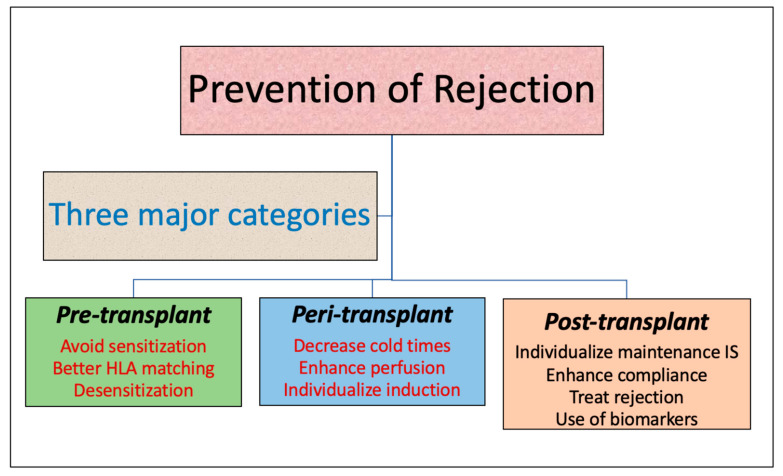
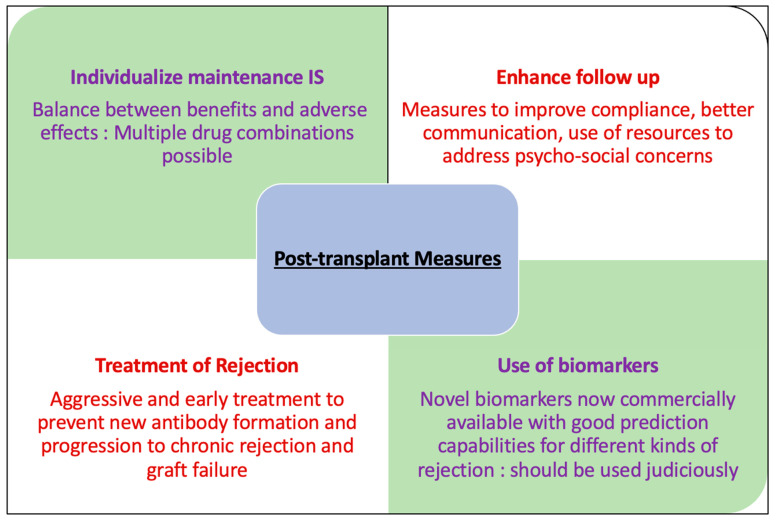
With increasing knowledge of immunologic factors and with the advent of potent immunosuppressive agents, the last several decades have seen significantly improved kidney allograft survival. However, despite overall improved short to medium-term allograft survival, long-term allograft outcomes remain unsatisfactory. A large body of literature implicates acute and chronic rejection as independent risk factors for graft loss. In this article, we review measures taken at various stages in the kidney transplant process to minimize the risk of rejection. In the pre-transplant phase, it is imperative to minimize the risk of sensitization, aim for better HLA matching including eplet matching and use desensitization in carefully selected high-risk patients. The peri-transplant phase involves strategies to minimize cold ischemia times, individualize induction immunosuppression and make all efforts for better HLA matching. In the post-transplant phase, the focus should move towards individualizing maintenance immunosuppression and using innovative strategies to increase compliance. Acute rejection episodes are risk factors for significant graft injury and development of chronic rejection thus one should strive for early detection and aggressive treatment. Monitoring for DSA development, especially in high-risk populations, should be made part of transplant follow-up protocols. A host of new biomarkers are now commercially available, and these should be used for early detection of rejection, immunosuppression modulation, prevention of unnecessary biopsies and monitoring response to rejection treatment. There is a strong push needed for the development of new drugs, especially for the management of chronic or resistant rejections, to prolong graft survival. Prevention of rejection is key for the longevity of kidney allografts. This requires a multipronged approach and significant effort on the part of the recipients and transplant centers.
随着对免疫因素的认识不断增加以及强效免疫抑制剂的出现,过去几十年中肾移植受者的存活率有了显著提高。然而,尽管短期至中期移植肾总体存活率有所提高,但长期移植肾结局仍不尽人意。大量文献表明,急性和慢性排斥反应是移植肾丢失的独立危险因素。在本文中,我们回顾了肾移植过程中各个阶段为降低排斥反应风险所采取的措施。在移植前阶段,必须尽量降低致敏风险,争取更好的HLA配型,包括表位配型,并在精心挑选的高风险患者中使用脱敏疗法。移植围手术期涉及尽量缩短冷缺血时间、个体化诱导免疫抑制并全力争取更好的HLA配型等策略。在移植后阶段,重点应转向个体化维持免疫抑制,并采用创新策略提高依从性。急性排斥反应是移植肾严重损伤和慢性排斥反应发生的危险因素,因此应努力实现早期检测和积极治疗。监测供体特异性抗体(DSA)的产生,尤其是在高风险人群中,应成为移植随访方案的一部分。目前有许多新的生物标志物可供商业使用,应用这些标志物进行排斥反应的早期检测、免疫抑制调节、避免不必要的活检以及监测排斥反应治疗的反应。迫切需要开发新药,尤其是用于治疗慢性或难治性排斥反应的药物,以延长移植肾存活时间。预防排斥反应是肾移植长期存活的关键。这需要多方面的努力,受者和移植中心都要付出巨大的努力。