Tanveer Waqas, Ridwan-Pramana Angela, Molinero-Mourelle Pedro, Forouzanfar Tymour
Department of Oral and Maxillofacial Surgery, Amsterdam University Medical Center, 1081 HV Amsterdam, The Netherlands.
Center for Special Care in Dentistry, Department of Maxillofacial Prosthodontics, Stichting Bijzondere Tandheelkunde, 1081 LA Amsterdam, The Netherlands.
J Clin Med. 2023 Sep 13;12(18):5950. doi: 10.3390/jcm12185950.
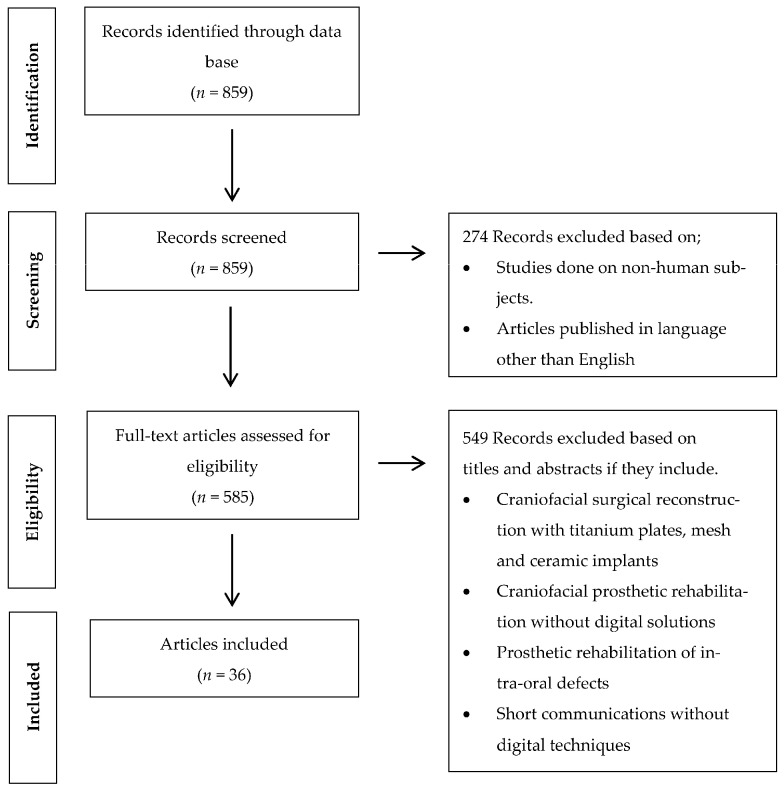
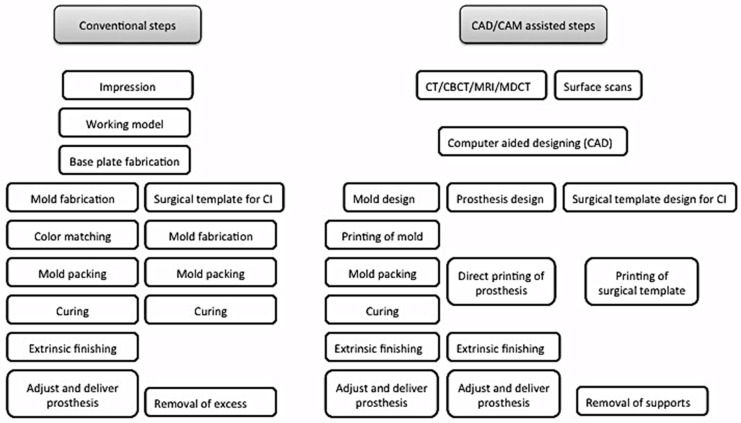
This systematic review was aimed at gathering the clinical and technical applications of CAD/CAM technology for craniofacial implant placement and processing of auricular prostheses based on clinical cases. According to the Preferred Reporting Items for Systematic Reviews and Meta-Analysis (PRISMA) guidelines, an electronic data search was performed. Human clinical studies utilizing digital planning, designing, and printing systems for craniofacial implant placement and processing of auricular prostheses for prosthetic rehabilitation of auricular defects were included. Following a data search, a total of 36 clinical human studies were included, which were digitally planned and executed through various virtual software to rehabilitate auricular defects. Preoperative data were collected mainly through computed tomography scans (CT scans) (55 cases); meanwhile, the most common laser scanners were the 3dMDface System (3dMD LLC, Atlanta, Georgia, USA) (6 cases) and the 3 Shape scanner (3 Shape, Copenhagen, Denmark) (6 cases). The most common digital design software are Mimics Software (Mimics Innovation Suite, Materialize, Leuven, Belgium) (18 cases), Freeform software (Freeform, NC, USA) (13 cases), and 3 Shape software (3 Shape, Copenhagen, Denmark) (12 cases). Surgical templates were designed and utilized in 35 cases to place 88 craniofacial implants in auricular defect areas. The most common craniofacial implants were Vistafix craniofacial implants (Entific Medical Systems, Goteborg, Sweden) in 22 cases. A surgical navigation system was used to place 20 craniofacial implants in the mastoid bone. Digital applications of CAD/CAM technology include, but are not limited to, study models, mirrored replicas of intact ears, molds, retentive attachments, customized implants, substructures, and silicone prostheses. The included studies demonstrated a predictable clinical outcome, reduced the patient's visits, and completed the prosthetic rehabilitation in reasonable time and at reasonable cost. However, equipment costs and trained technical staff were highlighted as possible limitations to the use of CAD/CAM systems.
本系统评价旨在基于临床病例收集计算机辅助设计/计算机辅助制造(CAD/CAM)技术在颅面植入物放置及耳假体加工方面的临床和技术应用。根据系统评价和Meta分析的首选报告项目(PRISMA)指南,进行了电子数据检索。纳入了利用数字规划、设计和打印系统进行颅面植入物放置及耳假体加工以修复耳缺损的人体临床研究。数据检索后,共纳入36项人体临床研究,这些研究通过各种虚拟软件进行数字规划和执行以修复耳缺损。术前数据主要通过计算机断层扫描(CT扫描)收集(55例);同时,最常用的激光扫描仪是3dMDface系统(3dMD有限责任公司,美国佐治亚州亚特兰大)(6例)和3Shape扫描仪(3Shape公司,丹麦哥本哈根)(6例)。最常用的数字设计软件是Mimics软件(Mimics创新套件,Materialize公司,比利时鲁汶)(18例)、Freeform软件(Freeform公司,美国北卡罗来纳州)(13例)和3Shape软件(3Shape公司,丹麦哥本哈根)(12例)。35例中设计并使用了手术模板,在耳缺损区域植入88枚颅面植入物。最常见的颅面植入物是Vistafix颅面植入物(Entific医疗系统公司,瑞典哥德堡),共22例。使用手术导航系统在乳突骨中植入20枚颅面植入物。CAD/CAM技术的数字应用包括但不限于研究模型、完整耳朵的镜像复制品、模具、固位附件、定制植入物、子结构和硅胶假体。纳入的研究显示出可预测的临床结果,减少了患者就诊次数,并在合理的时间和成本内完成了假体修复。然而,设备成本和训练有素的技术人员被认为是使用CAD/CAM系统的可能限制因素。