Luo Yiting, Fang Muaoer, Wang Hanqing, Dai Xiangrong, Su Rongkui, Ma Xiancheng
Hunan First Normal University, Changsha 410114, China.
College of Mechanical and Electrical Engineering, Central South University of Forestry and Technology, Changsha 410004, China.
Nanomaterials (Basel). 2023 Sep 15;13(18):2564. doi: 10.3390/nano13182564.
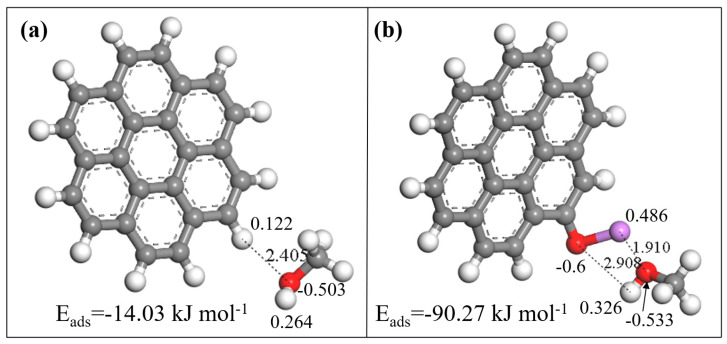
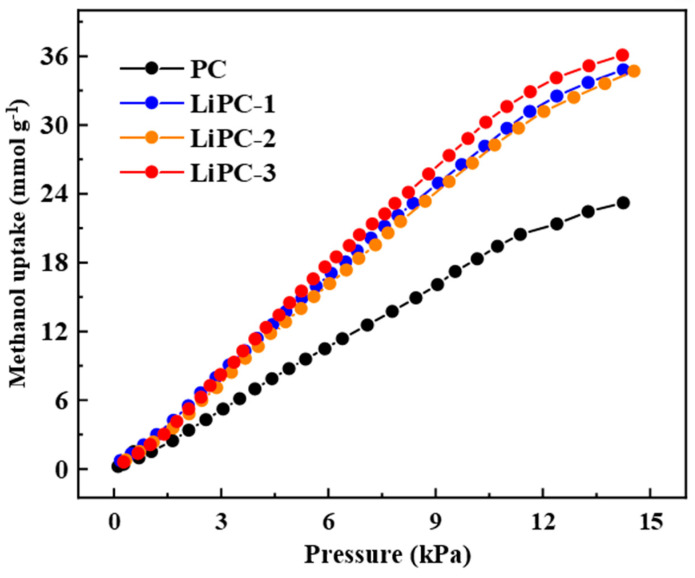
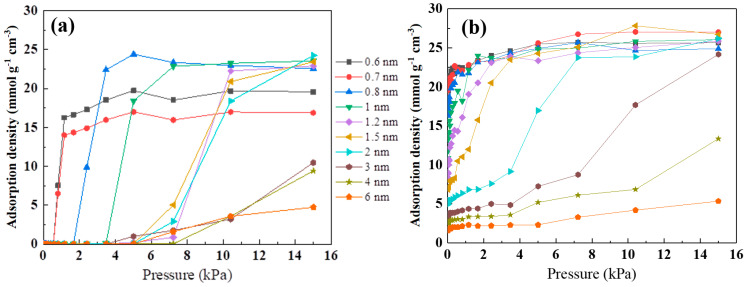
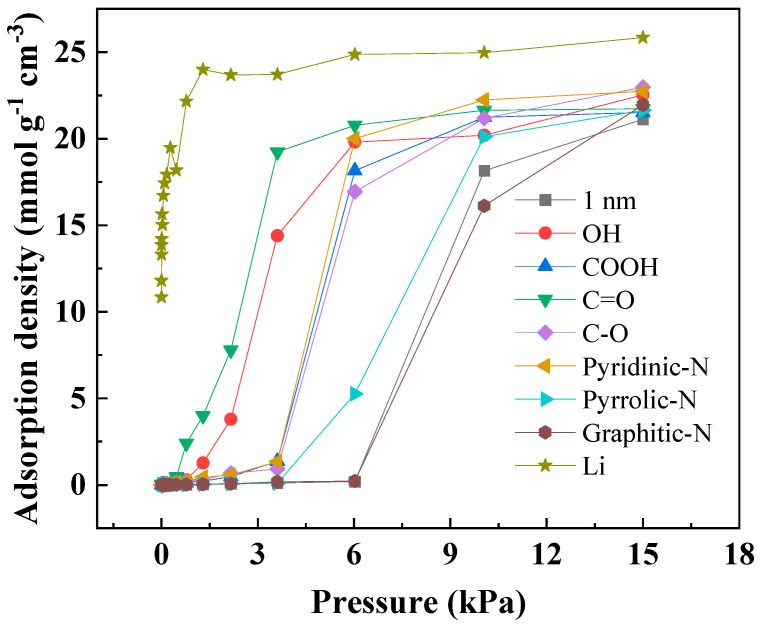
Previous reports have shown that it is difficult to improve the methanol adsorption performance of nitrogen and oxygen groups due to their low polarity. Here, we first prepared porous carbon with a high specific surface area and large pore volume using benzimidazole as a carbon precursor and KOH as an activating agent. Then, we improved the surface polarity of the porous carbon by doping with Lithium (Li) to enhance the methanol adsorption performance. The results showed that the methanol adsorption capacity of Li-doped porous carbon reached 35.4 mmol g, which increased by 57% compared to undoped porous carbon. Molecular simulation results showed that Li doping not only improved the methanol adsorption performance at low pressure, but also at relatively high pressure. This is mainly because Li-modified porous carbon has higher surface polarity than nitrogen and oxygen-modified surfaces, which can generate stronger electrostatic interactions. Furthermore, through density functional theory (DFT) calculations, we determined the adsorption energy, adsorption distance, and charge transfer between Li atom and methanol. Our results demonstrate that Li doping enhances the adsorption energy, reduces the adsorption distance, and increases the charge transfer in porous carbon. The mechanism of methanol adsorption by Li groups was revealed through experimental and theoretical calculations, providing a theoretical basis for the design and preparation of methanol adsorbents.
先前的报道表明,由于氮氧基团的低极性,很难提高其对甲醇的吸附性能。在此,我们首先以苯并咪唑为碳前驱体、氢氧化钾为活化剂制备了具有高比表面积和大孔体积的多孔碳。然后,通过锂(Li)掺杂提高了多孔碳的表面极性,以增强甲醇吸附性能。结果表明,锂掺杂多孔碳的甲醇吸附容量达到35.4 mmol/g,与未掺杂的多孔碳相比增加了57%。分子模拟结果表明,锂掺杂不仅提高了低压下的甲醇吸附性能,在相对高压下也是如此。这主要是因为锂改性的多孔碳比氮氧改性的表面具有更高的表面极性,能够产生更强的静电相互作用。此外,通过密度泛函理论(DFT)计算,我们确定了锂原子与甲醇之间的吸附能、吸附距离和电荷转移。我们的结果表明,锂掺杂增强了多孔碳中的吸附能,缩短了吸附距离,并增加了电荷转移。通过实验和理论计算揭示了锂基团对甲醇的吸附机理,为甲醇吸附剂的设计和制备提供了理论依据。