Department of Medical Epidemiology and Biostatistics, Karolinska Institutet, Stockholm, Sweden.
Department of Clinical Sciences, Danderyd Hospital, Karolinska Institutet, Stockholm, Sweden.
Gerontology. 2023;69(12):1385-1393. doi: 10.1159/000534131. Epub 2023 Sep 28.
Although frailty is commonly considered as a syndrome of old individuals, recent studies show that it can affect younger adults, too. Whether and how frailty differs in younger adults compared to old is however unknown. To this end, we analyzed the prevalence, characteristics, and risk factors of early-life (aged <65) and late-life (aged ≥65) frailty.
We analyzed individuals in the UK Biobank (N = 405,123) and Swedish Screening Across the Lifespan Twin (SALT; N = 43,641) study. Frailty index (FI) scores ≥0.21 were used to demarcate frailty. Characteristics of early-life versus late-life frailty were analyzed by collating the FI items (deficits) into domains and comparing the domain scores between younger and older frail individuals. Logistic regression was used to assess the risk factors of frailty.
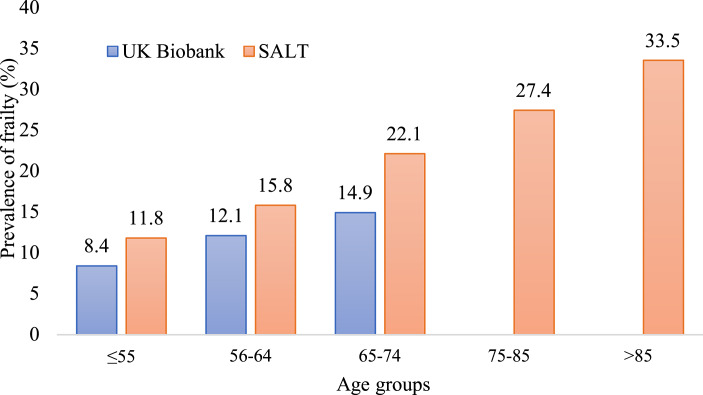
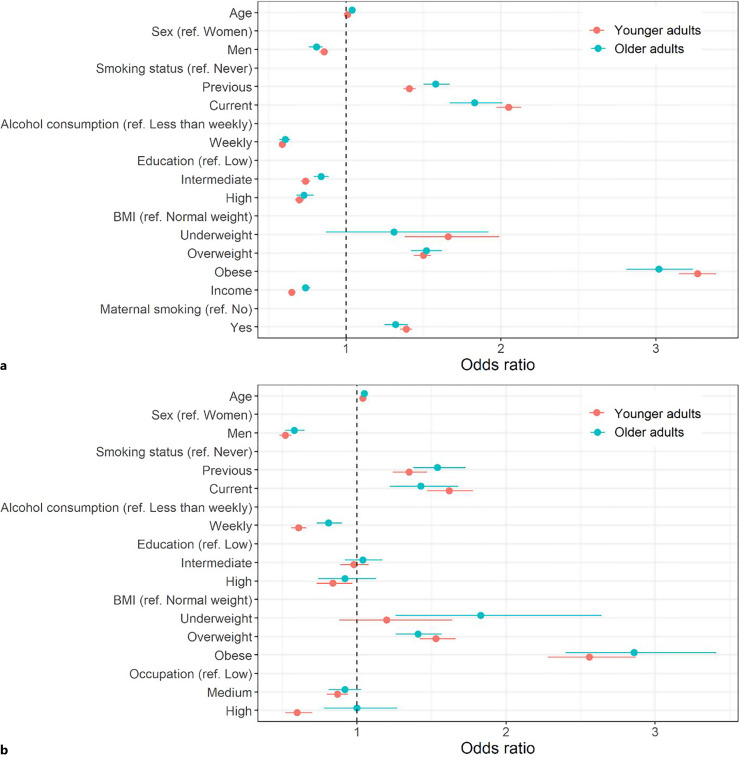
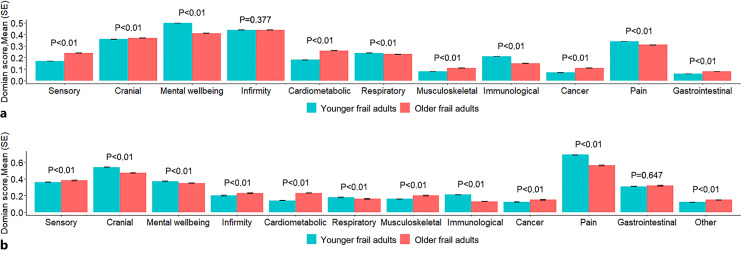
The pooled prevalence rates of frailty were 10.3% (95% confidence interval [CI]: 2.7-32.7), 14.4% (95% CI: 4.5-37.2), 19.2% (95% CI: 2.5-68.5) in individuals aged ≤55, 55-64, 65-74, respectively. Younger frail adults (aged <65) had higher scores in immunological, mental wellbeing, and pain-related domains, whereas older frail adults (aged ≥65) had higher scores in cardiometabolic, cancer, musculoskeletal, and sensory-related domains. Higher age, female sex, smoking, lower alcohol consumption, lower education, obesity, overweight, low income, and maternal smoking were similarly associated with the risk of early-life and late-life frailty.
Frailty is prevalent also in younger age groups (aged <65) but differs in some of its characteristics from the old. The risk factors of frailty are nevertheless largely similar for early-life and late-life frailty.
尽管衰弱通常被认为是老年人的综合征,但最近的研究表明,它也可能影响年轻成年人。然而,衰弱在年轻成年人和老年人中的表现和差异如何尚不清楚。为此,我们分析了早发性(年龄<65 岁)和晚发性(年龄≥65 岁)衰弱的患病率、特征和危险因素。
我们分析了英国生物银行(N=405123)和瑞典全生命周期双胞胎筛查(SALT;N=43641)研究中的个体。使用衰弱指数(FI)得分≥0.21 来划定衰弱。通过将 FI 项目(缺陷)整理到各个领域,并比较年轻和年老衰弱个体的领域得分,分析早发性和晚发性衰弱的特征。使用逻辑回归评估衰弱的危险因素。
≤55 岁、55-64 岁、65-74 岁个体的衰弱患病率分别为 10.3%(95%置信区间[CI]:2.7-32.7)、14.4%(95% CI:4.5-37.2)、19.2%(95% CI:2.5-68.5)。年轻的衰弱成年人(年龄<65 岁)在免疫、心理健康和与疼痛相关的领域得分较高,而年长的衰弱成年人(年龄≥65 岁)在心血管代谢、癌症、肌肉骨骼和感觉相关的领域得分较高。更高的年龄、女性、吸烟、较低的酒精摄入量、较低的教育程度、肥胖、超重、低收入和母亲吸烟与早发性和晚发性衰弱的风险均呈正相关。
衰弱在年龄较小的人群(年龄<65 岁)中也很常见,但在某些特征上与老年人不同。然而,衰弱的危险因素在早发性和晚发性衰弱中基本相似。