Department of Clinical Biochemistry, Herlev and Gentofte Hospital, Copenhagen University Hospital, Herlev, Denmark.
The Copenhagen General Population Study, Herlev and Gentofte Hospital, Copenhagen University Hospital, Herlev, Denmark.
Diabetologia. 2023 Dec;66(12):2238-2249. doi: 10.1007/s00125-023-06016-0. Epub 2023 Sep 30.
AIMS/HYPOTHESIS: Elevated remnant cholesterol is observationally and causally associated with increased risk of atherosclerotic cardiovascular disease (ASCVD) in the general population. This association is not well studied in individuals with diabetes, who are often included in clinical trials of remnant cholesterol-lowering therapy. We tested the hypothesis that elevated remnant cholesterol is associated with increased risk of ASCVD in individuals with diabetes. We also explored the fraction of excess risk conferred by diabetes which can be explained by elevated remnant cholesterol.
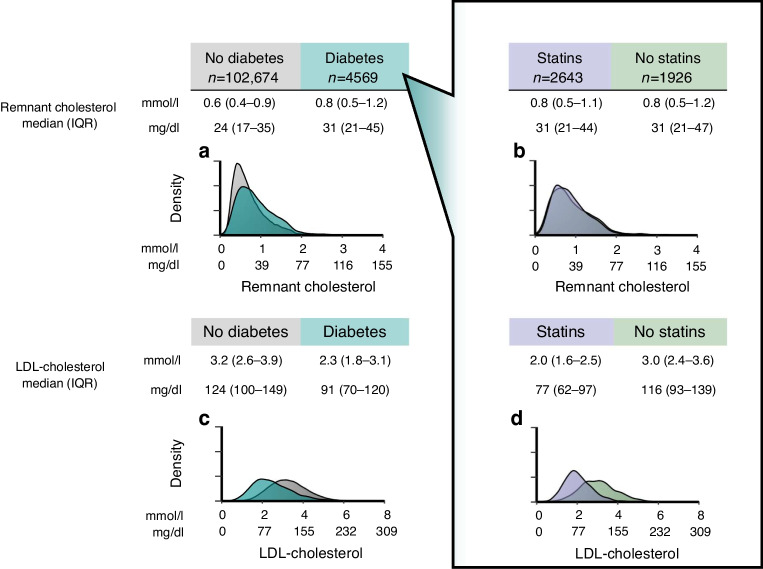
We included 4569 white Danish individuals with diabetes (58% statin users) nested within the Copenhagen General Population Study (2003-2015). The ASCVDs peripheral artery disease, myocardial infarction and ischaemic stroke were extracted from national Danish health registries without losses to follow-up. Remnant cholesterol was calculated from a standard lipid profile.
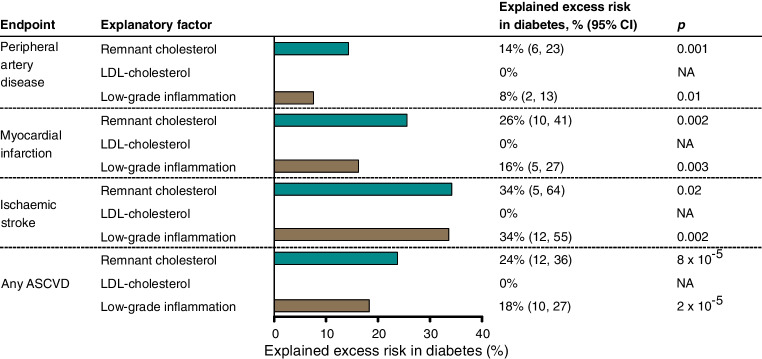
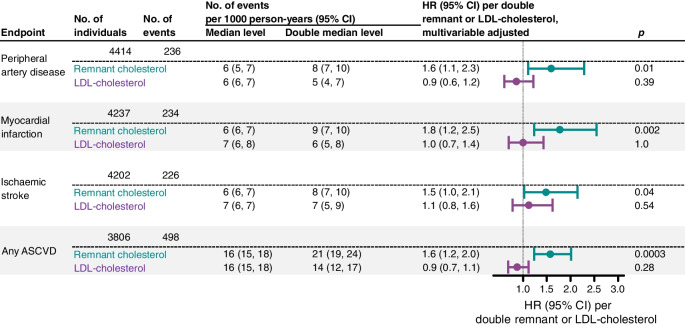
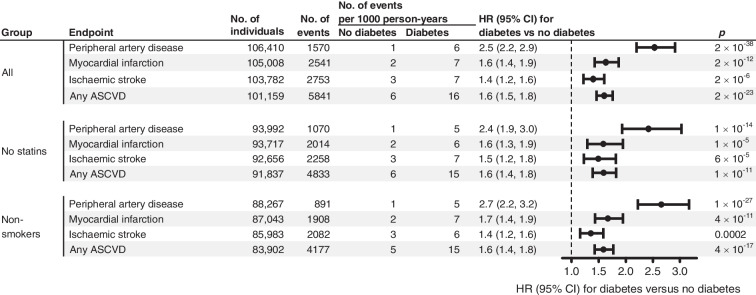
During up to 15 years of follow-up, 236 individuals were diagnosed with peripheral artery disease, 234 with myocardial infarction, 226 with ischaemic stroke and 498 with any ASCVD. Multivariable adjusted HR (95% CI) per doubling of remnant cholesterol was 1.6 (1.1, 2.3; p=0.01) for peripheral artery disease, 1.8 (1.2, 2.5; p=0.002) for myocardial infarction, 1.5 (1.0, 2.1; p=0.04) for ischaemic stroke, and 1.6 (1.2, 2.0; p=0.0003) for any ASCVD. Excess risk conferred by diabetes was 2.5-fold for peripheral artery disease, 1.6-fold for myocardial infarction, 1.4-fold for ischaemic stroke and 1.6-fold for any ASCVD. Excess risk explained by elevated remnant cholesterol and low-grade inflammation was 14% and 8% for peripheral artery disease, 26% and 16% for myocardial infarction, 34% and 34% for ischaemic stroke, and 24% and 18% for any ASCVD, respectively. LDL-cholesterol did not explain excess risk, as it was not higher in individuals with diabetes. We also explored the fraction of excess risk conferred by diabetes which can be explained by elevated remnant cholesterol.
CONCLUSIONS/INTERPRETATION: Elevated remnant cholesterol was associated with increased risk of ASCVD in individuals with diabetes. Remnant cholesterol and low-grade inflammation explained substantial excess risk of ASCVD conferred by diabetes. Whether remnant cholesterol should be used as a treatment target remains to be determined in randomised controlled trials.
目的/假设:在普通人群中,残留胆固醇升高与动脉粥样硬化性心血管疾病(ASCVD)风险增加具有观察性和因果关系。在经常被纳入残留胆固醇降低治疗临床试验的糖尿病患者中,这一关联尚未得到很好的研究。我们检验了以下假设,即残留胆固醇升高与糖尿病患者的 ASCVD 风险增加有关。我们还探讨了由糖尿病引起的、可以用升高的残留胆固醇来解释的额外风险的比例。
我们纳入了 4569 名丹麦白人糖尿病患者(58%为他汀类药物使用者),这些患者嵌套在哥本哈根普通人群研究中(2003-2015 年)。ASCVD 外周动脉疾病、心肌梗死和缺血性卒中等疾病从丹麦国家卫生登记处提取,无随访丢失。残留胆固醇根据标准血脂谱计算。
在长达 15 年的随访期间,236 名患者被诊断为外周动脉疾病,234 名患者被诊断为心肌梗死,226 名患者被诊断为缺血性卒中和 498 名患者被诊断为任何 ASCVD。残留胆固醇每增加一倍,多变量校正后的 HR(95%CI)分别为外周动脉疾病 1.6(1.1,2.3;p=0.01)、心肌梗死 1.8(1.2,2.5;p=0.002)、缺血性卒中 1.5(1.0,2.1;p=0.04)和任何 ASCVD 1.6(1.2,2.0;p=0.0003)。糖尿病引起的超额风险为外周动脉疾病 2.5 倍,心肌梗死 1.6 倍,缺血性卒中 1.4 倍,任何 ASCVD 1.6 倍。升高的残留胆固醇和低度炎症引起的超额风险分别为外周动脉疾病 14%和 8%,心肌梗死 26%和 16%,缺血性卒中 34%和 34%,任何 ASCVD 24%和 18%。LDL-胆固醇在糖尿病患者中并不高,因此不能解释超额风险。我们还探讨了由糖尿病引起的、可以用升高的残留胆固醇来解释的额外风险的比例。
结论/解释:在糖尿病患者中,残留胆固醇升高与 ASCVD 风险增加有关。残留胆固醇和低度炎症解释了糖尿病引起的 ASCVD 超额风险的大部分。是否应将残留胆固醇作为随机对照试验中的治疗靶点仍有待确定。