Zhang Ke, Zhang Ting-Ting, Guo Ren-Rong, Ye Quan, Zhao Hui-Lin, Huang Xu-Hui
SKL of Marine Food Processing & Safety Control, National Engineering Research Center of Seafood, Collaborative Innovation Center of Seafood Deep Processing, Dalian Technology Innovation Center for Chinese Prepared Food, School of Food Science and Technology, Dalian Polytechnic University, Dalian 116034, China.
School of Food and Biological Engineering, Hefei University of Technology, Engineering Research Center of Bio-Process, Ministry of Education, Hefei 230601, Anhui, China.
Food Chem X. 2023 Sep 9;19:100871. doi: 10.1016/j.fochx.2023.100871. eCollection 2023 Oct 30.
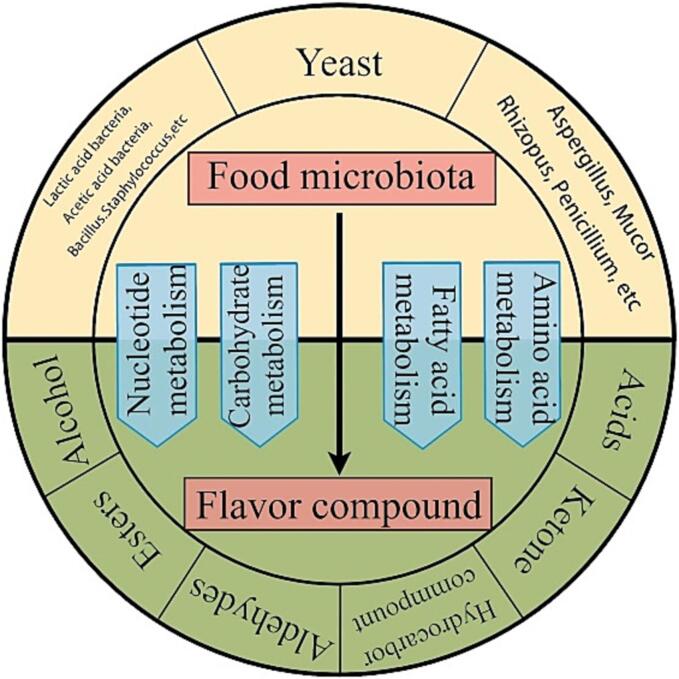
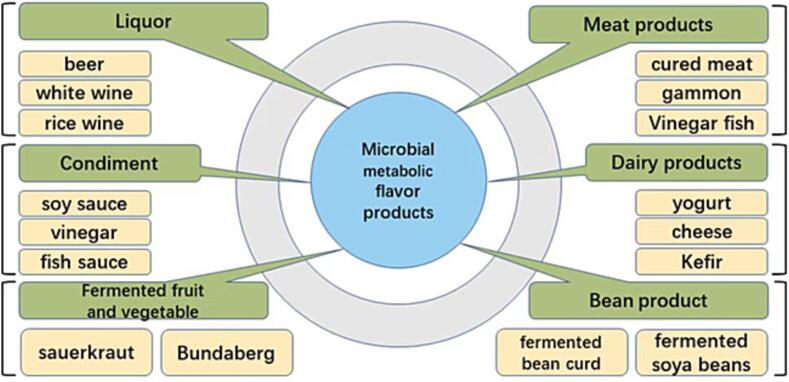
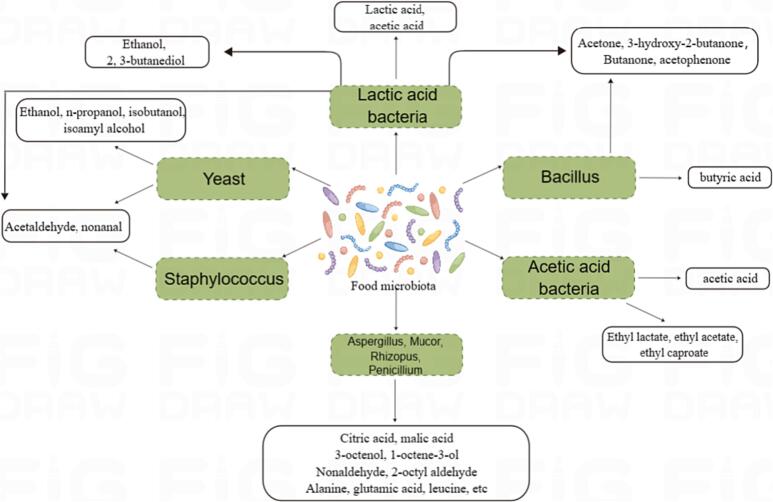
The beneficial microorganisms in food are diverse and complex in structure. These beneficial microorganisms can produce different and unique flavors in the process of food fermentation. The unique flavor of these fermented foods is mainly produced by different raw and auxiliary materials, fermentation technology, and the accumulation of flavor substances by dominant microorganisms during fermentation. The succession and metabolic accumulation of microbial flora significantly impacts the distinctive flavor of fermented foods. The investigation of the role of microbial flora changes in the production of flavor substances during fermentation can reveal the potential connection between microbial flora succession and the formation of key flavor compounds. This paper reviewed the evolution of microbial flora structure as food fermented and the key volatile compounds that contribute to flavor in the food system and their potential relationship. Further, it was a certain guiding significance for food industrial production.
食品中的有益微生物种类多样且结构复杂。这些有益微生物在食品发酵过程中能产生不同且独特的风味。这些发酵食品的独特风味主要由不同的原辅材料、发酵工艺以及优势微生物在发酵过程中风味物质的积累所产生。微生物菌群的演替和代谢积累对发酵食品独特风味有显著影响。研究发酵过程中微生物菌群变化在风味物质产生中的作用,可揭示微生物菌群演替与关键风味化合物形成之间的潜在联系。本文综述了食品发酵过程中微生物菌群结构的演变、食品体系中对风味有贡献的关键挥发性化合物及其潜在关系。此外,对食品工业生产具有一定的指导意义。