Rutgers University, New Brunswick, NJ, USA.
University of Virginia, Charlottesville, VA, USA.
J Diabetes Res. 2023 Sep 21;2023:4618215. doi: 10.1155/2023/4618215. eCollection 2023.
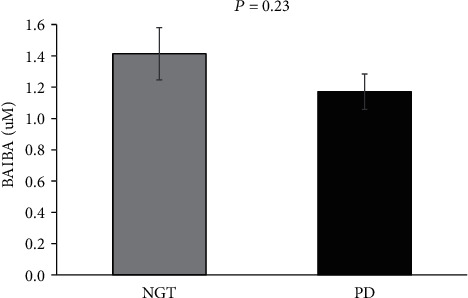
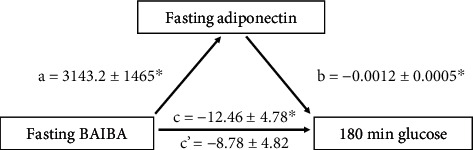
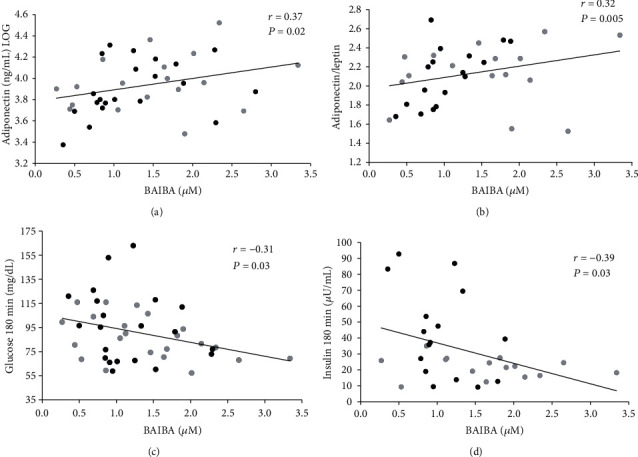
-Aminoisobutyric acid (BAIBA) is secreted by skeletal muscle and promotes insulin sensitivity, fat oxidation, and anti-inflammation. While BAIBA is purportedly lower in individuals with obesity, no work has examined if prediabetes (PD) differentially impacts BAIBA concentrations in people with obesity. . Adults were classified as normal glucose tolerant (NGT; = 22 (20F); 48.0 ± 2.4 yrs; 36.9 ± 1.2 kg/m) or PD ( = 23 (18F); 54.2 ± 1.6 yrs; 38.4 ± 1.2 kg/m) based on ADA criteria. A 180-minute 75 g OGTT was used to estimate fasting (HOMA-IR (liver)) and postprandial (Matsuda index (muscle)) insulin sensitivity as well as -cell function (disposition index (DI), glucose-stimulated insulin secretion adjusted for insulin sensitivity). Body composition and fasting measures of BAIBA, fat oxidation (indirect calorimetry), and adipokines were determined. . NGT and PD had similar BAIBA concentrations (1.4 ± 0.1 vs. 1.2 ± 0.1 M, = 0.23) and fat oxidation ( = 0.31), despite NGT having lower fasting (92.2 ± 1.2 vs. 104.1 ± 3.2 mg/dL, = 0.002) and tAUC glucose ( < 0.001) compared to PD. Moreover, NGT had higher postprandial insulin sensitivity ( = 0.01) and higher total phase DI ( = 0.003) and DI ( = 0.001). Increased BAIBA was associated with adiponectin ( = 0.37, = 0.02), adiponectin/leptin ratio ( = 0.39, = 0.01), and lower glucose and insulin at 180 minutes ( = -0.31, = 0.03 and = -0.39, = 0.03, respectively). Adiponectin also correlated with lower glucose at 180 minutes ( = -0.45, = 0.005), and mediation analysis showed that BAIBA was no longer a significant predictor of glucose at 180 minutes after controlling for adiponectin ( = 0.08). . While BAIBA did not differ between NGT and PD, higher BAIBA is related to favorable glucose metabolism, possibly through an adiponectin-related mechanism. Additional work is required to understand how exercise and/or diet impact BAIBA in relation to type 2 diabetes risk.
支链氨基酸(BAIBA)由骨骼肌分泌,可促进胰岛素敏感性、脂肪氧化和抗炎作用。虽然肥胖者体内的 BAIBA 据称较低,但尚无研究检查前驱糖尿病(PD)是否会对肥胖者的 BAIBA 浓度产生差异影响。。成年人根据 ADA 标准分为正常糖耐量(NGT;= 22(20F);48.0 ± 2.4 岁;36.9 ± 1.2 kg/m)或 PD(= 23(18F);54.2 ± 1.6 岁;38.4 ± 1.2 kg/m)。使用 180 分钟 75 g OGTT 估计空腹(HOMA-IR(肝脏))和餐后(Matsuda 指数(肌肉))胰岛素敏感性以及 -细胞功能(处置指数(DI),根据胰岛素敏感性调整的葡萄糖刺激胰岛素分泌)。测定了身体成分和 BAIBA、脂肪氧化(间接测热法)和脂肪因子的空腹测量值。。NGT 和 PD 的 BAIBA 浓度(1.4 ± 0.1 与 1.2 ± 0.1 M,= 0.23)和脂肪氧化(= 0.31)相似,尽管 NGT 的空腹血糖(92.2 ± 1.2 与 104.1 ± 3.2 mg/dL,= 0.002)和 tAUC 葡萄糖(< 0.001)低于 PD。此外,NGT 的餐后胰岛素敏感性更高(= 0.01),并且总相 DI(= 0.003)和 DI(= 0.001)更高。BAIBA 增加与脂联素(= 0.37,= 0.02)、脂联素/瘦素比值(= 0.39,= 0.01)以及 180 分钟时的血糖和胰岛素降低有关(= -0.31,= 0.03 和= -0.39,= 0.03,分别)。脂联素与 180 分钟时的血糖降低也相关(= -0.45,= 0.005),中介分析表明,在控制脂联素后,BAIBA 不再是 180 分钟时血糖的重要预测因子(= 0.08)。。虽然 NGT 和 PD 之间的 BAIBA 没有差异,但较高的 BAIBA 与更有利的葡萄糖代谢有关,可能通过脂联素相关机制。需要进一步研究以了解运动和/或饮食如何影响与 2 型糖尿病风险相关的 BAIBA。