
急性缺血性脑卒中患者急性便秘的影像学及临床预测因素
Imaging and clinical predictors of acute constipation in patients with acute ischemic stroke.
作者信息
Han I Joon, Lee Ji-Eun, Song Ha-Na, Baek In-Young, Choi Jongun, Chung Jong-Won, Bang Oh Young, Kim Gyeong-Moon, Seo Woo-Keun
机构信息
Sungkyunkwan University School of Medicine, Seoul, Republic of Korea.
Department of Neurology, Samsung Medical Center, Sungkyunkwan University School of Medicine, Seoul, Republic of Korea.
出版信息
Front Neurosci. 2023 Sep 13;17:1263693. doi: 10.3389/fnins.2023.1263693. eCollection 2023.
BACKGROUND
Constipation symptoms are highly prevalent in acute ischemic stroke, but the clinical and neuroimaging predictors are unknown. This study aimed to identify lesions and clinical features associated with acute constipation.
METHODS
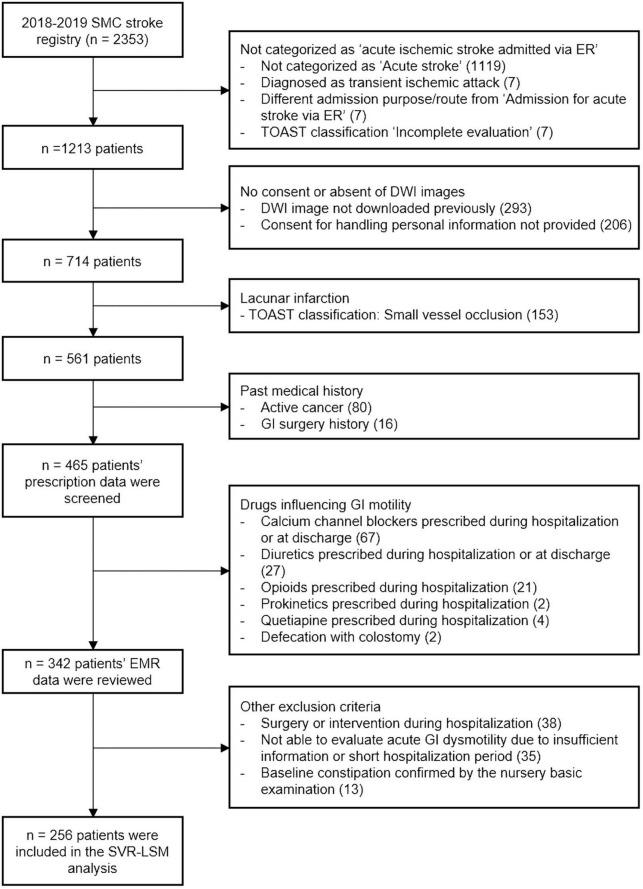
Data from patients with acute ischemic stroke registered in a hospital-based stroke registry between January 2018 and December 2019 were analyzed. Clinical, laboratory, and imaging features were examined for associations with acute constipation. Using the topographic lesion on diffusion-weighted images, multivariate support vector regression-based lesion-symptom mapping (SVR-LSM) was conducted and compared between the non-constipation and acute constipation groups.
RESULTS
A total of 256 patients (mean age 67 years, men: 64%) were included. Acute constipation was noted in 81 patients (32%). Initial stroke severity, represented by initial National Institutes of Health and Stroke Scale (NIHSS) scores, was associated with acute constipation. Laboratory parameters, including fibrin degradation products (FDP), fibrinogen, D-dimer, lipoprotein (a), and free fatty acid levels, also showed statistically significant differences between the non-constipation and constipation groups. FDP, D-dimer, and free fatty acid levels were independently associated with acute constipation in the logistic regression model after adjusting for initial NIHSS scores and potassium levels. SVR-LSM revealed that bilateral lesions in the precentral gyrus, insula, opercular part of the inferior frontal gyrus, the inferior parietal lobule, and lesions in the right middle frontal gyrus were significantly associated with acute constipation. The results were consistent after controlling for the initial NIHSS scores and poststroke potassium levels. When cardioembolic stroke subjects were excluded, the right insular and prefrontal cortex lesions lost their association with acute constipation.
CONCLUSION
Acute constipation symptoms after acute ischemic stroke are mainly related to bilateral lesions in the insula, precentral gyrus, postcentral gyrus, and inferior parietal lobule. Clinically important predictors of acute constipation include initial neurological severity and thromboembolic markers of stroke.
背景
便秘症状在急性缺血性卒中中极为普遍,但临床和神经影像学预测因素尚不清楚。本研究旨在确定与急性便秘相关的病变和临床特征。
方法
分析了2018年1月至2019年12月在一家医院卒中登记处登记的急性缺血性卒中患者的数据。检查临床、实验室和影像学特征与急性便秘的相关性。利用扩散加权图像上的地形病变,在非便秘组和急性便秘组之间进行基于多变量支持向量回归的病变-症状映射(SVR-LSM)并比较。
结果
共纳入256例患者(平均年龄67岁,男性占64%)。81例患者(32%)出现急性便秘。以初始美国国立卫生研究院卒中量表(NIHSS)评分表示的初始卒中严重程度与急性便秘相关。包括纤维蛋白降解产物(FDP)、纤维蛋白原、D-二聚体、脂蛋白(a)和游离脂肪酸水平在内的实验室参数,在非便秘组和便秘组之间也显示出统计学上的显著差异。在调整初始NIHSS评分和血钾水平后,FDP、D-二聚体和游离脂肪酸水平在逻辑回归模型中与急性便秘独立相关。SVR-LSM显示,中央前回、岛叶、额下回岛盖部、顶下小叶的双侧病变以及右额中回的病变与急性便秘显著相关。在控制初始NIHSS评分和卒中后血钾水平后,结果一致。排除心源性栓塞性卒中患者后,右侧岛叶和前额叶皮质病变与急性便秘的相关性消失。
结论
急性缺血性卒中后的急性便秘症状主要与岛叶、中央前回、中央后回和顶下小叶的双侧病变有关。急性便秘的重要临床预测因素包括初始神经严重程度和卒中的血栓栓塞标志物。


 Zotero 插件