Zhu Rong, Zheng Rong, Deng Bing, Liu Ping, Wang Yiru
Longhua Hospital, Shanghai University of Traditional Chinese Medicine, Shanghai, China.
Front Med (Lausanne). 2023 Sep 14;10:1235023. doi: 10.3389/fmed.2023.1235023. eCollection 2023.
The effectiveness of N-acetylcysteine (NAC) in treating contrast-induced nephropathy (CIN) has been the subject of conflicting meta-analyses, but the strength of the evidence for these correlations between NAC use and CIN has not been measured overall.
To evaluate the data from randomized clinical studies (RCTs) that examined the relationships between NAC use and CIN in meta-analyses.
Between the creation of the database and April 2023, searches were made in PubMed, Cochrane Library, EMBASE, and Web of Science. N-acetylcysteine, contrast-induced nephropathy, or contrast-induced renal disease were among the search keywords used, along with terms including systematic review and meta-analysis. The Assessment of Multiple Systematic Reviews, version 2, which assigned grades of extremely low, low, moderate, or high quality to each meta-analysis's scientific quality, was used to evaluate each meta-analysis. The confidence of the evidence in meta-analyses of RCTs was evaluated using the Grading of Recommendation, Assessment, Development and Evaluations method, with evidence being rated as very low, low, moderate, or high.
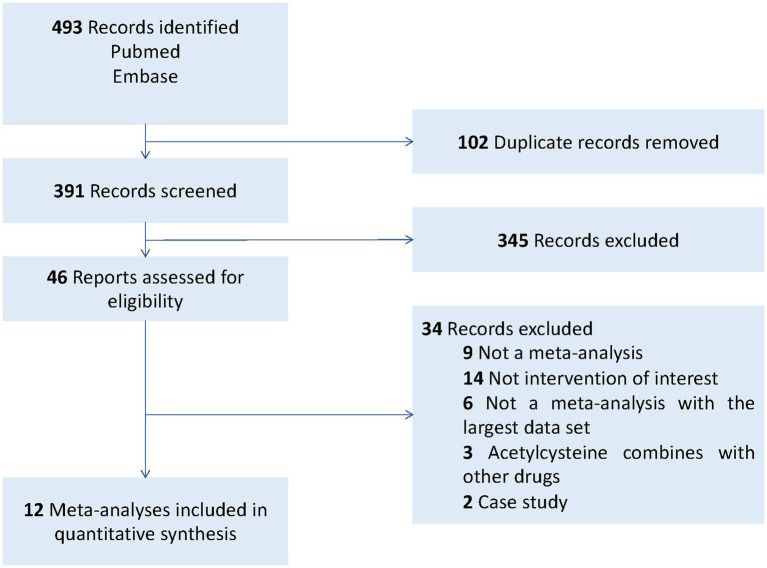
In total, 493 records were screened; of those, 46 full-text articles were assessed for eligibility, and 12 articles were selected for evidence synthesis as a result of the screening process. Based on the pooled data, which was graded as moderate-quality evidence, it can be concluded that NAC can decrease CIN (OR 0.72, 95% CI 0.65-0.79, < 0.00001) and blood levels of serum creatinine (MD -0.09, 95% CI -0.17 to -0.01, = 0.03). In spite of this, there were no associations between NAC and dialysis requirement or mortality in these studies.
The results of this umbrella review supported that the renal results were enhanced by NAC. The association was supported by moderate-quality evidence.
[https://clinicaltrials.gov/], identifier [CRD42022367811].
N-乙酰半胱氨酸(NAC)治疗造影剂肾病(CIN)的有效性一直是相互矛盾的荟萃分析的主题,但总体上尚未衡量NAC使用与CIN之间这些相关性的证据强度。
评估在荟萃分析中研究NAC使用与CIN之间关系的随机临床研究(RCT)数据。
在数据库创建至2023年4月期间,在PubMed、Cochrane图书馆、EMBASE和科学网进行了检索。检索关键词包括N-乙酰半胱氨酸、造影剂肾病或造影剂诱导的肾脏疾病,以及包括系统评价和荟萃分析在内的术语。使用多系统评价评估第2版对每个荟萃分析的科学质量分配极低、低、中或高质量等级,以评估每个荟萃分析。使用推荐分级、评估、制定和评价方法评估RCT荟萃分析中证据的可信度,证据被评为极低、低、中或高。
共筛选493条记录;其中,46篇全文文章被评估是否符合纳入标准,筛选过程后选择了12篇文章进行证据综合。基于汇总数据(被评为中等质量证据),可以得出结论,NAC可降低CIN(OR 0.72,95%CI 0.65-0.79,<0.00001)和血清肌酐血水平(MD -0.09,95%CI -0.17至-0.01,=0.03)。尽管如此,这些研究中NAC与透析需求或死亡率之间没有关联。
本伞状综述的结果支持NAC可改善肾脏结局。该关联得到中等质量证据的支持。