Costa Rafael M, Cerqueira Débora M, Bruder-Nascimento Ariane, Alves Juliano V, Awata Wanessa A C, Singh Shubhnita, Kufner Alexander, Cifuentes-Pagano Eugenia, Pagano Patrick J, Ho Jacqueline, Bruder-Nascimento Thiago
Department of Pediatrics at UPMC Children's Hospital of Pittsburgh, University of Pittsburgh, Pittsburgh, PA, USA.
Center for Pediatrics Research in Obesity and Metabolism (CPROM) at UPMC Children's Hospital of Pittsburgh, University of Pittsburgh, Pittsburgh, PA, USA.
bioRxiv. 2023 Sep 23:2023.09.22.558020. doi: 10.1101/2023.09.22.558020.
Aldosterone, a mineralocorticoid steroid hormone, has been described to initiate cardiovascular diseases by triggering exacerbated sterile vascular inflammation. The functions of C-C Motif Chemokine Ligand 5 (CCL5) and its receptor, C-C Motif Chemokine Receptor 5 (CCR5), are well known in infectious diseases, but their roles in the genesis of aldosterone-induced vascular injury and hypertension are unknown.
We analyzed the vascular profile, blood pressure, and renal damage in wild-type (CCR5) and CCR5 knockout (CCR5) mice treated with aldosterone (600 μg/kg/day for 14 days) while receiving 1% saline to drink.
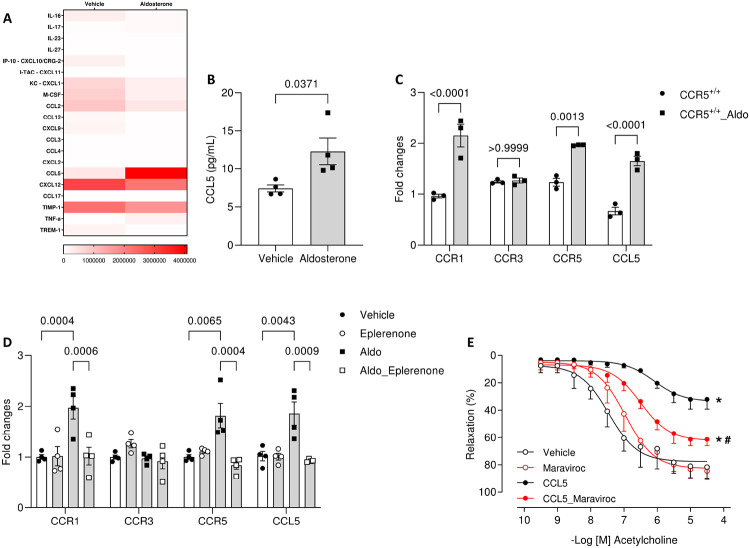
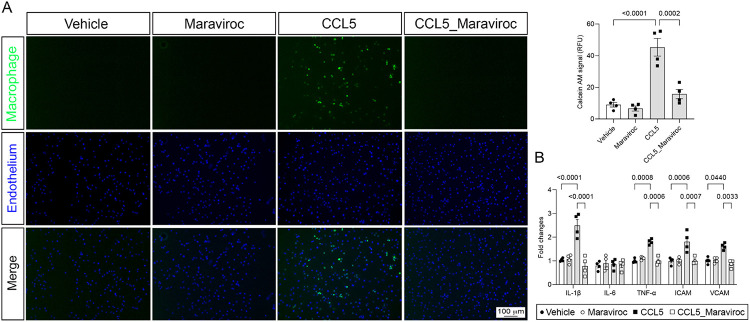
Here, we show that CCR5 plays a central role in aldosterone-induced vascular injury, hypertension, and renal damage. Long-term infusion of aldosterone in CCR5 mice resulted in exaggerated CCL5 circulating levels and vascular CCR5 expression. Aldosterone treatment also triggered vascular injury, characterized by endothelial dysfunction and inflammation, hypertension, and renal damage. Mice lacking CCR5 were protected from aldosterone-induced vascular damage, hypertension, and renal injury. Mechanistically, we demonstrated that CCL5 increased NADPH oxidase 1 (Nox1) expression, reactive oxygen species (ROS) formation, NFκB activation, and inflammation and reduced nitric oxide production in isolated endothelial cells. These effects were abolished by antagonizing CCR5 with Maraviroc. Finally, aortae incubated with CCL5 displayed severe endothelial dysfunction, which is prevented by blocking Nox1, NFκB, or with Maraviroc treatment.
Our data demonstrate that CCL5/CCR5, through activation of NFkB and Nox1, is critically involved in aldosterone-induced vascular and renal damage and hypertension. Our data place CCL5 and CCR5 as potential targets for therapeutic interventions in conditions with aldosterone excess.
醛固酮是一种盐皮质激素甾体激素,已被描述为通过引发加剧的无菌性血管炎症来引发心血管疾病。C-C基序趋化因子配体5(CCL5)及其受体C-C基序趋化因子受体5(CCR5)在传染病中的功能已为人熟知,但其在醛固酮诱导的血管损伤和高血压发生中的作用尚不清楚。
我们分析了用醛固酮(600μg/kg/天,持续14天)处理的野生型(CCR5)和CCR5基因敲除(CCR5)小鼠在饮用1%盐水时的血管情况、血压和肾脏损伤。
在此,我们表明CCR5在醛固酮诱导的血管损伤、高血压和肾脏损伤中起核心作用。在CCR5小鼠中长期输注醛固酮导致CCL5循环水平升高和血管CCR5表达增加。醛固酮治疗还引发了血管损伤,其特征为内皮功能障碍和炎症、高血压以及肾脏损伤。缺乏CCR5的小鼠免受醛固酮诱导的血管损伤、高血压和肾脏损伤。从机制上讲,我们证明CCL5增加了分离的内皮细胞中NADPH氧化酶1(Nox1)的表达、活性氧(ROS)的形成、NFκB的激活和炎症,并减少了一氧化氮的产生。用马拉维若拮抗CCR5可消除这些作用。最后,与CCL5一起孵育的主动脉显示出严重的内皮功能障碍,通过阻断Nox1、NFκB或用马拉维若治疗可预防这种情况。
我们的数据表明,CCL5/CCR5通过激活NFκB和Nox1,在醛固酮诱导的血管和肾脏损伤以及高血压中起关键作用。我们的数据将CCL5和CCR5定位为醛固酮过多情况下治疗干预的潜在靶点。