Sargurupremraj Muralidharan, Soumare Aicha, Bis Joshua C, Surakka Ida, Jurgenson Tuuli, Joly Pierre, Knol Maria J, Wang Ruiqi, Yang Qiong, Satizabal Claudia L, Gudjonsson Alexander, Mishra Aniket, Bouteloup Vincent, Phuah Chia-Ling, van Duijn Cornelia M, Cruchaga Carlos, Dufouil Carole, Chêne Geneviève, Lopez Oscar, Psaty Bruce M, Tzourio Christophe, Amouyel Philippe, Adams Hieab H, Jacqmin-Gadda Hélène, Ikram Mohammad Arfan, Gudnason Vilmundur, Milani Lili, Winsvold Bendik S, Hveem Kristian, Matthews Paul M, Longstreth W T, Seshadri Sudha, Launer Lenore J, Debette Stéphanie
University of Bordeaux, Inserm, Bordeaux Population Health Research Center, UMR 1219, Bordeaux, France.
Glenn Biggs Institute for Alzheimer's & Neurodegenerative Diseases, University of Texas Health Sciences Center, San Antonio, TX.
medRxiv. 2023 Aug 13:2023.08.08.23293761. doi: 10.1101/2023.08.08.23293761.
There is increasing recognition that vascular disease, which can be treated, is a key contributor to dementia risk. However, the contribution of specific markers of vascular disease is unclear and, as a consequence, optimal prevention strategies remain unclear.
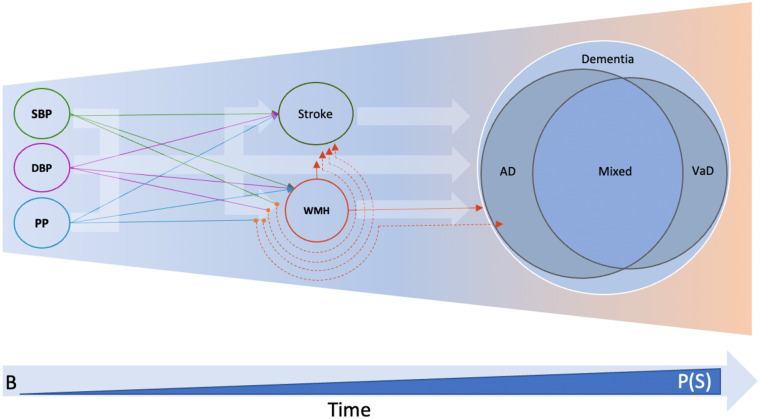
To disentangle the causal relation of several key vascular traits to dementia risk: (i) white matter hyperintensity (WMH) burden, a highly prevalent imaging marker of covert cerebral small vessel disease (cSVD); (ii) clinical stroke; and (iii) blood pressure (BP), the leading risk factor for cSVD and stroke, for which efficient therapies exist. To account for potential epidemiological biases inherent to late-onset conditions like dementia.
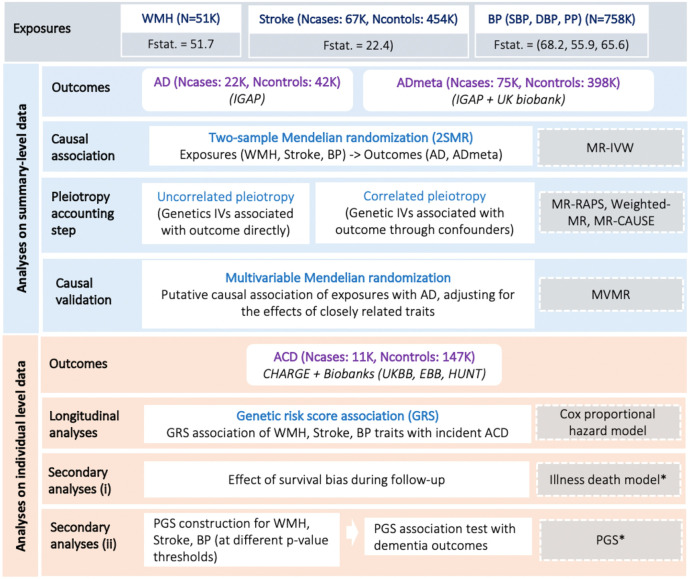
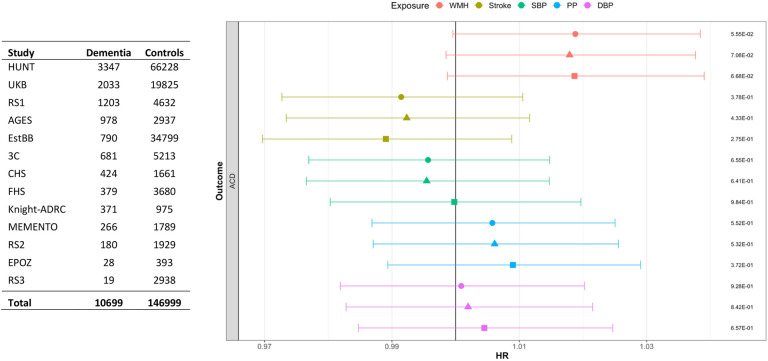
This study first explored the association of genetically determined WMH, BP levels and stroke risk with AD using summary-level data from large genome-wide association studies (GWASs) in a two-sample Mendelian randomization (MR) framework. Second, leveraging individual-level data from large longitudinal population-based cohorts and biobanks with prospective dementia surveillance, the association of weighted genetic risk scores (wGRSs) for WMH, BP, and stroke with incident all-cause-dementia was explored using Cox-proportional hazard and multi-state models. The data analysis was performed from July 26, 2020, through July 24, 2022.
Genetically determined levels of WMH volume and BP (systolic, diastolic and pulse blood pressures) and genetic liability to stroke.
The summary-level MR analyses focused on the outcomes from GWAS of clinically diagnosed AD (n-cases=21,982) and GWAS additionally including self-reported parental history of dementia as a proxy for AD diagnosis (AD, n-cases=53,042). For the longitudinal analyses, individual-level data of 157,698 participants with 10,699 incident all-cause-dementia were studied, exploring AD, vascular or mixed dementia in secondary analyses.
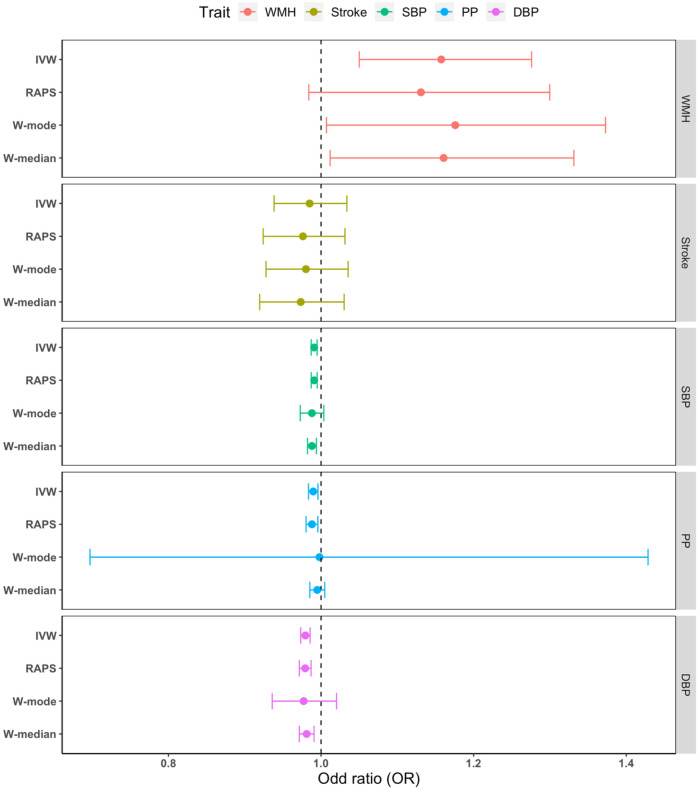
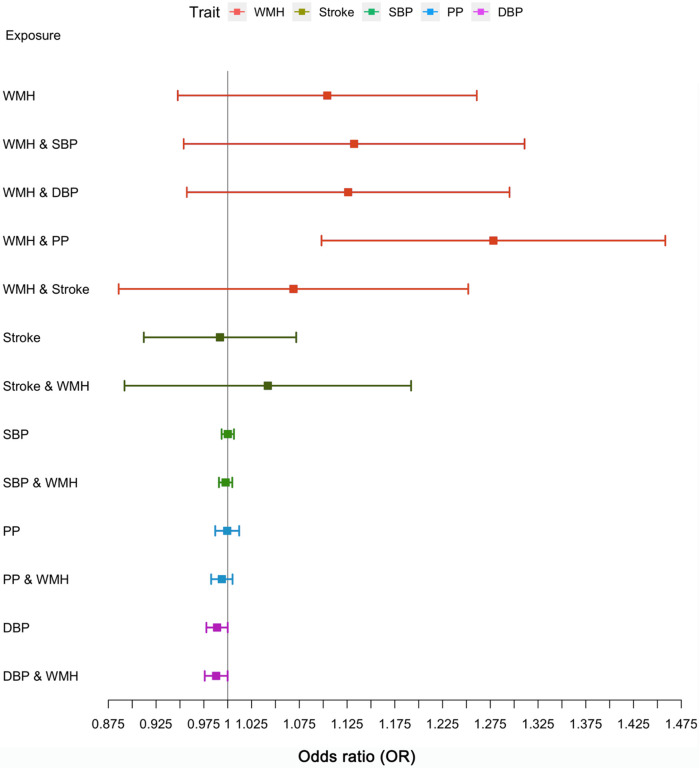
In the two-sample MR analyses, WMH showed strong evidence for a causal association with increased risk of AD (OR, 1.16; 95%CI:1.05-1.28; P=.003) and AD (OR, 1.28; 95%CI:1.07-1.53; P=.008), after accounting for genetically determined pulse pressure for the latter. Genetically predicted BP traits showed evidence for a protective association with both clinically defined AD and AD, with evidence for confounding by shared genetic instruments. In longitudinal analyses the wGRSs for WMH, but not BP or stroke, showed suggestive association with incident all-cause-dementia (HR, 1.02; 95%CI:1.00-1.04; P=.06). BP and stroke wGRSs were strongly associated with mortality but there was no evidence for selective survival bias during follow-up. In secondary analyses, polygenic scores with more liberal instrument definition showed association of both WMH and stroke with all-cause-dementia, AD, and vascular or mixed dementia; associations of stroke, but not WMH, with dementia outcomes were markedly attenuated after adjusting for interim stroke.
These findings provide converging evidence that WMH is a leading vascular contributor to dementia risk, which may better capture the brain damage caused by BP (and other etiologies) than BP itself and should be targeted in priority for dementia prevention in the population.
越来越多的人认识到,可治疗的血管疾病是痴呆风险的关键因素。然而,血管疾病特定标志物的作用尚不清楚,因此,最佳预防策略仍不明确。
理清几种关键血管特征与痴呆风险之间的因果关系:(i)白质高信号(WMH)负荷,一种隐匿性脑小血管疾病(cSVD)高度常见的影像学标志物;(ii)临床中风;(iii)血压(BP),cSVD和中风的主要危险因素,对此存在有效的治疗方法。以考虑痴呆等迟发性疾病固有的潜在流行病学偏倚。
设计、设置和参与者:本研究首先在两样本孟德尔随机化(MR)框架下,使用来自大型全基因组关联研究(GWAS)的汇总水平数据,探讨基因决定的WMH、血压水平和中风风险与阿尔茨海默病(AD)的关联。其次,利用来自大型纵向人群队列和生物样本库的个体水平数据以及前瞻性痴呆监测,使用Cox比例风险模型和多状态模型,探讨WMH、BP和中风的加权遗传风险评分(wGRS)与全因痴呆发病的关联。数据分析于2020年7月26日至2022年7月24日进行。
基因决定的WMH体积和BP水平(收缩压、舒张压和脉压)以及中风的遗传易感性。
汇总水平的MR分析重点关注临床诊断AD的GWAS结果(病例数=21,982)以及GWAS,后者还包括自我报告的痴呆家族史作为AD诊断的替代指标(AD,病例数=53,042)。对于纵向分析,研究了157,698名参与者的个体水平数据,其中有10,699例全因痴呆发病,在二次分析中探讨AD、血管性或混合性痴呆。
在两样本MR分析中,WMH显示出与AD风险增加存在因果关联的有力证据(比值比[OR],1.16;95%置信区间[CI]:1.05 - 1.28;P = 0.003)以及与AD存在因果关联的有力证据(OR,1.28;95%CI:1.07 - 1.53;P = 0.008),后者在考虑基因决定的脉压后得出。基因预测的BP特征显示出与临床定义的AD和AD均存在保护性关联的证据,存在共享遗传工具导致的混杂证据。在纵向分析中,WMH的wGRS显示出与全因痴呆发病存在提示性关联(风险比[HR],1.02;95%CI:1.00 - 1.04;P = 0.06),而BP和中风的wGRS则不然。BP和中风的wGRS与死亡率密切相关,但在随访期间没有选择性生存偏倚的证据。在二次分析中,采用更宽松工具定义的多基因评分显示WMH和中风与全因痴呆、AD以及血管性或混合性痴呆均存在关联;在调整中期中风后,中风与痴呆结局的关联(而非WMH与痴呆结局的关联)明显减弱。
这些发现提供了一致的证据,表明WMH是痴呆风险的主要血管因素,与BP本身相比,它可能更好地反映BP(以及其他病因)对脑损伤的影响,在人群痴呆预防中应优先针对WMH进行干预。