Bijsterbosch Janine D, Farahibozorg Seyedeh-Rezvan, Glasser Matthew F, Essen David Van, Snyder Lawrence H, Woolrich Mark W, Smith Stephen M
Department of Radiology, Washington University School of Medicine, Saint Louis, Missouri 63110, USA.
Wellcome Centre for Integrative Neuroimaging (WIN FMRIB), Oxford University, Oxford, United Kingdom.
bioRxiv. 2023 Sep 22:2023.09.21.558809. doi: 10.1101/2023.09.21.558809.
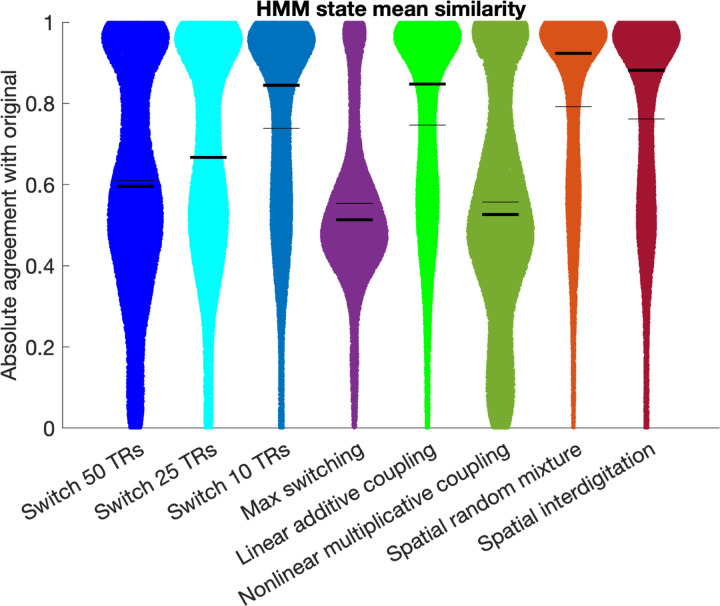
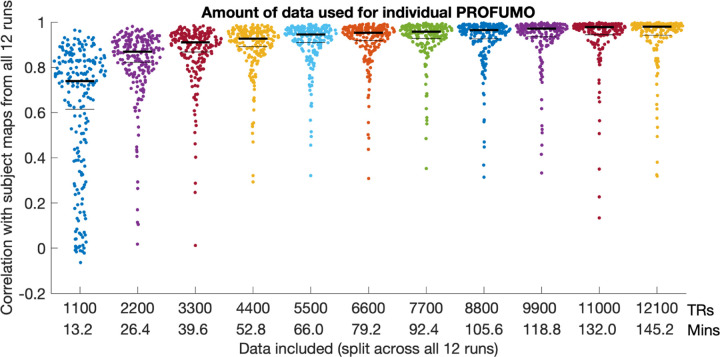
Individual differences in the spatial organization of resting state networks have received increased attention in recent years. Measures of individual-specific spatial organization of brain networks and overlapping network organization have been linked to important behavioral and clinical traits and are therefore potential biomarker targets for personalized psychiatry approaches. To better understand individual-specific spatial brain organization, this paper addressed three key goals. First, we determined whether it is possible to reliably estimate weighted (non-binarized) resting state network maps using data from only a single individual, while also maintaining maximum spatial correspondence across individuals. Second, we determined the degree of spatial overlap between distinct networks, using test-retest and twin data. Third, we systematically tested multiple hypotheses (spatial mixing, temporal switching, and coupling) as candidate explanations for why networks overlap spatially. To estimate weighted network organization, we adopt the Probabilistic Functional Modes (PROFUMO) algorithm, which implements a Bayesian framework with hemodynamic and connectivity priors to supplement optimization for spatial sparsity/independence. Our findings showed that replicable individual-specific estimates of weighted resting state networks can be derived using high quality fMRI data within individual subjects. Network organization estimates using only data from each individual subject closely resembled group-informed network estimates (which was not explicitly modeled in our individual-specific analyses), suggesting that cross-subject correspondence was largely maintained. Furthermore, our results confirmed the presence of spatial overlap in network organization, which was replicable across sessions within individuals and in monozygotic twin pairs. Intriguingly, our findings provide evidence that network overlap is indicative of linear additive coupling. These results suggest that regions of network overlap concurrently process information from all contributing networks, potentially pointing to the role of overlapping network organization in the integration of information across multiple brain systems.
近年来,静息态网络空间组织中的个体差异受到了越来越多的关注。脑网络个体特异性空间组织和重叠网络组织的测量方法已与重要的行为和临床特征相关联,因此是个性化精神病学方法潜在的生物标志物靶点。为了更好地理解个体特异性的空间脑组织结构,本文提出了三个关键目标。首先,我们确定仅使用单个个体的数据是否有可能可靠地估计加权(非二值化)静息态网络图谱,同时在个体间保持最大的空间对应性。其次,我们使用重测和双胞胎数据确定不同网络之间的空间重叠程度。第三,我们系统地测试了多个假设(空间混合、时间切换和耦合),作为网络在空间上重叠的候选解释。为了估计加权网络组织,我们采用概率功能模式(PROFUMO)算法,该算法实现了一个具有血流动力学和连接性先验的贝叶斯框架,以补充对空间稀疏性/独立性优化。我们的研究结果表明,使用个体受试者的高质量功能磁共振成像(fMRI)数据可以得出可重复的个体特异性加权静息态网络估计值。仅使用每个个体受试者的数据进行的网络组织估计与基于群体信息的网络估计非常相似(在我们的个体特异性分析中未明确建模),这表明在很大程度上保持了跨受试者的对应性。此外,我们的结果证实了网络组织中存在空间重叠,这在个体内的不同测试阶段以及同卵双胞胎对中都是可重复的。有趣的是,我们的研究结果提供了证据表明网络重叠指示线性加性耦合。这些结果表明,网络重叠区域同时处理来自所有贡献网络的信息,这可能表明重叠网络组织在跨多个脑系统的信息整合中的作用。