Weinstock Ruth S, Trief Paula M, Burke Brian K, Wen Hui, Liu Xun, Kalichman Seth, Anderson Barbara J, Bulger Jane D
Department of Medicine, State University of New York Upstate Medical University, Syracuse.
Department of Psychiatry and Behavioral Sciences, State University of New York Upstate Medical University, Syracuse.
JAMA Netw Open. 2023 Oct 2;6(10):e2336964. doi: 10.1001/jamanetworkopen.2023.36964.
Youth-onset type 2 diabetes is associated with early development of chronic complications. Treatment of elevated blood pressure (BP), nephropathy, and dyslipidemia are critical to reduce morbidity. Data are needed on adherence to BP- and lipid-lowering medications in young adults with youth-onset diabetes.
To assess adherence and factors associated with adherence to BP- and lipid-lowering medications in young adults with youth-onset type 2 diabetes and diagnoses of hypertension, nephropathy, or dyslipidemia.
DESIGN, SETTING, AND PARTICIPANTS: This cohort study measured medication adherence with 3 monthly unannounced pill counts at 2 time points 1 year apart during iCount, conducted during the last years (2017-2019) of the observational phase of the Treatment Options for Type 2 Diabetes in Adolescents and Youth study. Psychosocial factors associated with medication adherence were examined. Participants included individuals with youth-onset type 2 diabetes with hypertension, nephropathy, or dyslipidemia receiving diabetes care in their communities. Data were analyzed from September 2022 to September 2023.
The main outcome was BP- and lipid-lowering medication adherence, with low adherence defined as using less than 80% of pills and high adherence, at least 80% of pills. Psychosocial factors were measured using the Beliefs about Medicines Questionnaire and Material Needs Insecurities Survey.
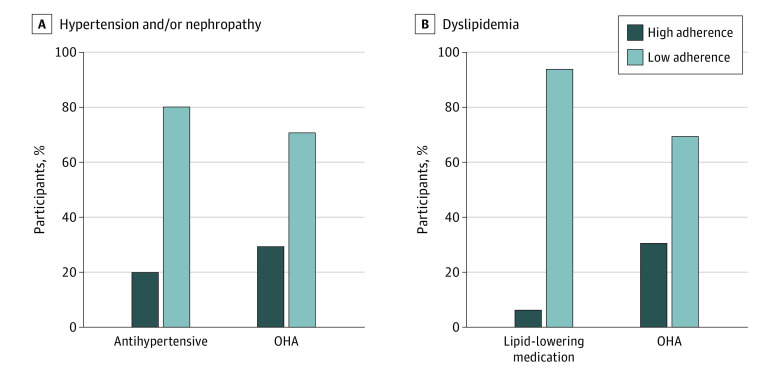
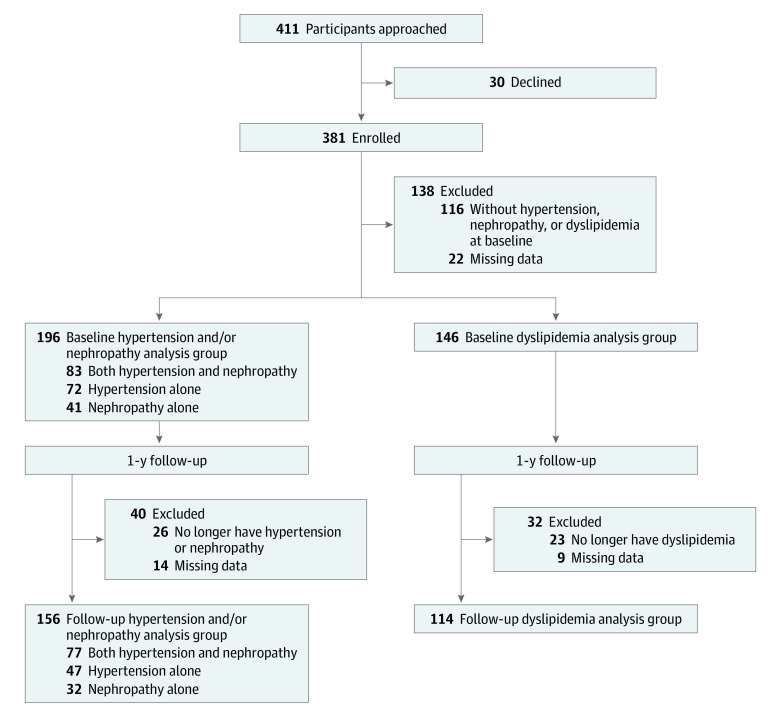
Of 381 participants in iCount, 243 participants (mean [SD] age, 26.12 [2.51] years; 159 [65.43%] women) with hypertension, nephropathy, or dyslipidemia were included in analysis. Among 196 participants with hypertension or nephropathy, 157 (80.1%) had low adherence. Participants with low adherence, compared with those with high adherence, were younger (mean [SD] age, 25.99 [2.41] vs 27.26 [2.41] years; P = .005), had higher glycated hemoglobin A1c (mean [SD], 10.33% [2.66 percentage points] vs 8.85% [2.39 percentage points]; P = .001), shorter diabetes duration (mean [SD], 12.32 [1.49] vs 12.90 [1.46] years; P = .03), and less education (eg, 17 participants [10.83%] vs 0 participants with no high school diploma; P = .004). Of 146 participants with dyslipidemia, 137 (93.8%) had low adherence and only 9 participants (6.2%) had high adherence. Of 103 participants with low adherence to BP-lowering medications and using oral hypoglycemic agents, 83 (80.58%) had low adherence to oral hypoglycemic agents. Beliefs that medications are necessary were higher for participants with high adherence to BP-lowering medications than those with low adherence in unadjusted analyses (mean [SD] necessity score, 16.87 [6.78] vs 13.89 [9.15]; P = .03). In adjusted multivariable analyses of participants with hypertension or nephropathy, having at least 1 unmet social need (odds ratio [OR], 0.20; 95% CI, 0.05-0.65; P = .04) and medication concerns (OR, 0.63; 95% CI, 0.40-0.96; P = .01) were associated with worse medication adherence 1 year follow-up. Diabetes distress, self-efficacy, depressive and anxiety symptoms, and self-management support were not associated with 1-year medication adherence.
These findings suggest that adherence to BP- and lipid-lowering medications was very poor in this cohort. To improve medication adherence and prevent early vascular events, approaches that identify and address medication concerns and unmet social needs are needed.
青年期2型糖尿病与慢性并发症的早期发生有关。治疗高血压、肾病和血脂异常对于降低发病率至关重要。需要有关青年期糖尿病患者对降压和降脂药物依从性的数据。
评估青年期2型糖尿病且患有高血压、肾病或血脂异常的年轻成年人对降压和降脂药物的依从性及相关因素。
设计、设置和参与者:这项队列研究在青少年和青年2型糖尿病治疗选择研究观察阶段的最后几年(2017 - 2019年)进行的iCount中,通过在相隔1年的2个时间点每月进行3次不预先通知的药丸计数来测量药物依从性。检查了与药物依从性相关的心理社会因素。参与者包括在社区接受糖尿病护理的患有青年期2型糖尿病且伴有高血压、肾病或血脂异常的个体。数据于2022年9月至2023年9月进行分析。
主要结局是降压和降脂药物依从性,低依从性定义为服用少于80%的药丸,高依从性定义为至少服用80%的药丸。使用药物信念问卷和物质需求不安全感调查来测量心理社会因素。
在iCount的381名参与者中,243名患有高血压、肾病或血脂异常的参与者(平均[标准差]年龄,26.12[2.51]岁;159名[65.43%]为女性)纳入分析。在196名患有高血压或肾病的参与者中,157名(80.1%)依从性低。与高依从性参与者相比,低依从性参与者更年轻(平均[标准差]年龄,25.99[2.41]岁对27.26[2.41]岁;P = 0.005),糖化血红蛋白A1c更高(平均[标准差],10.33%[2.66个百分点]对8.85%[2.39个百分点];P = 0.001),糖尿病病程更短(平均[标准差],12.32[1.49]年对12.90[1.46]年;P = 0.03),受教育程度更低(例如,17名参与者[10.83%]对0名没有高中文凭的参与者;P = 0.004)。在146名患有血脂异常的参与者中,137名(93.8%)依从性低,只有9名(6.2%)依从性高。在103名对降压药物依从性低且使用口服降糖药的参与者中,83名(80.58%)对口服降糖药依从性低。在未调整分析中,对降压药物高依从性的参与者比低依从性的参与者认为药物必要性更高(平均[标准差]必要性评分,16.87[6.78]对13.89[9.15];P = 0.03)。在对患有高血压或肾病的参与者进行的调整多变量分析中,至少有1项未满足的社会需求(比值比[OR],0.20;95%置信区间,0.05 - 0.65;P = 0.04)和药物顾虑(OR,0.63;95%置信区间,0.40 - 0.96;P = 0.01)与1年随访时较差的药物依从性相关。糖尿病困扰、自我效能感、抑郁和焦虑症状以及自我管理支持与1年药物依从性无关。
这些发现表明该队列中对降压和降脂药物的依从性非常差。为了提高药物依从性并预防早期血管事件,需要识别并解决药物顾虑和未满足的社会需求的方法。