Division of Neurosurgery, Department of Surgery, St Michael's Hospital, University of Toronto, Toronto, Ontario, Canada
Department of Neurointervention, Gold Coast University Hospital, Southport, Queensland, Australia.
J Neurointerv Surg. 2024 Mar 14;16(4):405-411. doi: 10.1136/jnis-2023-020161.
Robotic-assisted neurointervention was recently introduced, with implications that it could be used to treat neurovascular diseases.
To evaluate the effectiveness and safety of the robotic-assisted platform CorPath GRX for treating cerebral aneurysms.
This prospective, international, multicenter study enrolled patients with brain aneurysms that required endovascular coiling and/or stent-assisted coiling. The primary effectiveness endpoint was defined as successful completion of the robotic-assisted endovascular procedure without any unplanned conversion to manual treatment with guidewire or microcatheter navigation, embolization coil(s) or intracranial stent(s) deployment, or an inability to navigate vessel anatomy. The primary safety endpoint included intraprocedural and periprocedural events.
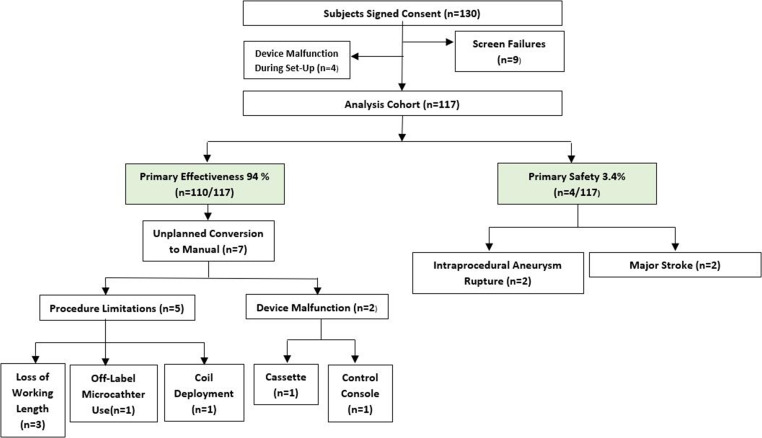
The study enrolled 117 patients (74.4% female) with mean age of 56.6 years from 10 international sites,. Headache was the most common presenting symptom in 40/117 (34.2%) subjects. Internal carotid artery was the most common location (34/122, 27.9%), and the mean aneurysm height and neck width were 5.7±2.6 mm and 3.5±1.4 mm, respectively. The overall procedure time was 117.3±47.3 min with 59.4±32.6 min robotic procedure time. Primary effectiveness was achieved in 110/117 (94%) subjects with seven subjects requiring conversion to manual for procedure completion. Only four primary safety events were recorded with two intraprocedural aneurysm ruptures and two strokes. A Raymond-Roy Classification Scale score of 1 was achieved in 71/110 (64.5%) subjects, and all subjects were discharged with a modified Rankin Scale score of ≤2.
This first-of-its-kind robotic-assisted neurovascular trial demonstrates the effectiveness and safety of the CorPath GRX System for endovascular embolization of cerebral aneurysm procedures.
NCT04236856.
机器人辅助神经介入技术最近被引入,其可能用于治疗神经血管疾病。
评估 CorPath GRX 机器人辅助平台治疗脑动脉瘤的有效性和安全性。
这是一项前瞻性、国际性、多中心研究,纳入了需要血管内线圈栓塞和/或支架辅助线圈栓塞治疗的脑动脉瘤患者。主要有效性终点定义为机器人辅助血管内手术成功完成,没有任何计划外转为手动治疗,包括导丝或微导管导航、栓塞线圈或颅内支架部署,或无法进行血管解剖导航。主要安全性终点包括手术过程中和围手术期事件。
研究纳入了来自 10 个国际中心的 117 名(74.4%为女性)平均年龄为 56.6 岁的患者。头痛是 40/117(34.2%)患者最常见的首发症状。颈内动脉是最常见的部位(34/122,27.9%),平均动脉瘤高度和颈部宽度分别为 5.7±2.6mm 和 3.5±1.4mm。总手术时间为 117.3±47.3 分钟,机器人手术时间为 59.4±32.6 分钟。主要有效性在 110/117(94%)名患者中实现,7 名患者需要转为手动完成手术。仅记录了 4 起主要安全性事件,包括 2 起术中动脉瘤破裂和 2 起卒中。71/110(64.5%)名患者达到 Raymond-Roy 分类量表 1 级,所有患者出院时改良 Rankin 量表评分≤2。
这是首例机器人辅助神经血管试验,证明了 CorPath GRX 系统在脑动脉瘤血管内栓塞治疗中的有效性和安全性。
NCT04236856。