Nguyen Ha Ngoc, Yamada Atsushi, Naka Shigeyuki, Mukaisho Ken-Ichi, Tani Tohru
Department of Advanced Medical Research and Development, Shiga University of Medical Science, Shiga, Japan.
Department of Urology, Faculty of Medicine, University of Medicine and Pharmacy at Ho Chi Minh City, Ho Chi Minh City, Vietnam.
Front Surg. 2023 Sep 19;10:1255929. doi: 10.3389/fsurg.2023.1255929. eCollection 2023.
To compare the usefulness and safety of off-clamp microwave scissors-based sutureless partial nephrectomy (MSPN) with on-clamp conventional partial nephrectomy (cPN) in dogs.
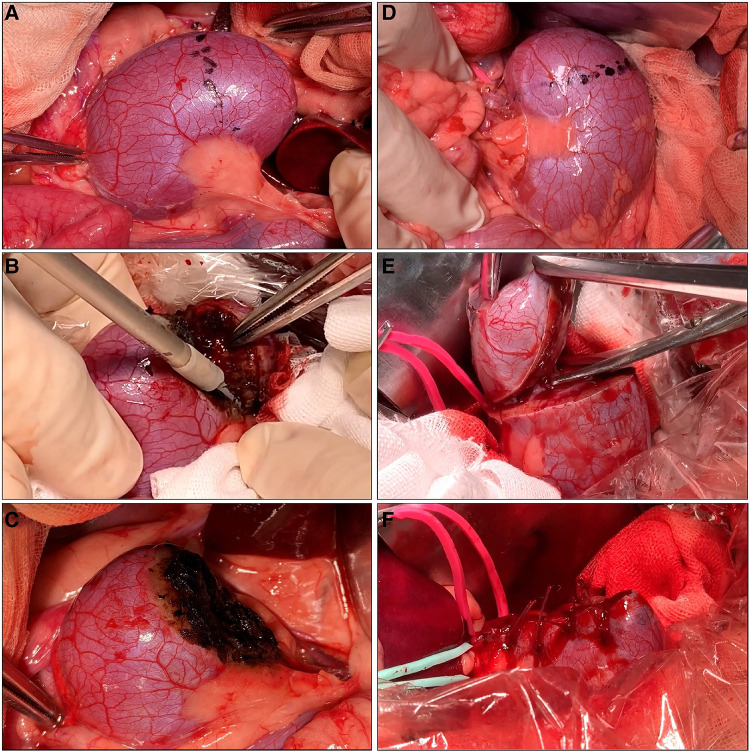
We performed off-clamp MSPN using microwave scissors (MWS) in six dogs, and on-clamp cPN in three dogs, in two-stage experiments. The bilateral kidney upper poles were resected via a midline incision under general anesthesia. After 14 days of follow-up, the lower pole resections were performed. The renal calyces exposed during renal resections were sealed and transected using MWS in off-clamp MSPN and were sutured in on-clamp cPN. In the off-clamp MSPN group, the generator's power output of MWS was set as either 50 W or 60 W for each kidney side. We compared the procedure time (PT), ischemic time (IT), blood loss (BL), and normal nephron loss (NNL) between the two techniques using the Mann-Whitney -test.
We successfully performed 24 off-clamp MSPNs and 12 on-clamp cPNs. The off-clamp MSPN was significantly superior to on-clamp cPN in avoiding renal ischemia (median IT, 0 min vs. 8.6 min, < 0.001) and reducing PT (median PT, 5.8 min vs. 11.5 min, < 0.001) and NNL (median NNL, 5.3 mm vs. 6.0 mm, = 0.006) with comparable BL (median BL, 20.9 ml vs. 23.2 ml, = 0.804). No bleeding and major urine leakage were noted during the reoperations.
Off-clamp MSPN outperforms on-clamp cPN in lowering the risks of postoperative renal function impairment in dogs.
比较犬类中基于微波剪刀的无夹闭缝合法部分肾切除术(MSPN)与有夹闭传统部分肾切除术(cPN)的有效性和安全性。
我们在两阶段实验中,对6只犬实施了使用微波剪刀(MWS)的无夹闭MSPN,对3只犬实施了有夹闭cPN。在全身麻醉下通过中线切口切除双侧肾上极。随访14天后,进行下极切除。在无夹闭MSPN中,使用MWS对肾切除术中暴露的肾盏进行密封和横断,在有夹闭cPN中则进行缝合。在无夹闭MSPN组中,MWS发生器的功率输出针对每侧肾脏设定为50W或60W。我们使用Mann-Whitney检验比较了两种技术之间的手术时间(PT)、缺血时间(IT)、失血量(BL)和正常肾单位损失(NNL)。
我们成功实施了24例无夹闭MSPN和12例有夹闭cPN。在避免肾缺血(中位IT,0分钟对8.6分钟,<0.001)、缩短PT(中位PT,5.8分钟对11.5分钟,<0.001)和减少NNL(中位NNL,5.3毫米对6.0毫米,=0.006)方面,无夹闭MSPN明显优于有夹闭cPN,而BL相当(中位BL,20.9毫升对23.2毫升,=0.804)。再次手术期间未发现出血和严重尿液渗漏。
在降低犬类术后肾功能损害风险方面,无夹闭MSPN优于有夹闭cPN。