
阿齐沙坦通过抑制巨噬细胞中 TNF-α 的表达抑制炎症触发的骨吸收和破骨细胞生成。
Azilsartan inhibits inflammation-triggered bone resorption and osteoclastogenesis via suppression of TNF-α expression in macrophages.
机构信息
Division of Orthodontics and Dentofacial Orthopedics, Tohoku University Graduate School of Dentistry, Sendai, Miyagi, Japan.
Frontier Research Institute for Interdisciplinary Sciences, Tohoku University, Sendai, Miyagi, Japan.
出版信息
Front Endocrinol (Lausanne). 2023 Sep 15;14:1207502. doi: 10.3389/fendo.2023.1207502. eCollection 2023.
INTRODUCTION
Hypertension is a major risk factor for cardiovascular disease (CVD) and is associated with increased bone loss due to excessive activity of the local renin-angiotensin system (RAS). Angiotensinogen/Angiotensin (ANG) II/Angiotensin II type 1 receptor (AT1R) axis is considered as the core axis regulating RAS activity. Azilsartan is an FDA-approved selective AT1R antagonist that is used to treat hypertension. This study aimed to determine whether azilsartan affects formation of osteoclast, resorption of bone, and the expression of cytokines linked with osteoclastogenesis during lipopolysaccharide (LPS)-triggered inflammation .
METHODS
, following a 5-day supracalvarial injection of LPS or tumor necrosis factor-alpha (TNF-α) with or without azilsartan, the proportion of bone resorption and the number of tartrate-resistant acid phosphatase (TRAP)-positive multinucleated cells, which are identified as osteoclasts on mice calvariae were counted. The mRNA expression levels of TRAP, cathepsin K, receptor activator of NF-κB ligand (RANKL), and TNF-α were also evaluated. , the effect of azilsartan (0, 0.01, 0.1, 1, and 10 μM) on RANKL and TNF-α-triggered osteoclastogenesis were investigated. Also, whether azilsartan restrains LPS-triggered TNF-α mRNA and protein expression in macrophages and RANKL expression in osteoblasts were assessed. Furthermore, western blotting for analysis of mitogen-activated protein kinases (MAPKs) signaling was conducted.
RESULTS
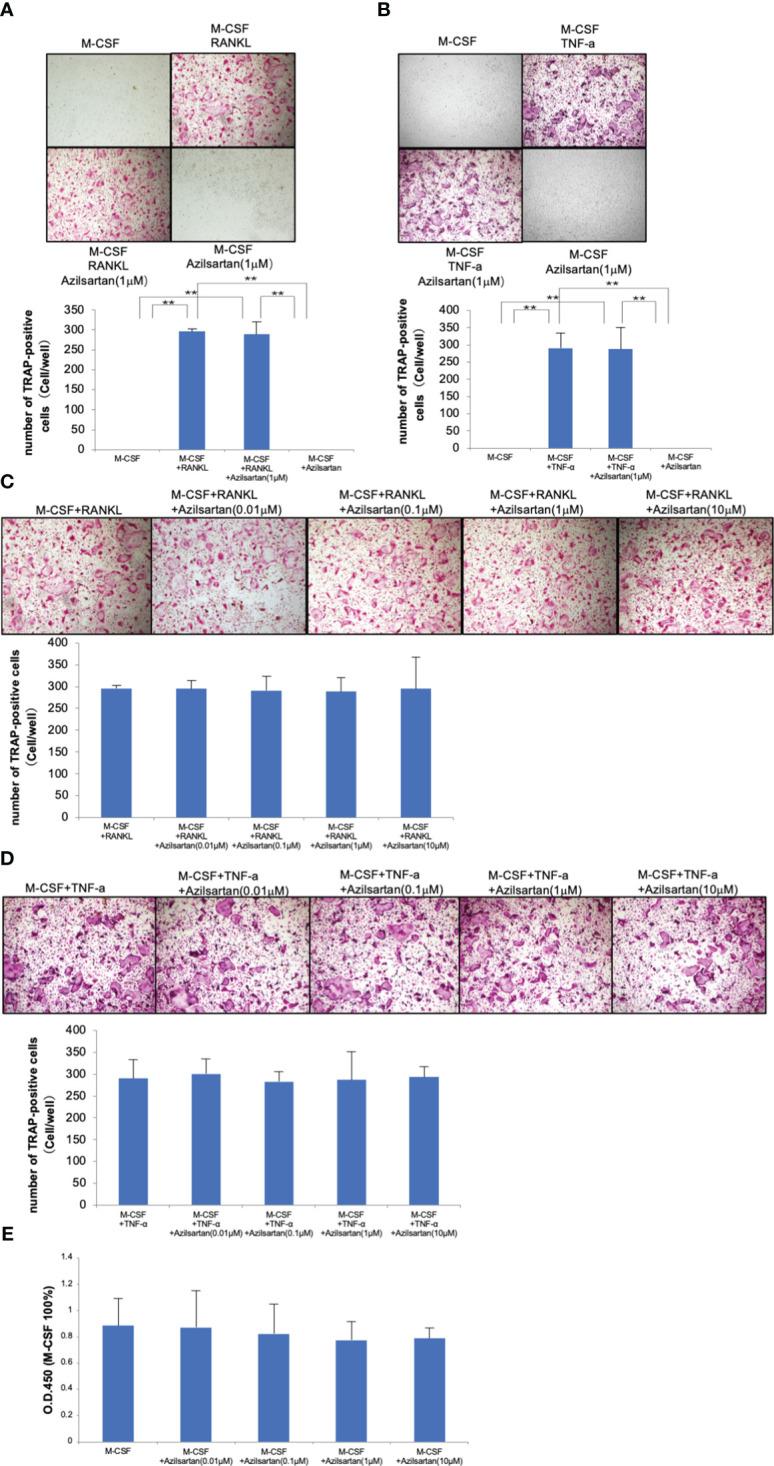
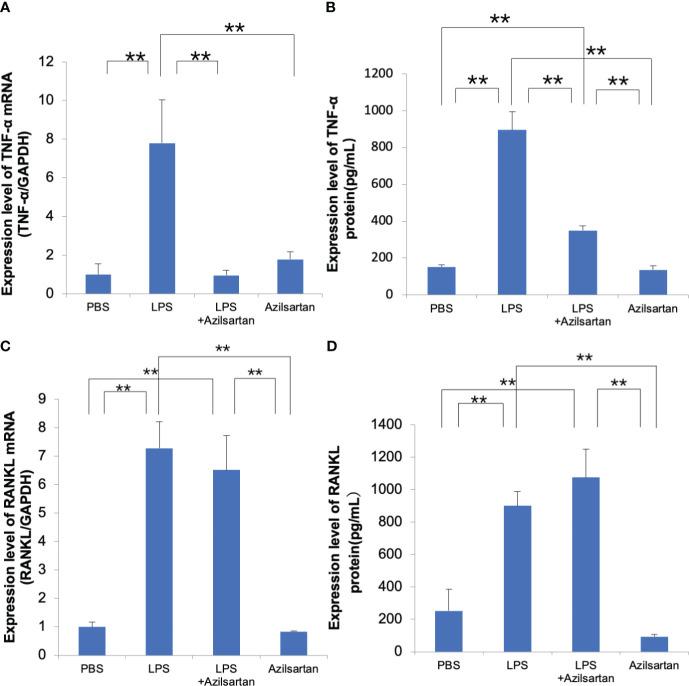
Azilsartan-treated calvariae exhibited significantly lower bone resorption and osteoclastogenesis than those treated with LPS alone. , LPS with azilsartan administration resulted in lower levels of receptor activator of RANKL and TNF-α mRNA expression than LPS administration alone. Nevertheless, azilsartan did not show inhibitory effect on RANKL- and TNF-α-triggered osteoclastogenesis . Compared to macrophages treated with LPS, TNF-α mRNA and protein levels were lower in macrophages treated by LPS with azilsartan. In contrast, RANKL mRNA and protein expression levels in osteoblasts were the same in cells co-treated with azilsartan and LPS and those exposed to LPS only. Furthermore, azilsartan suppressed LPS-triggered MAPKs signaling pathway in macrophages. After 5-day supracalvarial injection, there is no difference between TNF-α injection group and TNF-α with azilsartan injection group.
CONCLUSION
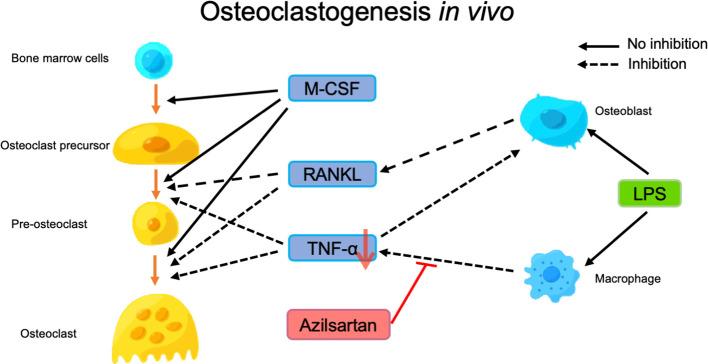
These findings imply that azilsartan prevents LPS-triggered TNF-α production in macrophages, which in turn prevents LPS-Triggered osteoclast formation and bone resorption .
简介
高血压是心血管疾病(CVD)的一个主要危险因素,由于局部肾素-血管紧张素系统(RAS)过度活跃,与骨丢失增加有关。血管紧张素原/血管紧张素(ANG)II/血管紧张素 II 型 1 受体(AT1R)轴被认为是调节 RAS 活性的核心轴。阿齐沙坦是一种获得 FDA 批准的选择性 AT1R 拮抗剂,用于治疗高血压。本研究旨在确定阿齐沙坦是否影响脂多糖(LPS)触发炎症期间破骨细胞的形成、骨吸收以及与破骨细胞形成相关的细胞因子的表达。
方法
在小鼠颅骨上进行为期 5 天的颅上侧注射 LPS 或肿瘤坏死因子-α(TNF-α),并加入或不加入阿齐沙坦,计算破骨细胞的骨吸收比例和抗酒石酸酸性磷酸酶(TRAP)阳性多核细胞的数量,这些细胞在小鼠颅骨上被鉴定为破骨细胞。还评估了 TRAP、组织蛋白酶 K、核因子-κB 配体(RANKL)和 TNF-α的 mRNA 表达水平。研究了阿齐沙坦(0、0.01、0.1、1 和 10 μM)对 RANKL 和 TNF-α触发的破骨细胞形成的影响。此外,还评估了阿齐沙坦是否抑制 LPS 触发的巨噬细胞中 TNF-α mRNA 和蛋白表达以及成骨细胞中 RANKL 表达。此外,还进行了丝裂原激活蛋白激酶(MAPKs)信号通路的 Western 印迹分析。
结果
用阿齐沙坦治疗的颅骨表现出比单独用 LPS 治疗的颅骨更低的骨吸收和破骨细胞形成。用 LPS 加阿齐沙坦治疗导致的 RANKL 和 TNF-α mRNA 表达水平低于单独用 LPS 治疗。然而,阿齐沙坦对 RANKL 和 TNF-α 触发的破骨细胞形成没有抑制作用。与用 LPS 处理的巨噬细胞相比,用 LPS 加阿齐沙坦处理的巨噬细胞中 TNF-α mRNA 和蛋白水平较低。相反,用 LPS 加阿齐沙坦处理的成骨细胞中 RANKL mRNA 和蛋白表达水平与仅用 LPS 处理的细胞相同。此外,阿齐沙坦抑制了 LPS 触发的巨噬细胞中的 MAPKs 信号通路。在进行 5 天的颅上侧注射后,TNF-α 注射组与 TNF-α 加阿齐沙坦注射组之间没有差异。
结论
这些发现表明,阿齐沙坦可预防 LPS 触发的巨噬细胞中 TNF-α 的产生,从而防止 LPS 触发的破骨细胞形成和骨吸收。




 Zotero 插件