Gynecological Endocrinology Unit, Division of Endocrinology, Hospital de Clínicas de Porto Alegre, Porto Alegre, Rio Grande do Sul, Brazil.
Postgraduate Program in Endocrinology, Medicine School, Universidade Federal do Rio Grande do Sul, Porto Alegre, Rio Grande do Sul, Brazil.
PLoS One. 2023 Oct 5;18(10):e0292623. doi: 10.1371/journal.pone.0292623. eCollection 2023.
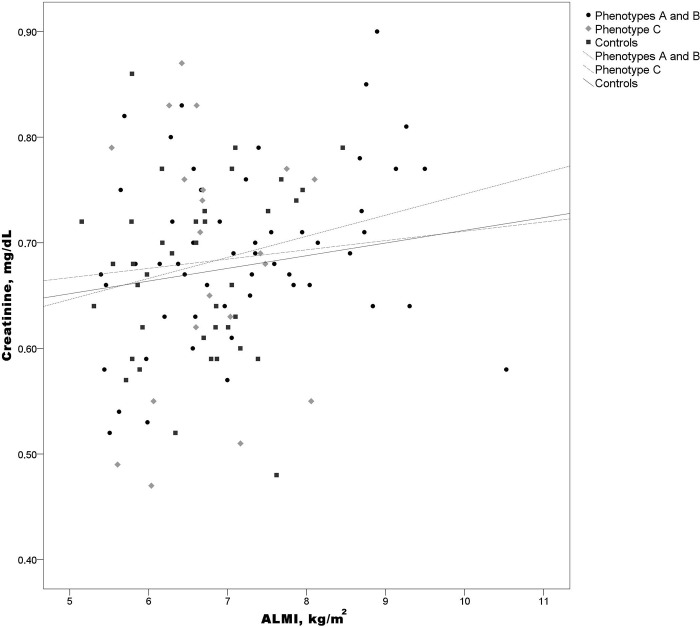
Although current evidence suggests increased risk of obesity, insulin resistance, and metabolic alterations in patients with polycystic ovary syndrome (PCOS), especially of a hyperandrogenic phenotype, the impact of each one of these variables on muscle mass remains uncertain. In this case-control study, we evaluated clinical and hormonal characteristics related to lean body mass according to the different PCOS phenotypes. We performed clinical, metabolic, and hormonal assessments and evaluated body compartments by dual-energy X-ray absorptiometry in 133 women of reproductive age. Creatinine served as an indirect marker of lean mass. Median age was 28 (range, 17-37) years. Women with phenotypes A and B (n = 59) had higher body mass index (BMI) and metabolic syndrome prevalence than those with phenotype C (n = 23) and controls (n = 51) (p<0.005). Women with phenotypes A and B also had higher Ferriman-Gallwey score (p<0.001), insulin levels (p = 0.006), HOMA-IR (p = 0.008), testosterone (p = 0.008), free androgen index (FAI) (p<0.001), fat mass index (FMI) (p = 0.015), android-to-gynoid fat ratio (p = 0.036), and bone mineral density (BMD) at lumbar spine (p = 0.027) and total femur (p = 0.013) than controls. Median appendicular lean mass index (ALMI) was higher in phenotypes A and B than in controls (7.01 [IQR, 6.33-8.02] vs. 6.69 [IQR, 5.94-7.09], p = 0.024), but it did not differ significantly from that in phenotype C (6.60 [IQR, 6.16-7.22], p = 0.222). Even after adjusting for BMI, ALMI correlated positively with creatinine in women with phenotypes A and B (rho = 0.319, p = 0.023) but not in those with phenotype C (p = 0.238) or controls (p = 0.097). In multivariate linear regression analyses, ALMI was positively associated with insulin, FAI, FMI, and total femur BMD. The present results suggest that fasting insulin, FAI, fat mass, and total femur BMD were positively associated with increased lean mass in women with PCOS phenotypes A and B.
虽然目前的证据表明多囊卵巢综合征(PCOS)患者,尤其是高雄激素表型患者,存在肥胖、胰岛素抵抗和代谢改变的风险,但这些变量对肌肉质量的影响仍不确定。在这项病例对照研究中,我们根据不同的 PCOS 表型评估了与瘦体重相关的临床和激素特征。我们对 133 名育龄妇女进行了临床、代谢和激素评估,并通过双能 X 射线吸收法评估了身体成分。肌酐作为瘦体重的间接标志物。中位年龄为 28 岁(范围,17-37 岁)。表型 A 和 B(n=59)的女性体重指数(BMI)和代谢综合征患病率高于表型 C(n=23)和对照组(n=51)(p<0.005)。表型 A 和 B 的女性也有更高的 Ferriman-Gallwey 评分(p<0.001)、胰岛素水平(p=0.006)、HOMA-IR(p=0.008)、睾酮(p=0.008)、游离雄激素指数(FAI)(p<0.001)、脂肪质量指数(FMI)(p=0.015)、男性型脂肪比例(p=0.036)以及腰椎(p=0.027)和全股骨(p=0.013)的骨密度。表型 A 和 B 的四肢瘦体重指数(ALMI)中位数高于对照组(7.01[IQR,6.33-8.02]比 6.69[IQR,5.94-7.09],p=0.024),但与表型 C 差异无统计学意义(6.60[IQR,6.16-7.22],p=0.222)。即使在校正 BMI 后,表型 A 和 B 的女性的 ALMI 与肌酐呈正相关(rho=0.319,p=0.023),但表型 C 或对照组(p=0.238)无相关性(p=0.097)。在多元线性回归分析中,ALMI 与胰岛素、FAI、FMI 和全股骨骨密度呈正相关。本研究结果提示,PCOS 表型 A 和 B 的女性空腹胰岛素、FAI、脂肪量和全股骨骨密度与瘦体重增加呈正相关。