Department of Life Sciences, University of Bath, Claverton Down, Bath BA2 7AY, U.K.
Department of Chemical & Biological Engineering, Colorado School of Mines, Golden, Colorado 80401, United States.
Mol Pharm. 2023 Nov 6;20(11):5910-5920. doi: 10.1021/acs.molpharmaceut.3c00755. Epub 2023 Oct 6.
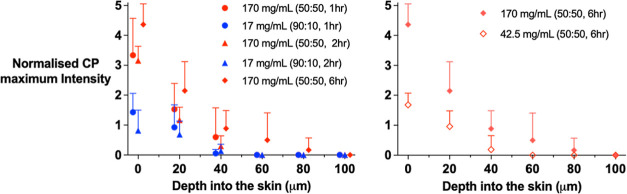
Confocal Raman spectroscopy is being assessed as a tool with which to quantify the rate and extent of drug uptake to and its clearance from target sites of action within the viable epidermis below the skin's stratum corneum (SC) barrier. The objective of this research was to confirm that Raman can interrogate drug disposition within the living layers of the skin (where many topical drugs elicit their pharmacological effects) and to identify procedures by which Raman signal attenuation with increasing skin depth may be corrected and normalized so that metrics descriptive of topical bioavailability may be identified. It was first shown in experiments on skin cross-sections parallel to the skin surface that the amide I signal, originating primarily from keratin, was quite constant with depth into the skin and could be used to correct for signal attenuation when confocal Raman data were acquired in a "top-down" fashion. Then, using 4-cyanophenol (CP) as a model skin penetrant with a strong Raman-active C≡N functionality, a series of uptake and clearance experiments, performed as a function of time, demonstrated clearly that normalized spectroscopic data were able to detect the penetrant to at least 40-80 μm into the skin and to distinguish the disposition of CP from different vehicles. Metrics related to local bioavailability (and potentially bioequivalence) included areas under the normalized C≡N signal versus depth profiles and elimination rate constants deduced post-removal of the formulations. Finally, Raman measurements were made with an approved dermatological drug, crisaborole, for which delivery from a fully saturated formulation into the skin layers just below the SC was detectable.
共聚焦拉曼光谱正在被评估为一种工具,用于定量测量药物在皮肤角质层(SC)屏障下的作用靶点内的摄取速度和程度及其清除率。本研究的目的是确认拉曼可以检测到皮肤活层(许多局部药物在该处发挥其药理作用)内的药物分布情况,并确定可以校正和归一化拉曼信号随皮肤深度增加而衰减的程序,以便确定描述局部生物利用度的指标。首先,在与皮肤表面平行的皮肤横截面上进行的实验中表明,酰胺 I 信号主要来源于角蛋白,其在皮肤深度范围内非常稳定,可以用于校正共聚焦拉曼数据以“自上而下”方式采集时的信号衰减。然后,使用 4-氰基苯酚(CP)作为具有强拉曼活性 C≡N 官能团的模型皮肤渗透剂,进行了一系列随时间变化的摄取和清除实验,清楚地表明,归一化光谱数据能够检测到渗透剂至少进入皮肤 40-80μm 深度,并能够区分 CP 从不同载体的分布。与局部生物利用度(和潜在的生物等效性)相关的指标包括归一化 C≡N 信号与深度分布曲线下的面积以及从制剂去除后推断出的消除速率常数。最后,对一种已批准的皮肤科药物克立硼罗(crisaborole)进行了拉曼测量,该药物从完全饱和的制剂递送到 SC 下方的皮肤层是可检测的。