
基于人工智能的犬类胸部X光片诊断黏液瘤性二尖瓣疾病严重程度方法的开发。
Development of an artificial intelligence-based method for the diagnosis of the severity of myxomatous mitral valve disease from canine chest radiographs.
作者信息
Valente Carlotta, Wodzinski Marek, Guglielmini Carlo, Poser Helen, Chiavegato David, Zotti Alessandro, Venturini Roberto, Banzato Tommaso
机构信息
Department of Animal Medicine, Production and Health, University of Padua, Padua, Italy.
Department of Measurement and Electronics, AGH University of Science and Technology, Krakow, Poland.
出版信息
Front Vet Sci. 2023 Sep 22;10:1227009. doi: 10.3389/fvets.2023.1227009. eCollection 2023.
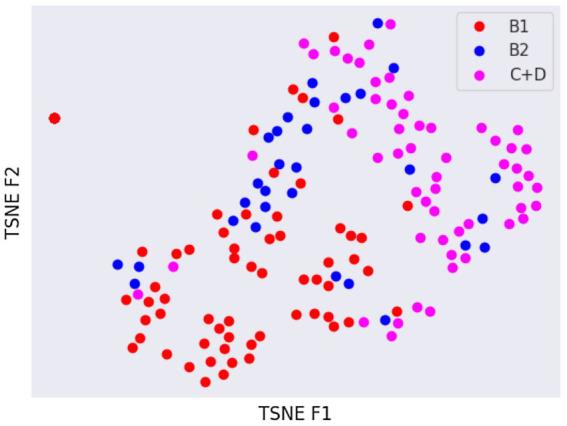
An algorithm based on artificial intelligence (AI) was developed and tested to classify different stages of myxomatous mitral valve disease (MMVD) from canine thoracic radiographs. The radiographs were selected from the medical databases of two different institutions, considering dogs over 6 years of age that had undergone chest X-ray and echocardiographic examination. Only radiographs clearly showing the cardiac silhouette were considered. The convolutional neural network (CNN) was trained on both the right and left lateral and/or ventro-dorsal or dorso-ventral views. Each dog was classified according to the American College of Veterinary Internal Medicine (ACVIM) guidelines as stage B1, B2 or C + D. ResNet18 CNN was used as a classification network, and the results were evaluated using confusion matrices, receiver operating characteristic curves, and t-SNE and UMAP projections. The area under the curve (AUC) showed good heart-CNN performance in determining the MMVD stage from the lateral views with an AUC of 0.87, 0.77, and 0.88 for stages B1, B2, and C + D, respectively. The high accuracy of the algorithm in predicting the MMVD stage suggests that it could stand as a useful support tool in the interpretation of canine thoracic radiographs.
开发并测试了一种基于人工智能(AI)的算法,用于从犬胸部X光片中对黏液瘤性二尖瓣疾病(MMVD)的不同阶段进行分类。这些X光片选自两个不同机构的医学数据库,选取的是年龄超过6岁且已接受胸部X光和超声心动图检查的犬只。仅考虑清晰显示心脏轮廓的X光片。卷积神经网络(CNN)在右侧和左侧侧位及/或腹背位或背腹位视图上进行训练。每只犬根据美国兽医内科学会(ACVIM)指南被分类为B1、B2或C+D阶段。使用ResNet18 CNN作为分类网络,并使用混淆矩阵、受试者工作特征曲线以及t-SNE和UMAP投影对结果进行评估。曲线下面积(AUC)显示,从侧位视图确定MMVD阶段时,心脏-CNN表现良好,B1、B2和C+D阶段的AUC分别为0.87、0.77和0.88。该算法在预测MMVD阶段方面的高准确性表明,它可以作为解释犬胸部X光片的有用辅助工具。


 Zotero 插件