Chiñas Marcos, Fernandez-Salinas Daniela, Aguiar Vitor R C, Nieto-Caballero Victor E, Lefton Micah, Nigrovic Peter A, Ermann Joerg, Gutierrez-Arcelus Maria
Division of Immunology, Boston Children's Hospital, Boston, MA, USA.
Program in Medical and Population Genetics, Broad Institute of Harvard and MIT, Cambridge, MA, USA.
medRxiv. 2024 May 9:2023.09.21.23295912. doi: 10.1101/2023.09.21.23295912.
Multiple lines of evidence indicate that ankylosing spondylitis (AS) is a lymphocyte-driven disease. However, which lymphocyte populations are critical in AS pathogenesis is not known. In this study, we aimed to identify the key cell types mediating the genetic risk in AS using an unbiased functional genomics approach.
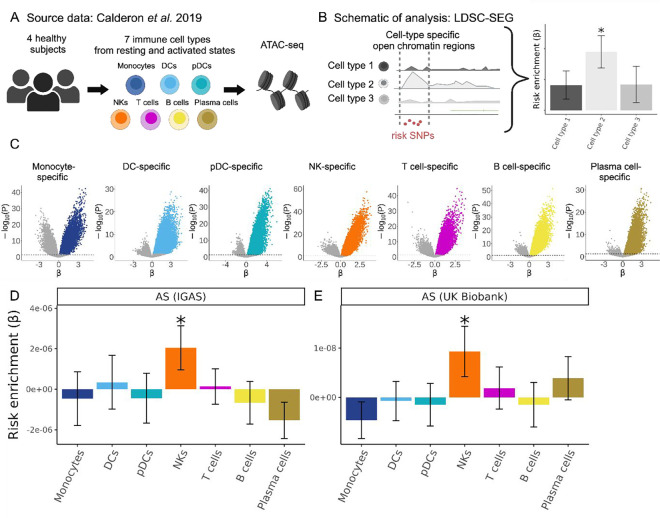
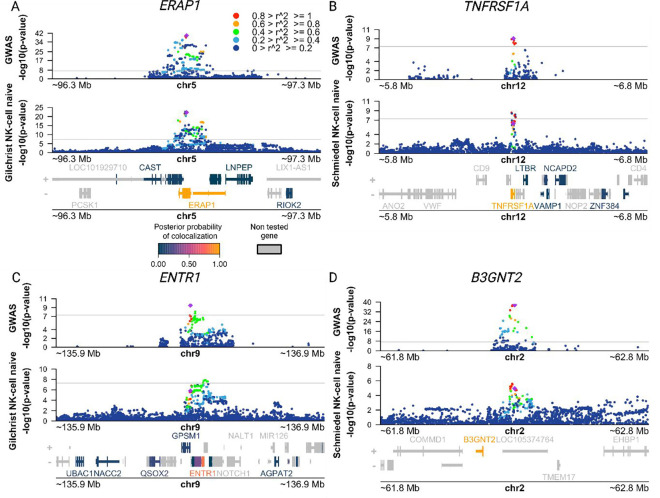
We integrated genome-wide association study (GWAS) data with epigenomic and transcriptomic datasets of human immune cells. To quantify enrichment of cell type-specific open chromatin or gene expression in AS risk loci, we used three published methods that have successfully identified relevant cell types in other diseases. We performed co-localization analyses between GWAS risk loci and genetic variants associated with gene expression (eQTL) to find putative target genes.
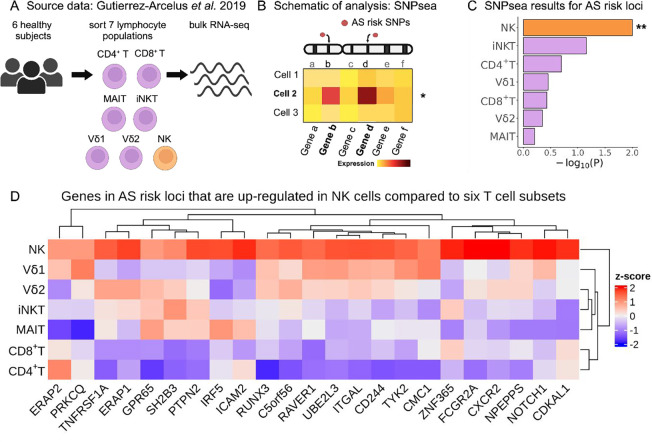
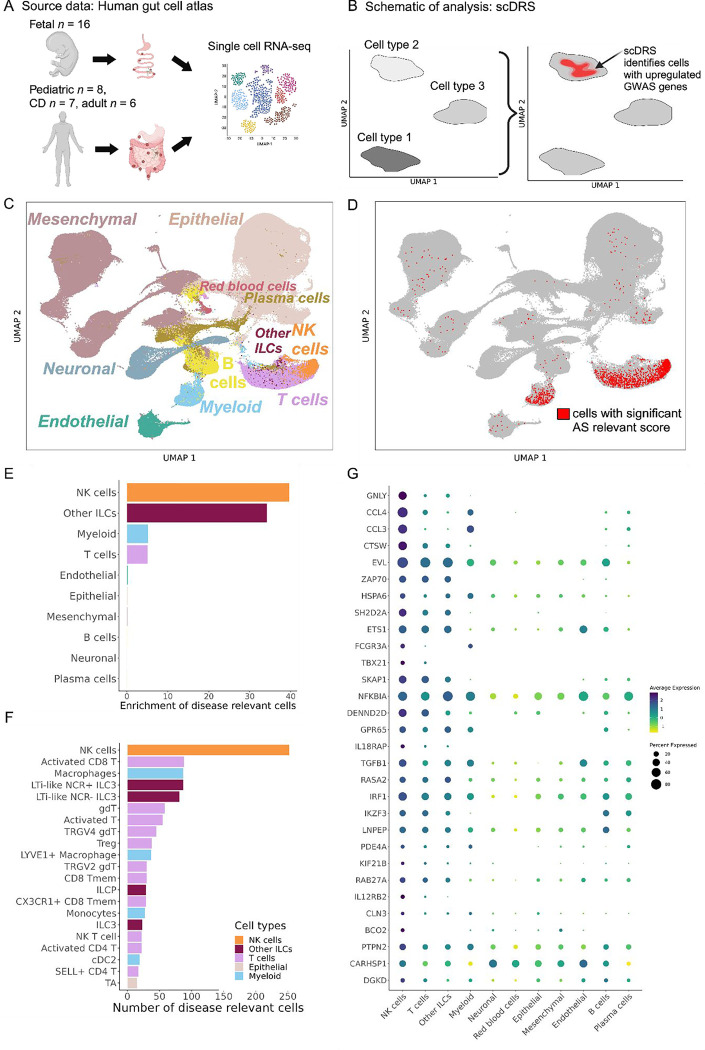
Natural killer (NK) cell-specific open chromatin regions are significantly enriched in heritability for AS, compared to other immune cell types such as T cells, B cells, and monocytes. This finding was consistent between two AS GWAS. Using RNA-seq data, we validated that genes in AS risk loci are enriched in NK cell-specific gene expression. Using the human Space-Time Gut Cell Atlas, we also found significant upregulation of AS-associated genes predominantly in NK cells. Co-localization analysis revealed four AS risk loci affecting regulation of candidate target genes in NK cells: two known loci, , and two under-studied loci, (aka ) and .
Our findings suggest that NK cells may play a crucial role in AS development and highlight four putative target genes for functional follow-up in NK cells.
多项证据表明强直性脊柱炎(AS)是一种由淋巴细胞驱动的疾病。然而,尚不清楚哪些淋巴细胞亚群在AS发病机制中起关键作用。在本研究中,我们旨在使用无偏倚的功能基因组学方法确定介导AS遗传风险的关键细胞类型。
我们将全基因组关联研究(GWAS)数据与人类免疫细胞的表观基因组和转录组数据集整合。为了量化AS风险位点中细胞类型特异性开放染色质或基因表达的富集情况,我们使用了三种已发表的方法,这些方法已成功在其他疾病中鉴定出相关细胞类型。我们在GWAS风险位点与基因表达相关的遗传变异(eQTL)之间进行共定位分析,以寻找推定的靶基因。
与其他免疫细胞类型(如T细胞、B细胞和单核细胞)相比,自然杀伤(NK)细胞特异性开放染色质区域在AS遗传力中显著富集。这一发现在两项AS GWAS中是一致的。使用RNA测序数据,我们验证了AS风险位点中的基因在NK细胞特异性基因表达中富集。使用人类时空肠道细胞图谱,我们还发现AS相关基因主要在NK细胞中显著上调。共定位分析揭示了四个影响NK细胞中候选靶基因调控的AS风险位点:两个已知位点,以及两个研究较少的位点,(又名)和。
我们的研究结果表明NK细胞可能在AS发展中起关键作用,并突出了四个推定的靶基因,以供在NK细胞中进行功能后续研究。