Lewies Angélique, Botes Lezelle, van den Heever Johannes Jacobus, Dohmen Pascal Maria, Smit Francis Edwin
Department of Cardiothoracic Surgery, Faculty of Health Sciences, University of the Free State, Bloemfontein, South Africa.
Department of Health Sciences, Central University of Technology, Free State, Bloemfontein, South Africa.
Heliyon. 2023 Sep 1;9(9):e19712. doi: 10.1016/j.heliyon.2023.e19712. eCollection 2023 Sep.
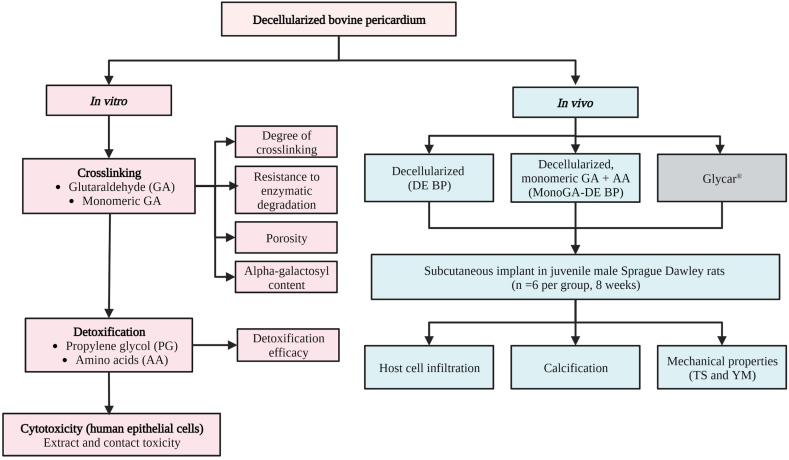
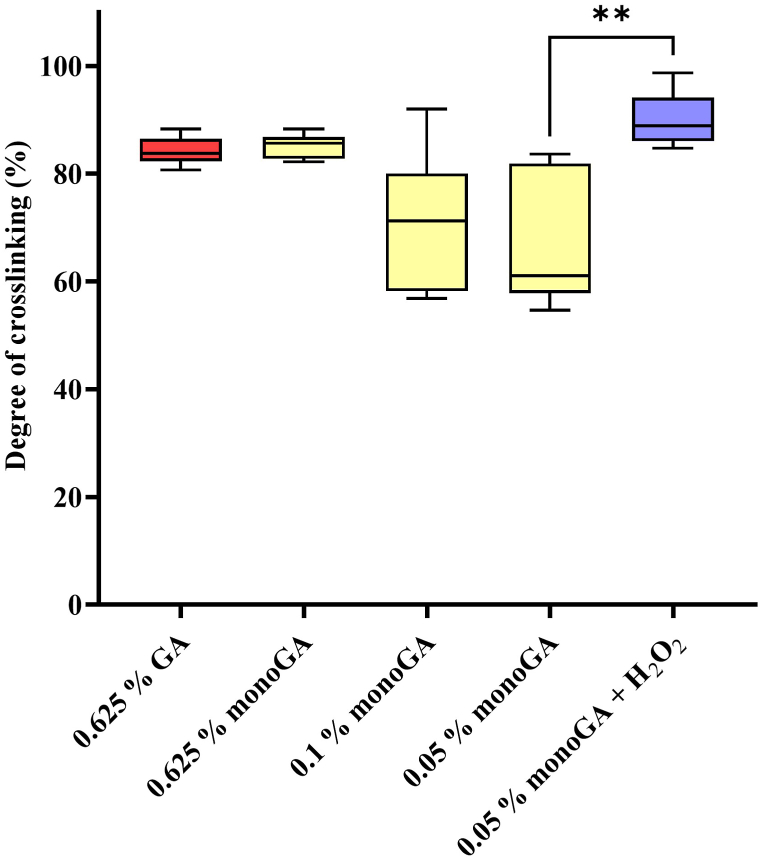
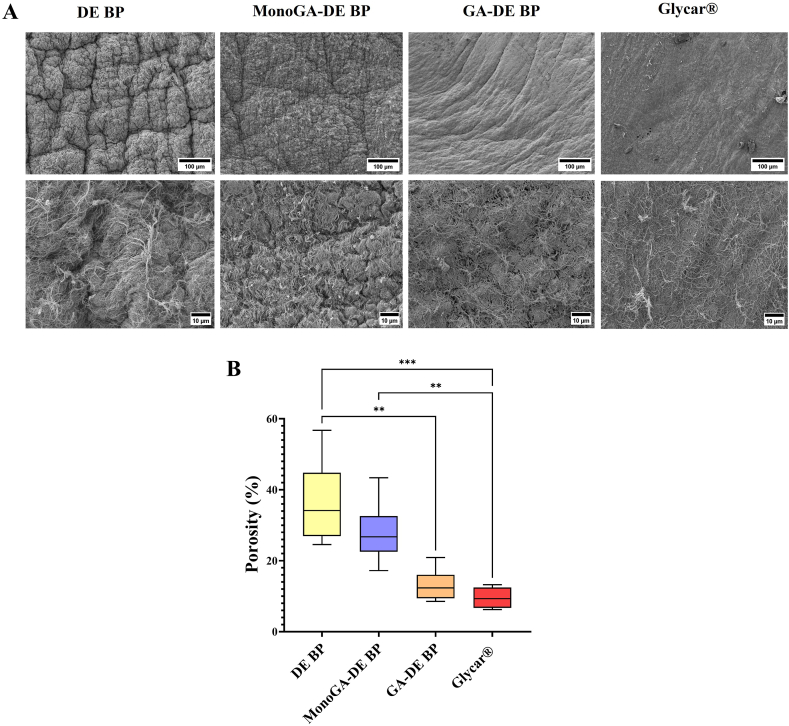
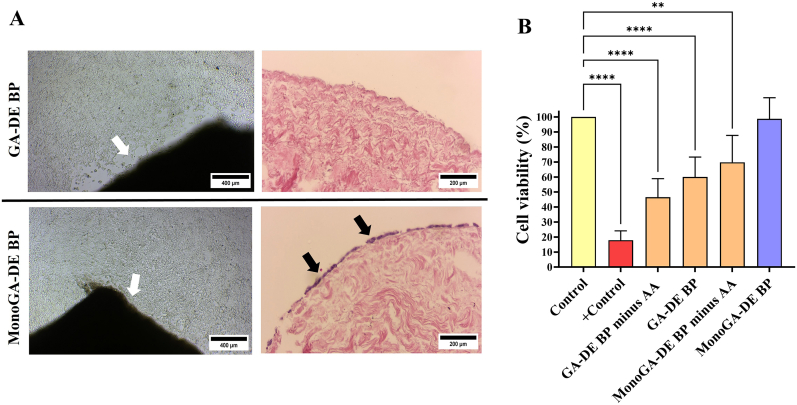
The effect of monomeric glutaraldehyde fixation and amino acid detoxification on biocompatibility and tissue-guided regenerative potential of decellularized bovine pericardium was evaluated. The degree of cross-linking, porosity, enzymatic degradation, alpha-galactosyl content, the efficacy of detoxification, and cytotoxicity towards human epithelial cells were assessed. Tissue was subcutaneously implanted for eight weeks in male juvenile Sprague-Dawley rats, and mechanical properties, host cell infiltration, and calcification were evaluated. Three groups were compared i) decellularized tissue, ii) decellularized, monomeric glutaraldehyde fixed and amino acid detoxified tissue, and iii) commercial glutaraldehyde fixed non-decellularized tissue (Glycar®) (n = 6 rats per group). The fixation process gave a high degree of cross-linking (>85%), and was resistant to enzymatic degradation, with no significant effect on porosity. The detoxification process was effective, and the tissue was not toxic to mammalian cells . Tissue from both decellularized groups had significantly higher (p < 0.05) porosity and host cell infiltration . The process mitigated calcification. A non-significant decrease in the alpha-galactosyl content was observed, which increased when including the alpha-galactosidase enzyme. Mechanical properties were maintained. The fixation and detoxification process adequately removes free aldehyde groups and reduces toxicity, preventing enzymatic degradation and allowing for host cell infiltration while mitigating calcification and retaining the mechanical properties of the tissue. This process can be considered for processing decellularized bovine pericardium with tissue-guided regeneration potential for use in cardiovascular bioprostheses; however, methods of further reducing antigenicity, such as the use of enzymes, should be investigated.
评估了单体戊二醛固定和氨基酸解毒对脱细胞牛心包生物相容性和组织引导再生潜力的影响。评估了交联程度、孔隙率、酶降解、α-半乳糖基含量、解毒效果以及对人上皮细胞的细胞毒性。将组织皮下植入雄性幼年Sprague-Dawley大鼠体内8周,评估其力学性能、宿主细胞浸润和钙化情况。比较了三组:i)脱细胞组织,ii)脱细胞、单体戊二醛固定和氨基酸解毒组织,iii)商业戊二醛固定的非脱细胞组织(Glycar®)(每组n = 6只大鼠)。固定过程产生了高度交联(>85%),且抗酶降解,对孔隙率无显著影响。解毒过程有效,且该组织对哺乳动物细胞无毒。两个脱细胞组的组织孔隙率和宿主细胞浸润均显著更高(p < 0.05)。该过程减轻了钙化。观察到α-半乳糖基含量有不显著的降低,加入α-半乳糖苷酶后含量增加。力学性能得以维持。固定和解毒过程充分去除了游离醛基并降低了毒性,防止酶降解并允许宿主细胞浸润,同时减轻钙化并保留组织的力学性能。对于具有组织引导再生潜力的脱细胞牛心包用于心血管生物假体的处理,可考虑该过程;然而,应研究进一步降低抗原性的方法,如使用酶。