Sleep Medicine and Research Center, St. Luke's Hospital, Chesterfield, Missouri.
Apnimed Inc., Cambridge, Massachusetts.
Am J Respir Crit Care Med. 2023 Dec 15;208(12):1316-1327. doi: 10.1164/rccm.202306-1036OC.
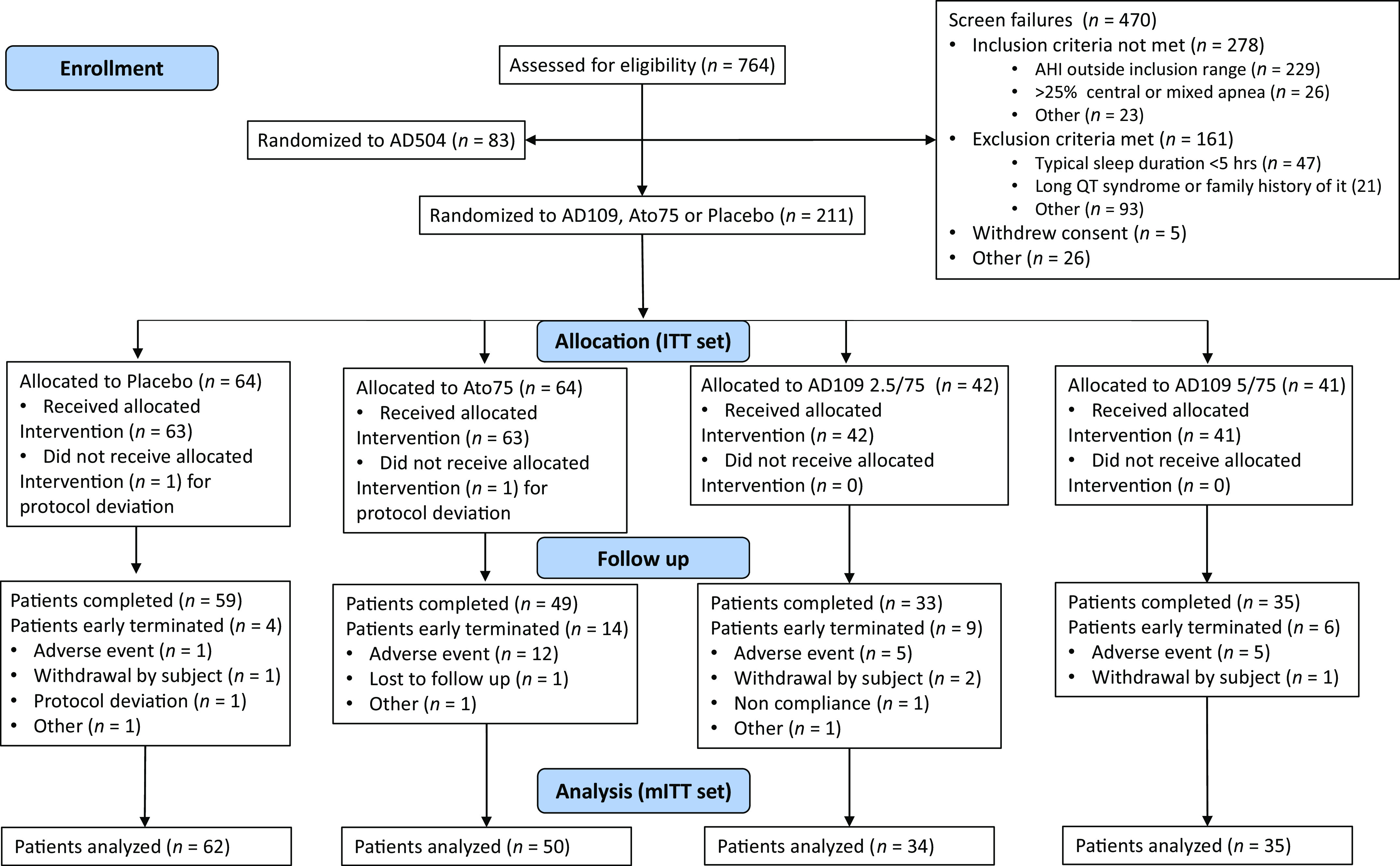
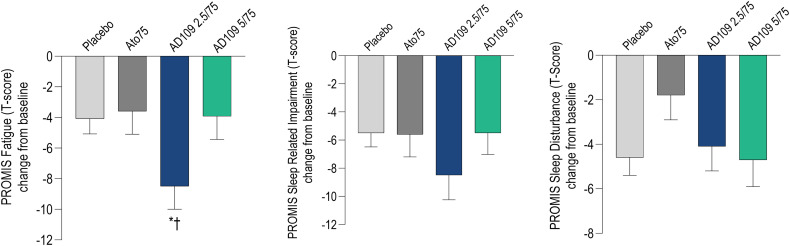
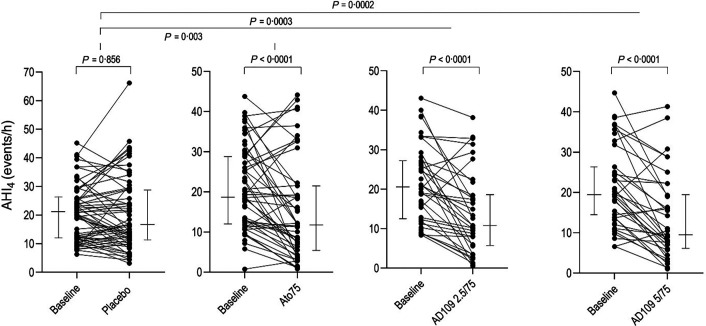
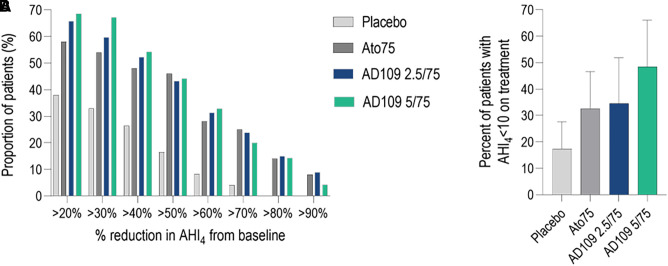
Obstructive sleep apnea (OSA) is a common sleep disorder for which the principal treatment option, continuous positive airway pressure, is often poorly tolerated. There is currently no approved pharmacotherapy for OSA. However, recent studies have demonstrated improvement in OSA with combined antimuscarinic and noradrenergic drugs. The aim of this study was to evaluate the efficacy and safety of AD109, a combination of the novel antimuscarinic agent aroxybutynin and the norepinephrine reuptake inhibitor atomoxetine, in the treatment of OSA. Phase II randomized, double-blind, placebo-controlled, parallel-group, 4-week trial comparing AD109 2.5/75 mg, AD109 5/75 mg, atomoxetine 75 mg alone, and placebo (www.clinicaltrials.gov identifier NCT05071612). Of 211 randomized patients, 181 were included in the prespecified efficacy analyses. Sleep was assessed by two baseline and two treatment polysomnograms. Apnea-hypopnea index with a 4% desaturation criterion (primary outcome) was reduced from a median (IQR) of 20.5 (12.3-27.2) to 10.8 (5.6-18.5) in the AD109 2.5/75 mg arm (-47.1%), from 19.4 (13.7-26.4) to 9.5 (6.1-19.3) in the AD109 5/75 mg arm (-42.9%; both < 0.0001 vs. placebo), and from 19.0 (11.8-28.8) to 11.8 (5.5-21.5) with atomoxetine alone (-38.8%; < 0.01 vs. placebo). Apnea-hypopnea index with a 4% desaturation criterion decreased from 20.1 (11.9-25.9) to 16.3 (11.1-28.9) in the placebo arm. Subjectively, there was improvement in fatigue with AD109 2.5/75 mg ( < 0.05 vs. placebo and atomoxetine). Atomoxetine taken alone decreased total sleep time ( < 0.05 vs. AD109 and placebo). The most common adverse events were dry mouth, insomnia, and urinary hesitancy. AD109 showed clinically meaningful improvement in OSA, suggesting that further development of the compound is warranted. Clinical trial registered with www.clinicaltrials.gov (NCT05071612).
阻塞性睡眠呼吸暂停(OSA)是一种常见的睡眠障碍,其主要治疗选择持续气道正压通气(CPAP)往往难以耐受。目前尚无批准用于 OSA 的药物治疗方法。然而,最近的研究表明,联合使用抗毒蕈碱药物和去甲肾上腺素能药物可改善 OSA。本研究旨在评估新型抗毒蕈碱药物阿罗西汀丁和去甲肾上腺素再摄取抑制剂托莫西汀的组合 AD109 治疗 OSA 的疗效和安全性。这是一项为期 4 周的随机、双盲、安慰剂对照、平行组、Ⅱ期临床试验,比较 AD109 2.5/75mg、AD109 5/75mg、托莫西汀 75mg 单药和安慰剂(www.clinicaltrials.gov 标识符 NCT05071612)。在 211 名随机患者中,181 名患者符合预设的疗效分析。通过两次基线和两次治疗多导睡眠图评估睡眠。以 4%的脱氧标准评估呼吸暂停低通气指数(主要结局),AD109 2.5/75mg 组从 20.5(12.3-27.2)降至 10.8(5.6-18.5)(-47.1%),AD109 5/75mg 组从 19.4(13.7-26.4)降至 9.5(6.1-19.3)(-42.9%;均<0.0001 与安慰剂相比),托莫西汀单药组从 19.0(11.8-28.8)降至 11.8(5.5-21.5)(-38.8%;与安慰剂相比,<0.01)。安慰剂组的呼吸暂停低通气指数以 4%的脱氧标准从 20.1(11.9-25.9)降至 16.3(11.1-28.9)。AD109 2.5/75mg 组的疲劳感得到改善(与安慰剂和托莫西汀相比,均<0.05)。托莫西汀单药治疗会减少总睡眠时间(与 AD109 和安慰剂相比,均<0.05)。最常见的不良事件是口干、失眠和尿犹豫。AD109 显示出对 OSA 的临床意义上的改善,表明进一步开发该化合物是合理的。临床试验在 www.clinicaltrials.gov 注册(NCT05071612)。