Parasiewicz Piotr, Belka Kamila, Łapińska Małgorzata, Ławniczak Karol, Prus Paweł, Adamczyk Mikołaj, Buras Paweł, Szlakowski Jacek, Kaczkowski Zbigniew, Krauze Kinga, O'Keeffe Joanna, Suska Katarzyna, Ligięza Janusz, Melcher Andreas, O'Hanley Jesse, Birnie-Gauvin Kim, Aarestrup Kim, Jones Peter E, Jones Joshua, Garcia de Leaniz Carlos, Tummers Jeroen S, Consuegra Sofia, Kemp Paul, Schwedhelm Hannah, Popek Zbigniew, Segura Gilles, Vallesi Sergio, Zalewski Maciej, Wiśniewolski Wiesław
National Inland Fisheries Research Institute, Olsztyn, Poland.
European Regional Centre for Ecohydrology of the Polish Academy of Sciences, Łódź, Poland.
Nat Commun. 2023 Oct 9;14(1):6289. doi: 10.1038/s41467-023-40922-6.
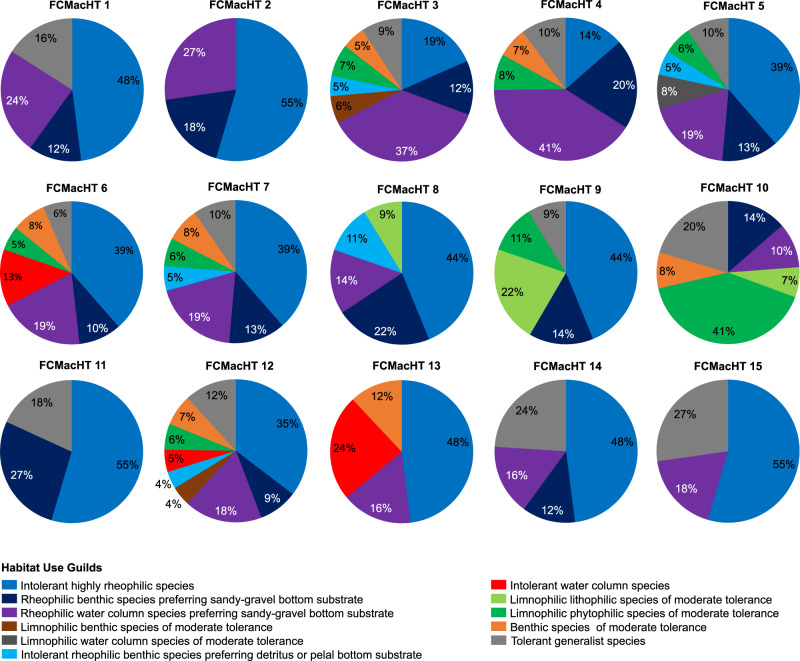
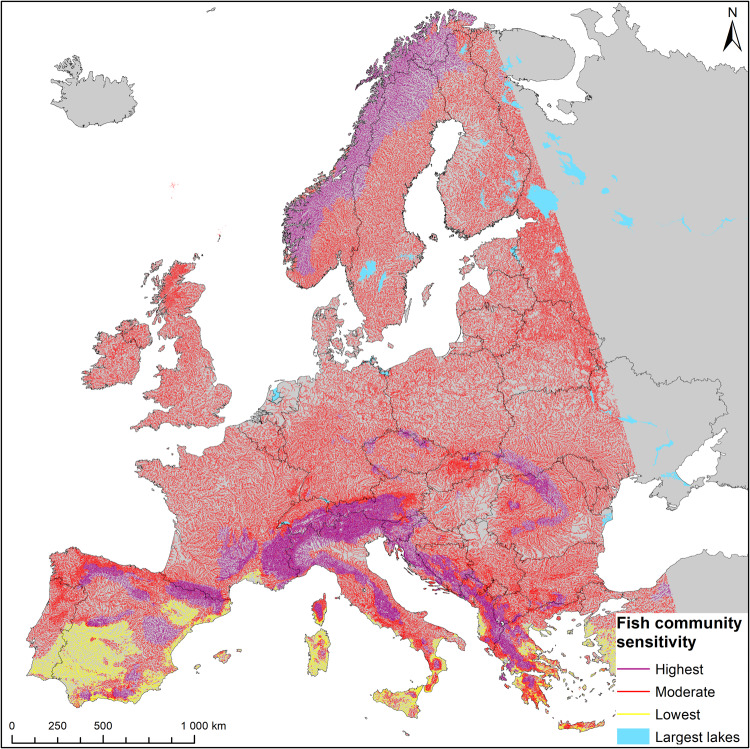
European rivers are disconnected by more than one million man-made barriers that physically limit aquatic species migration and contribute to modification of freshwater habitats. Here, a Conceptual Habitat Alteration Model for Ponding is developed to aid in evaluating the effects of impoundments on fish habitats. Fish communities present in rivers with low human impact and their broad environmental settings enable classification of European rivers into 15 macrohabitat types. These classifications, together with the estimated fish sensitivity to alteration of their habitat are used for assessing the impacts of six main barrier types (dams, weirs, sluices, culverts, fords, and ramps). Our results indicate that over 200,000 km or 10% of previously free-flowing river habitat has been altered due to impoundments. Although they appear less frequently, dams, weirs and sluices cause much more habitat alteration than the other types. Their impact is regionally diverse, which is a function of barrier height, type and density, as well as biogeographical location. This work allows us to foresee what potential environmental gain or loss can be expected with planned barrier management actions in rivers, and to prioritize management actions.
欧洲河流被超过100万个人造障碍物隔断,这些障碍物切实限制了水生物种的迁移,并导致淡水栖息地发生改变。在此,我们开发了一个用于蓄水的概念性栖息地改变模型,以协助评估蓄水对鱼类栖息地的影响。受人类影响较小的河流中的鱼类群落及其广泛的环境背景,使得欧洲河流能够被划分为15种大型栖息地类型。这些分类,连同估计的鱼类对其栖息地改变的敏感性,被用于评估六种主要障碍物类型(水坝、堰闸、水闸、涵洞、浅滩和坡道)的影响。我们的结果表明,由于蓄水,超过200,000公里或之前自由流动的河流栖息地的10%已经发生改变。尽管水坝、堰闸和水闸出现的频率较低,但它们造成的栖息地改变比其他类型要多得多。它们的影响在区域上各不相同,这是障碍物高度、类型和密度以及生物地理位置的函数。这项工作使我们能够预见在河流中进行有计划的障碍物管理行动可能带来的潜在环境收益或损失,并对管理行动进行优先排序。