Department of Periodontics, School and Hospital of Stomatology, China Medical University, No.117 Nanjing North Street, Heping District, Shenyang, Liaoning, 110002, China.
School of Stomatology, Dalian Medical University, Dalian, Liaoning, China.
BMC Oral Health. 2023 Oct 9;23(1):736. doi: 10.1186/s12903-023-03248-9.
Periodontitis is a chronic and multi-factorial infectious disease. A notable difference exists in the prognosis of patients with severe periodontitis after non-surgical periodontal treatment. Thus, a retrospective study was conducted to identify common and specific factors that impact the prognosis of patients with periodontitis stage III-IV following non-surgical periodontal treatment at different tooth sites.
A total of 977 teeth were included in the study, comprising 266 patients diagnosed with periodontitis stage III-IV. This sample included 330 anterior teeth, 362 maxillary posterior teeth, and 285 mandibular posterior teeth. Following treatment, the teeth were categorized into two groups based on residual pocket depth [probing depth (PD) ≥ 5 mm] at 3 months post-treatment. The prognosis of periodontitis stage III-IV was assessed through multivariate analysis employing logistic regression to determine the association of various risk factors.
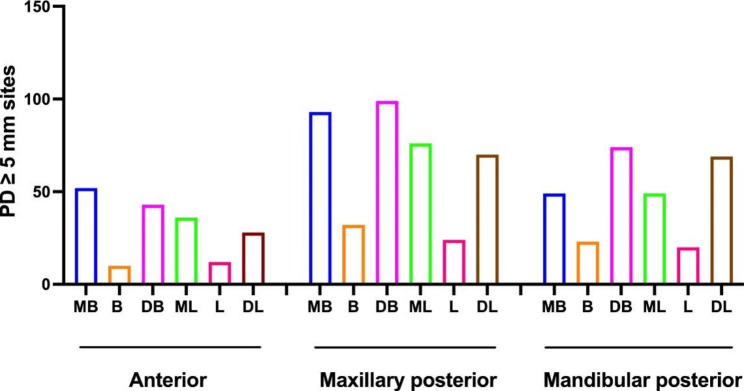
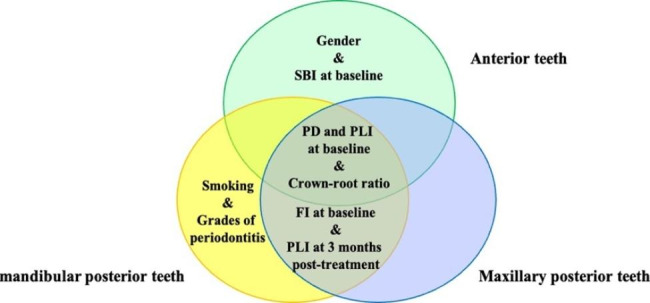
The PD values of each site and the deepest PD values of each tooth significantly decreased at 3 months post-treatment. Residual pockets were predominantly found in the mesio/disto-buccal and mesio/disto-lingual regions. Multivariate analysis revealed that gender, PD, sulcus bleeding index (SBI) and plaque index (PLI) at baseline, and crown-root ratio in anterior teeth had a significant influence on periodontitis stage III-IV (P < 0.05). Smoking, PD, PLI and furcation involvement (FI) at baseline, PLI at 3 months post-treatment, grades of periodontitis, and crown-root ratio were prediction factors for maxillary posterior teeth. Factors such as PD, PLI and FI at baseline, PLI at 3 months post-treatment, and crown-root were significant in mandibular posterior teeth.
The outcome of non-surgical treatment varies depending on the tooth positions for patients with periodontitis stage III-IV. Dentists must accurately identify the affected teeth that have periodontal pockets of more than 5 mm, taking into consideration the positions of the affected teeth, as well as various local and systemic factors. This comprehensive assessment will enable dentists to develop a customized and effective treatment plan.
牙周炎是一种慢性、多因素的感染性疾病。经过非手术牙周治疗后,重度牙周炎患者的预后存在显著差异。因此,本研究回顾性分析了不同牙位牙周炎Ⅲ-Ⅳ期患者非手术牙周治疗后的预后相关的常见和特异因素。
本研究共纳入 977 颗牙,共涉及 266 例牙周炎Ⅲ-Ⅳ期患者。其中,前牙 330 颗,上颌后牙 362 颗,下颌后牙 285 颗。治疗后根据 3 个月时的牙周袋探诊深度(PD)是否≥5mm 将患牙分为两组。采用 logistic 回归多因素分析评估牙周炎Ⅲ-Ⅳ期的预后,分析各风险因素与治疗预后的相关性。
治疗后 3 个月时,各牙位 PD 值及各牙最深 PD 值均显著降低,且牙周袋主要位于近远中颊侧和近远中舌侧。多因素分析显示,性别、治疗前 PD、龈沟出血指数(SBI)、菌斑指数(PLI)、前牙冠根比,以及治疗后 3 个月 PLI 与牙周炎Ⅲ-Ⅳ期显著相关(P<0.05)。吸烟、治疗前 PD、PLI、根分叉病变(FI)、治疗后 3 个月 PLI、牙周炎严重程度和前牙冠根比是上颌后牙的预测因素。治疗前 PD、PLI、FI,治疗后 3 个月 PLI 以及冠根比是下颌后牙的预测因素。
对于牙周炎Ⅲ-Ⅳ期患者,非手术治疗的预后因牙位而异。牙医需要准确识别出有 5mm 以上牙周袋的患牙,并综合考虑患牙位置及各种局部和全身因素,制定出个体化、有效的治疗计划。