Adult Congenital and Paediatric Heart Unit, Freeman Hospital, Freeman Road, High Heaton, Newcastle Upon Tyne Hospitals NHS Foundation Trust, Newcastle upon Tyne NE7 7DN, UK.
Population Health Sciences Institute, Newcastle University, Newcastle upon Tyne NE1 7RU, UK.
Europace. 2023 Nov 2;25(11). doi: 10.1093/europace/euad304.
Patients with systemic right ventricles are at high risk of sudden cardiac death. Arrhythmia is a significant risk factor. Routine Holter monitoring is opportunistic with poor adherence. The aim of this study was to determine if continuous rhythm monitoring with an implantable loop recorder (ILR) could allow early detection of clinically important arrhythmias.
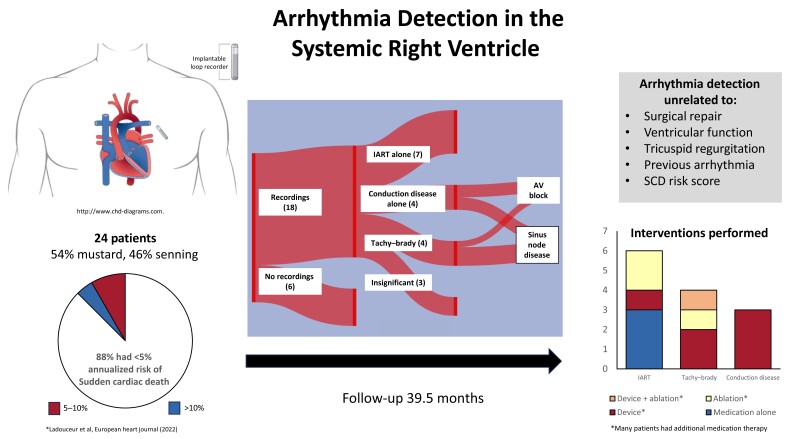
Implantable loop recorder implantation was offered to patients with atrial switch repair for transposition of the great arteries. Recordings were made with symptoms or, automatically for pauses, significant bradycardia or tachycardia and reviewed by the multi-disciplinary team. Twenty-four out of 36 eligible patients underwent ILR implantation with no complication. Forty-two per cent had preserved ventricular function, 75% were NYHA functional class I, 88% had low sudden cardiac death risk, 33% had previous intra-atrial re-entrant tachycardia (IART), and none had known conduction disease. Eighteen out of 24 (75%) patients made 52 recordings (52% automated) over 39.5 months (1.6-72.5). Thirty-two out of 52 (62%) recordings in 15/24 (63%) of the cohort were clinically significant and included sinus node disease (two patients), atrioventricular block (two patients), IART (seven patients), and IART with sinus node disease or atrioventricular block (four patients). Implantable loop recorder recordings prompted medication change in 11 patients [beta-blockers (n = 9), anti-coagulation (n = 5), and stopping anti-coagulation (n = 1)] and device therapy recommendation in seven patients [five pacemakers (three: atrioventricular block) and two defibrillators]. Two patients declined intervention; one suffered an arrhythmic death. Intra-atrial re-entrant tachycardia and clinically relevant conduction disease were detected in patients irrespective of sudden cardiac death risk.
Continuous monitoring with an ILR in patients with systemic right ventricle following atrial switch detects clinically relevant arrhythmias that impact decision-making. In this cohort, clinically relevant arrhythmias did not correlate with sudden cardiac death risk.
患有系统性右心室的患者有发生心源性猝死的高风险。心律失常是一个重要的危险因素。常规动态心电图监测是一种机会性检查,患者的依从性较差。本研究的目的是确定植入式环形记录器(ILR)的连续节律监测是否能够早期发现具有临床意义的心律失常。
为法洛四联症矫正术后的大动脉转位患者提供植入式环形记录器植入。根据症状或自动记录(因停顿、显著心动过缓或心动过速)进行记录,并由多学科团队进行审查。36 名符合条件的患者中有 24 名成功植入 ILR,无并发症。42%的患者保留了心室功能,75%的患者心功能分级为 I 级,88%的患者心源性猝死风险低,33%的患者曾有房内折返性心动过速(IART),且无已知的传导疾病。24 名患者中的 18 名(75%)进行了 52 次记录(52%自动记录),随访时间为 39.5 个月(1.6-72.5)。在 24 名患者中的 15 名(63%)的 52 次记录中,有 32 次(62%)记录具有临床意义,包括窦房结疾病(2 名患者)、房室传导阻滞(2 名患者)、IART(7 名患者)、以及伴有窦房结疾病或房室传导阻滞的 IART(4 名患者)。ILR 记录提示 11 名患者改变了药物治疗[β受体阻滞剂(n = 9)、抗凝治疗(n = 5)和停止抗凝治疗(n = 1)],并建议 7 名患者进行器械治疗[5 名起搏器(3 名:房室传导阻滞)和 2 名除颤器]。2 名患者拒绝干预;1 名患者死于心律失常。植入式环形记录器在接受心房切换术的系统性右心室患者中的连续监测可检测出具有临床意义的心律失常,从而影响决策。在本队列中,具有临床意义的心律失常与心源性猝死风险无关。
在接受心房切换术后的系统性右心室患者中使用 ILR 进行连续监测可检测出具有临床意义的心律失常,从而影响决策。在本队列中,具有临床意义的心律失常与心源性猝死风险无关。