Hahn ChangHoon, Eickenberg Michael, Ho Shirley, Hou Jiamin, Lemos Pablo, Massara Elena, Modi Chirag, Moradinezhad Dizgah Azadeh, Blancard Bruno Régaldo-Saint, Abidi Muntazir M
Department of Astrophysical Sciences, Princeton University, Princeton NJ 08544.
Center for Computational Mathematics, Flatiron Institute, New York, NY 10010.
Proc Natl Acad Sci U S A. 2023 Oct 17;120(42):e2218810120. doi: 10.1073/pnas.2218810120. Epub 2023 Oct 11.
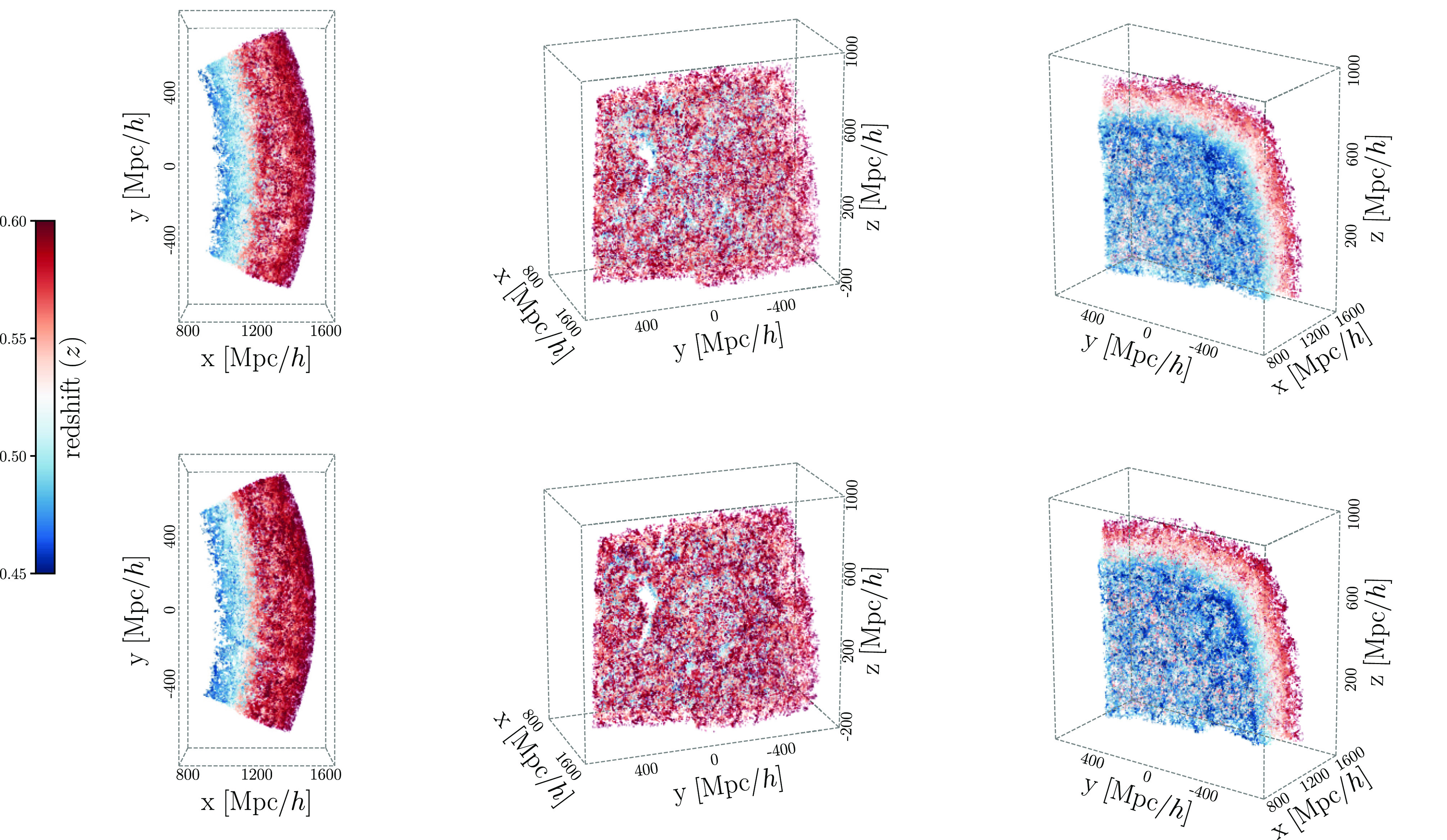
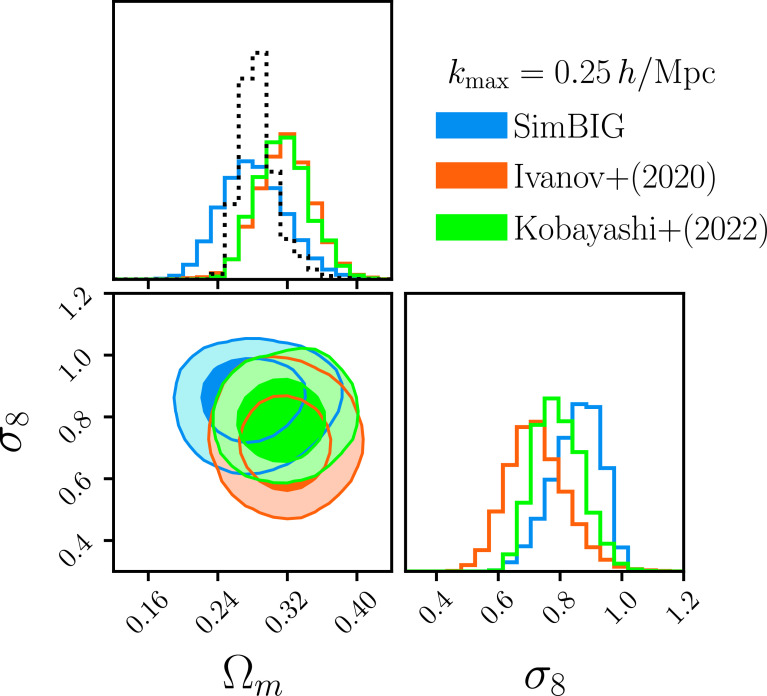
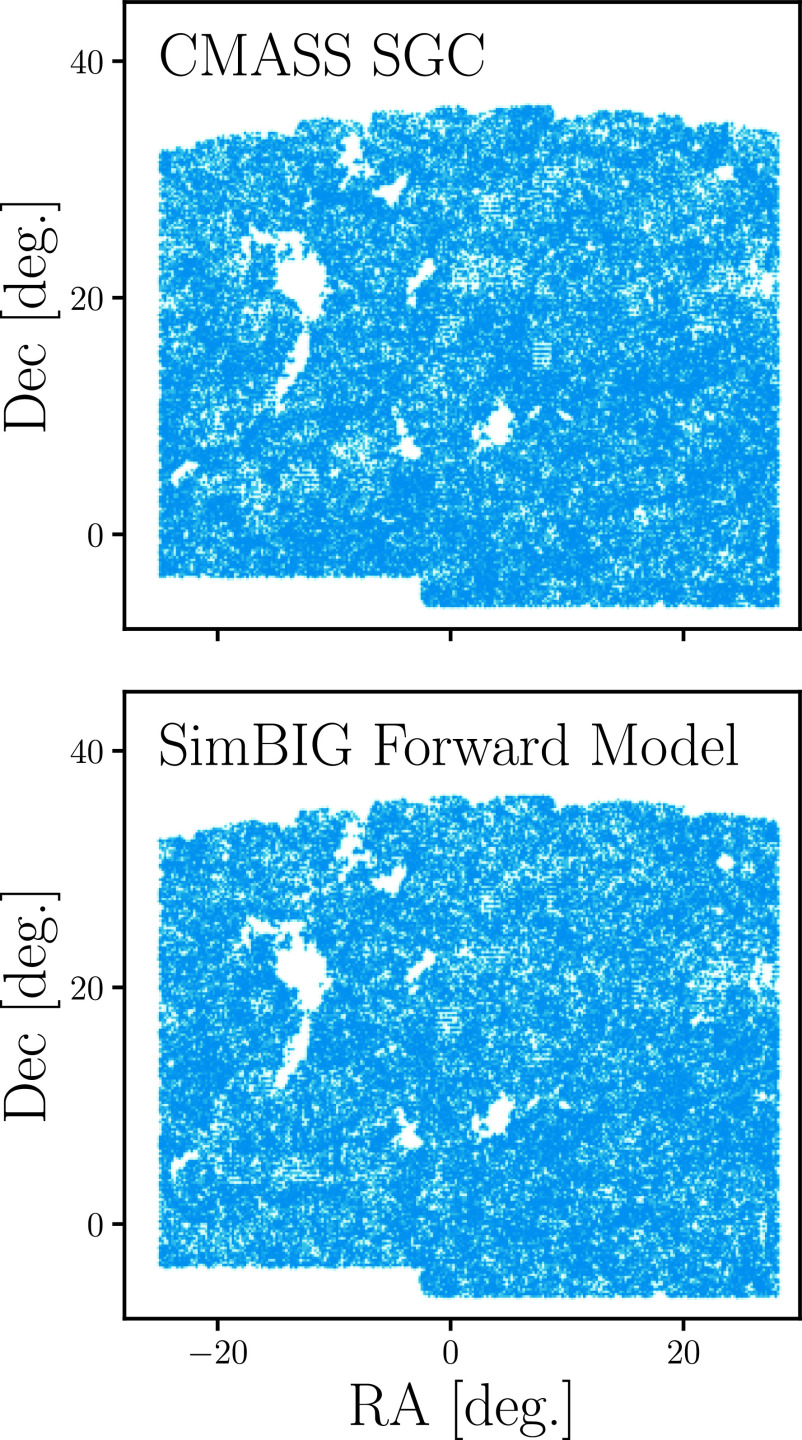
We present cosmological constraints from a simulation-based inference (SBI) analysis of galaxy clustering from the SimBIG forward modeling framework. SimBIG leverages the predictive power of high-fidelity simulations and provides an inference framework that can extract cosmological information on small nonlinear scales. In this work, we apply SimBIG to the Baryon Oscillation Spectroscopic Survey (BOSS) CMASS galaxy sample and analyze the power spectrum, [Formula: see text], to [Formula: see text]. We construct 20,000 simulated galaxy samples using our forward model, which is based on 2,000 high-resolution Quijote[Formula: see text]-body simulations and includes detailed survey realism for a more complete treatment of observational systematics. We then conduct SBI by training normalizing flows using the simulated samples and infer the posterior distribution of [Formula: see text]CDM cosmological parameters: [Formula: see text]. We derive significant constraints on [Formula: see text] and [Formula: see text], which are consistent with previous works. Our constraint on [Formula: see text] is 27% more precise than standard [Formula: see text] analyses because we exploit additional cosmological information on nonlinear scales beyond the limit of current analytic models, [Formula: see text]. This improvement is equivalent to the statistical gain expected from a standard [Formula: see text] analysis of galaxy sample [Formula: see text]60% larger than CMASS. While we focus on [Formula: see text] in this work for validation and comparison to the literature, SimBIG provides a framework for analyzing galaxy clustering using any summary statistic. We expect further improvements on cosmological constraints from subsequent SimBIG analyses of summary statistics beyond [Formula: see text].
我们展示了基于SimBIG正向建模框架对星系团簇进行基于模拟推理(SBI)分析得出的宇宙学限制。SimBIG利用高保真模拟的预测能力,并提供了一个可以在小非线性尺度上提取宇宙学信息的推理框架。在这项工作中,我们将SimBIG应用于重子振荡光谱巡天(BOSS)的CMASS星系样本,并分析了功率谱,从[公式:见正文]到[公式:见正文]。我们使用我们的正向模型构建了20000个模拟星系样本,该模型基于2000次高分辨率的Quijote[公式:见正文]体模拟,并包括详细的巡天逼真度,以便更全面地处理观测系统误差。然后,我们通过使用模拟样本训练归一化流来进行SBI,并推断[公式:见正文]CDM宇宙学参数的后验分布:[公式:见正文]。我们对[公式:见正文]和[公式:见正文]得出了显著的限制,这与之前的工作一致。我们对[公式:见正文]的限制比标准的[公式:见正文]分析精确27%,因为我们利用了超出当前解析模型极限的非线性尺度上的额外宇宙学信息,[公式:见正文]。这种改进等同于对比CMASS大[公式:见正文]60%的星系样本进行标准[公式:见正文]分析所预期的统计增益。虽然在这项工作中我们专注于[公式:见正文]以进行验证并与文献进行比较,但SimBIG提供了一个使用任何汇总统计量分析星系团簇的框架。我们预计,后续对超出[公式:见正文]的汇总统计量进行SimBIG分析将进一步改进宇宙学限制。