• 文献检索
  • 文档翻译
  • 深度研究
  • 学术资讯
  • Suppr Zotero 插件Zotero 插件
  • 邀请有礼
  • 套餐&价格
  • 历史记录
应用&插件
Suppr Zotero 插件Zotero 插件浏览器插件Mac 客户端Windows 客户端微信小程序
定价
高级版会员购买积分包购买API积分包
服务
文献检索文档翻译深度研究API 文档MCP 服务
关于我们
关于 Suppr公司介绍联系我们用户协议隐私条款
关注我们

Suppr 超能文献

核心技术专利:CN118964589B侵权必究
粤ICP备2023148730 号-1Suppr @ 2026

文献检索

告别复杂PubMed语法,用中文像聊天一样搜索,搜遍4000万医学文献。AI智能推荐,让科研检索更轻松。

立即免费搜索

文件翻译

保留排版,准确专业,支持PDF/Word/PPT等文件格式,支持 12+语言互译。

免费翻译文档

深度研究

AI帮你快速写综述,25分钟生成高质量综述,智能提取关键信息,辅助科研写作。

立即免费体验

一种综合个性化辅助设备方法,以降低糖尿病患者足部溃疡复发的风险(DIASSIST):一项多中心随机对照试验的研究方案。

An integrated personalized assistive devices approach to reduce the risk of foot ulcer recurrence in diabetes (DIASSIST): study protocol for a multicenter randomized controlled trial.

机构信息

Rehabilitation Medicine, Amsterdam UMC Location University of Amsterdam, Meibergdreef 9, Amsterdam, the Netherlands.

Rehabilitation & Development, Amsterdam Movement Sciences, Amsterdam, the Netherlands.

出版信息

Trials. 2023 Oct 12;24(1):663. doi: 10.1186/s13063-023-07635-z.

DOI:10.1186/s13063-023-07635-z
PMID:37828618
原文链接:https://pmc.ncbi.nlm.nih.gov/articles/PMC10568814/
Abstract

BACKGROUND

Preventing foot ulcers in people with diabetes can increase quality of life and reduce costs. Despite the availability of various interventions to prevent foot ulcers, recurrence rates remain high. We hypothesize that a multimodal treatment approach incorporating various footwear, self-management, and education interventions that matches an individual person's needs can reduce the risk of ulcer recurrence with beneficial cost-utility. The aim of this study is to assess the effect on foot ulcer recurrence, footwear adherence, and cost-utility of an integrated personalized assistive devices approach in high-risk people with diabetes.

METHODS

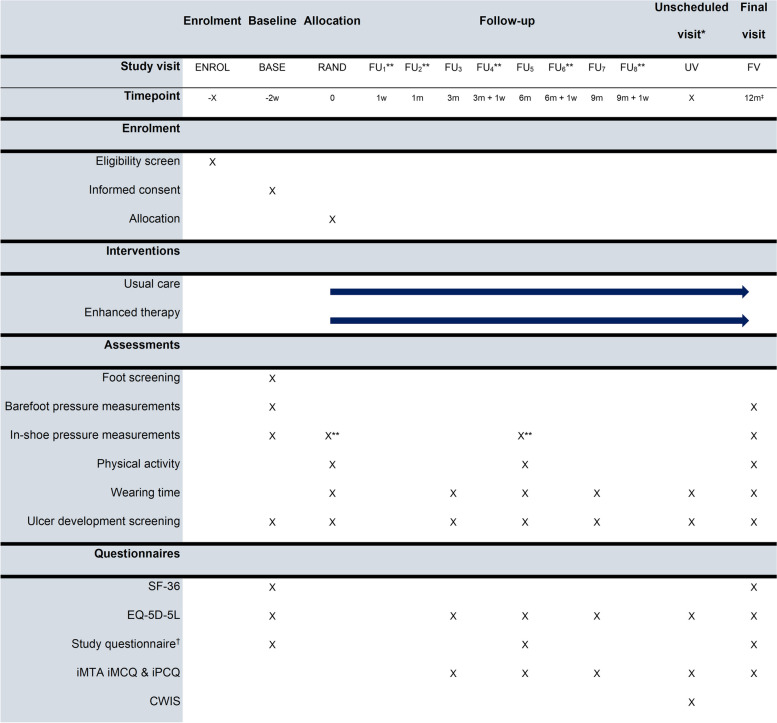
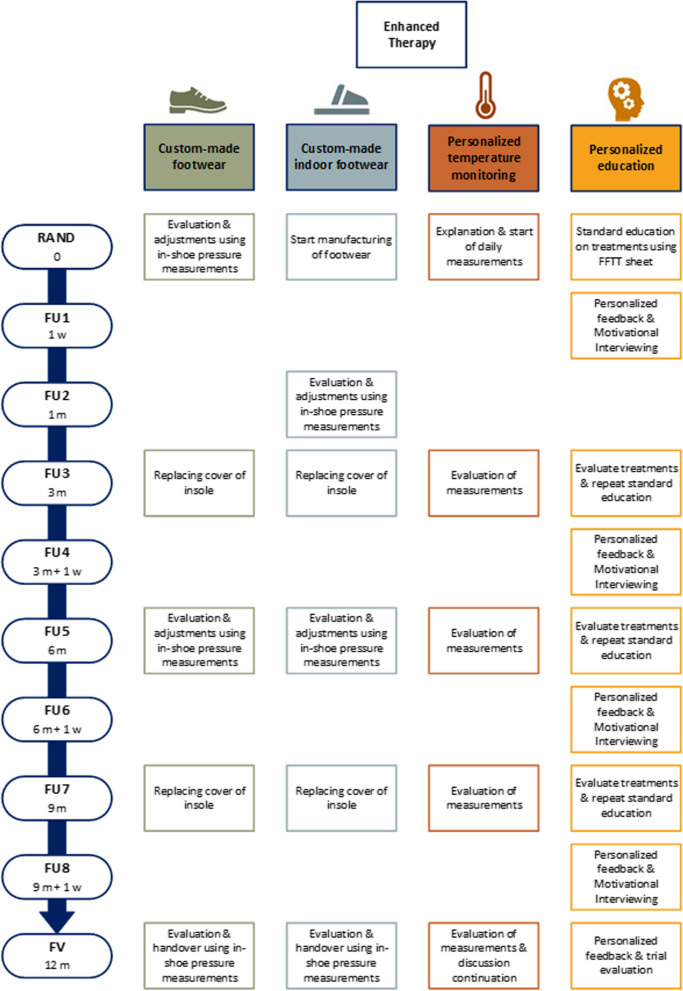
In a parallel-group multicenter randomized controlled trial, 126 adult participants with diabetes mellitus type 1 or 2, loss of protective sensation based on the presence of peripheral neuropathy, a healed plantar foot ulcer in the preceding 4 years, and possession of any type of custom-made footwear will be included. Participants will be randomly assigned to either enhanced therapy or usual care. Enhanced therapy consists of usual care and additionally a personalized treatment approach including pressure-optimized custom-made footwear, pressure-optimized custom-made footwear for indoor use, at-home daily foot temperature monitoring, and structured education, which includes motivational interviewing and personalized feedback on adherence and self-care. Participants will be followed for 12 months. Assessments include barefoot and in-shoe plantar pressure measurements; questionnaires concerning quality of life, costs, disease, and self-care knowledge; physical activity and footwear use monitoring; and clinical monitoring for foot ulcer outcomes. The study is powered for 3 primary outcomes: foot ulcer recurrence, footwear adherence, and cost-utility, the primary clinical, patient-related, and health-economic outcome respectively.

DISCUSSION

This is the first study to integrate multiple interventions for ulcer prevention into a personalized state-of-the-art treatment approach and assess their combined efficacy in a randomized controlled trial in people with diabetes at high ulcer risk. Proven effectiveness, usability, and cost-utility will facilitate implementation in healthcare, improve the quality of life of high-risk people with diabetes, and reduce treatment costs.

TRIAL REGISTRATION

ClinicalTrials.gov NCT05236660. Registered on 11 February 2022.

摘要

背景

预防糖尿病患者的足部溃疡可以提高生活质量并降低成本。尽管有各种预防足部溃疡的干预措施,但溃疡复发率仍然很高。我们假设,一种结合各种鞋类、自我管理和教育干预措施的多模式治疗方法,根据个体的需求进行匹配,可以降低溃疡复发的风险,同时具有良好的成本效益。本研究旨在评估针对高危糖尿病患者的综合个性化辅助设备方法对足部溃疡复发、鞋类使用依从性和成本效益的影响。

方法

在一项平行组多中心随机对照试验中,将纳入 126 名成年 1 型或 2 型糖尿病患者,这些患者存在基于周围神经病变的保护性感觉丧失、在过去 4 年内有足底愈合性溃疡,以及拥有任何类型的定制鞋。参与者将被随机分配到增强治疗组或常规护理组。增强治疗组包括常规护理和个性化治疗方法,包括压力优化定制鞋、室内压力优化定制鞋、家庭日常足部温度监测以及结构化教育,包括动机性访谈和对依从性和自我护理的个性化反馈。参与者将接受 12 个月的随访。评估包括赤脚和穿鞋时的足底压力测量;关于生活质量、成本、疾病和自我护理知识的问卷;身体活动和鞋类使用监测;以及足部溃疡结果的临床监测。该研究的主要结果包括 3 个方面:足部溃疡复发、鞋类使用依从性和成本效益,分别为主要的临床、患者相关和健康经济学结果。

讨论

这是第一项将多种预防溃疡的干预措施整合到个性化的最先进治疗方法中,并在高溃疡风险的糖尿病患者中进行随机对照试验评估其联合疗效的研究。如果证明该方法有效、易用且具有成本效益,将有助于在医疗保健中实施,提高高危糖尿病患者的生活质量,并降低治疗成本。

试验注册

ClinicalTrials.gov NCT05236660。于 2022 年 2 月 11 日注册。
https://cdn.ncbi.nlm.nih.gov/pmc/blobs/531f/10568814/4a6111a762b0/13063_2023_7635_Fig2_HTML.jpg
https://cdn.ncbi.nlm.nih.gov/pmc/blobs/531f/10568814/c605749f2ff2/13063_2023_7635_Fig1_HTML.jpg
https://cdn.ncbi.nlm.nih.gov/pmc/blobs/531f/10568814/4a6111a762b0/13063_2023_7635_Fig2_HTML.jpg
https://cdn.ncbi.nlm.nih.gov/pmc/blobs/531f/10568814/c605749f2ff2/13063_2023_7635_Fig1_HTML.jpg
https://cdn.ncbi.nlm.nih.gov/pmc/blobs/531f/10568814/4a6111a762b0/13063_2023_7635_Fig2_HTML.jpg

相似文献

1
An integrated personalized assistive devices approach to reduce the risk of foot ulcer recurrence in diabetes (DIASSIST): study protocol for a multicenter randomized controlled trial.一种综合个性化辅助设备方法,以降低糖尿病患者足部溃疡复发的风险(DIASSIST):一项多中心随机对照试验的研究方案。
Trials. 2023 Oct 12;24(1):663. doi: 10.1186/s13063-023-07635-z.
2
The cost-effectiveness and cost-utility of at-home infrared temperature monitoring in reducing the incidence of foot ulcer recurrence in patients with diabetes (DIATEMP): study protocol for a randomized controlled trial.家庭红外体温监测在降低糖尿病患者足溃疡复发发生率方面的成本效益和成本效用(DIATEMP):一项随机对照试验的研究方案。
Trials. 2018 Sep 24;19(1):520. doi: 10.1186/s13063-018-2890-2.
3
Effects of novel diabetic therapeutic footwear on preventing ulcer recurrence in patients with a history of diabetic foot ulceration: study protocol for an open-label, randomized, controlled trial.新型糖尿病治疗鞋预防糖尿病足溃疡患者溃疡复发的效果:一项开放标签、随机、对照试验的研究方案。
Trials. 2021 Feb 17;22(1):151. doi: 10.1186/s13063-021-05098-8.
4
Using motivational interviewing combined with digital shoe-fitting to improve adherence to wearing orthopedic shoes in people with diabetes at risk of foot ulceration: study protocol for a cluster-randomized controlled trial.采用动机性访谈联合数字化鞋适配改善糖尿病足溃疡高危人群矫形鞋依从性的研究方案:一项整群随机对照试验
Trials. 2021 Oct 28;22(1):750. doi: 10.1186/s13063-021-05680-0.
5
Footwear and insole design parameters to prevent occurrence and recurrence of neuropathic plantar forefoot ulcers in patients with diabetes: a series of N-of-1 trial study protocol.鞋类和鞋垫设计参数预防糖尿病患者神经病变性足底前足溃疡的发生和复发:一系列 N-of-1 试验研究方案。
Trials. 2022 Dec 16;23(1):1017. doi: 10.1186/s13063-022-06968-5.
6
Risk assessments and structured care interventions for prevention of foot ulceration in diabetes: development and validation of a prognostic model.糖尿病足溃疡预防的风险评估和结构化护理干预:预测模型的制定和验证。
Health Technol Assess. 2020 Nov;24(62):1-198. doi: 10.3310/hta24620.
7
Footwear and offloading interventions to prevent and heal foot ulcers and reduce plantar pressure in patients with diabetes: a systematic review. footwear and offloading interventions to prevent and heal foot ulcers and reduce plantar pressure in patients with diabetes: a systematic review.
Diabetes Metab Res Rev. 2016 Jan;32 Suppl 1:99-118. doi: 10.1002/dmrr.2702.
8
Clinical efficacy of therapeutic footwear with a rigid rocker sole in the prevention of recurrence in patients with diabetes mellitus and diabetic polineuropathy: A randomized clinical trial.矫形刚性前掌足弓托的临床疗效可预防糖尿病和糖尿病多发性神经病患者的复发:一项随机临床试验。
PLoS One. 2019 Jul 11;14(7):e0219537. doi: 10.1371/journal.pone.0219537. eCollection 2019.
9
Cost-effectiveness of temperature monitoring to help prevent foot ulcer recurrence in people with diabetes: A multicenter randomized controlled trial.温度监测预防糖尿病患者足部溃疡复发的成本效益:一项多中心随机对照试验。
Diabetes Metab Res Rev. 2024 May;40(4):e3805. doi: 10.1002/dmrr.3805.
10
Effect of custom-made footwear on foot ulcer recurrence in diabetes: a multicenter randomized controlled trial.定制鞋类对糖尿病足溃疡复发的影响:一项多中心随机对照试验。
Diabetes Care. 2013 Dec;36(12):4109-16. doi: 10.2337/dc13-0996. Epub 2013 Oct 15.

引用本文的文献

1
Short-Term Efficacy of a Multi-Modal Intervention Program to Improve Custom-Made Footwear Use in People at High Risk of Diabetes-Related Foot Ulceration.一项多模式干预计划改善糖尿病相关足部溃疡高危人群定制鞋具使用情况的短期疗效
J Clin Med. 2025 May 22;14(11):3635. doi: 10.3390/jcm14113635.

本文引用的文献

1
Guidelines on the prevention of foot ulcers in persons with diabetes (IWGDF 2023 update).《糖尿病患者足部溃疡预防指南(IWGDF 2023 更新版)》。
Diabetes Metab Res Rev. 2024 Mar;40(3):e3651. doi: 10.1002/dmrr.3651. Epub 2023 Jun 11.
2
Practical guidelines on the prevention and management of diabetes-related foot disease (IWGDF 2023 update).《糖尿病相关足部疾病预防与管理实用指南(IWGDF 2023 更新版)》。
Diabetes Metab Res Rev. 2024 Mar;40(3):e3657. doi: 10.1002/dmrr.3657. Epub 2023 May 27.
3
Prevention of foot ulcers in persons with diabetes at risk of ulceration: A systematic review and meta-analysis.
预防有溃疡风险的糖尿病患者发生足部溃疡:系统评价和荟萃分析。
Diabetes Metab Res Rev. 2024 Mar;40(3):e3652. doi: 10.1002/dmrr.3652. Epub 2023 May 27.
4
Guidelines on offloading foot ulcers in persons with diabetes (IWGDF 2023 update).糖尿病患者足部溃疡减压指南(IWGDF 2023 更新)。
Diabetes Metab Res Rev. 2024 Mar;40(3):e3647. doi: 10.1002/dmrr.3647. Epub 2023 May 25.
5
Definitions and criteria for diabetes-related foot disease (IWGDF 2023 update).糖尿病相关足部疾病的定义和标准(IWGDF 2023 更新)。
Diabetes Metab Res Rev. 2024 Mar;40(3):e3654. doi: 10.1002/dmrr.3654. Epub 2023 May 15.
6
Guidelines on the classification of foot ulcers in people with diabetes (IWGDF 2023 update).糖尿病患者足部溃疡分类指南(IWGDF 2023 更新)。
Diabetes Metab Res Rev. 2024 Mar;40(3):e3648. doi: 10.1002/dmrr.3648. Epub 2023 May 14.
7
Fragile Feet and Trivial Trauma: Communicating the Etiology of Diabetic Foot Ulcers to Patients.脆弱的足部与微不足道的创伤:向患者传达糖尿病足溃疡的病因。
J Am Podiatr Med Assoc. 2023 Jan-Feb;113(1). doi: 10.7547/21-027.
8
Adherence to at-Home Monitoring of Foot Temperatures in People with Diabetes at High Risk of Ulceration.糖尿病足溃疡高危人群对居家足部温度监测的依从性。
Int J Low Extrem Wounds. 2022 Jul 15:15347346221114565. doi: 10.1177/15347346221114565.
9
Efficacy of at home monitoring of foot temperature for risk reduction of diabetes-related foot ulcer: A meta-analysis.家庭足部温度监测对降低糖尿病相关足部溃疡风险的疗效:一项荟萃分析。
Diabetes Metab Res Rev. 2022 Sep;38(6):e3549. doi: 10.1002/dmrr.3549. Epub 2022 Jun 8.
10
Custom-made footwear designed for indoor use increases short-term and long-term adherence in people with diabetes at high ulcer risk.为室内使用而定制的鞋子可提高高溃疡风险糖尿病患者的短期和长期依从性。
BMJ Open Diabetes Res Care. 2022 Feb;10(1). doi: 10.1136/bmjdrc-2021-002593.