Lee Ji Yeon, Bu Seon Hee, Song EunHyang, Cho Seongcheol, Yu Sungbong, Kim Jungok, Kym Sungmin, Seo Kwang Won, Kwon Ki Tae, Kim Jin Yong, Kim Sunghyun, Ahn Keumyoung, Jung Nahyun, Lee Yeonmi, Jung Yoobin, Hwang Chankyoung, Park Sang Won
Keimyung University Daegu Dongsan Hospital, Daegu, Republic of Korea.
Seoul Metropolitan City Bukbu Hospital, Seoul, Republic of Korea.
Infect Dis Ther. 2023 Oct;12(10):2417-2435. doi: 10.1007/s40121-023-00859-1. Epub 2023 Oct 13.
Regdanvimab, a neutralising monoclonal antibody (mAb) against severe acute respiratory syndrome coronavirus 2 (SARS-CoV-2), received approval for the treatment of coronavirus disease 2019 (COVID-19) in South Korea in 2021. The Ministry of Food and Drug Safety in South Korea mandate that new medications be re-examined for safety and effectiveness post-approval in at least 3000 individuals. This post-marketing surveillance (PMS) study was used to evaluate the safety and effectiveness of regdanvimab in real-world clinical care.
This prospective, multicentre, phase 4 PMS study was conducted between February 2021 and March 2022 in South Korea. Eligible patients were aged ≥ 18 years with confirmed mild COVID-19 at high risk of disease progression or moderate COVID-19. Patients were hospitalised and treated with regdanvimab (40 mg/kg, day 1) and then monitored until discharge, with a follow-up call on day 28. Adverse events (AEs) were documented, and the COVID-19 disease progression rate was used to measure effectiveness.
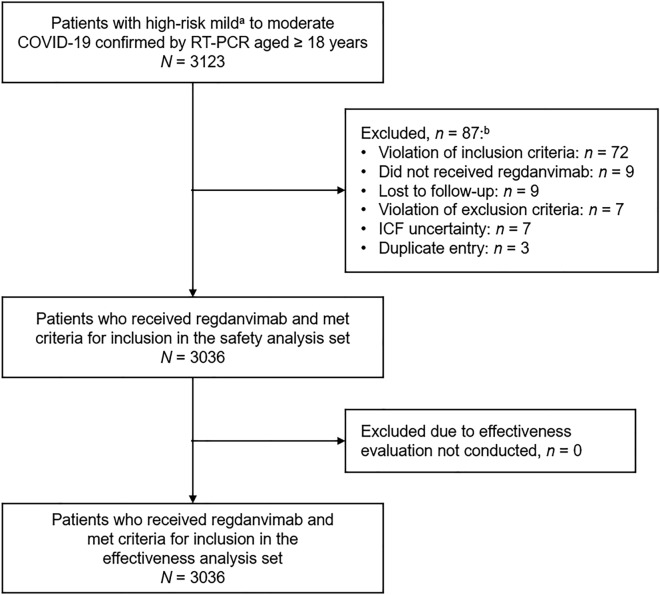
Of the 3123 patients with COVID-19 infection identified, 3036 were eligible for inclusion. Approximately 80% and 5% of the eligible patients were diagnosed with COVID-19 during the delta- and omicron-dominant periods, respectively. Median (range) age was 57 (18-95) years, and 50.6% of patients were male. COVID-19 severity was assessed before treatment, and high-risk mild and moderate COVID-19 was diagnosed in 1030 (33.9%) and 2006 (66.1%) patients, respectively. AEs and adverse drug reactions (ADRs) were experienced by 684 (22.5%) and 363 (12.0%) patients, respectively. The most common ADR was increased liver function test (n = 62, 2.0%). Nine (0.3%) patients discontinued regdanvimab due to ADRs. Overall, 378 (12.5%) patients experienced disease progression after regdanvimab infusion, with extended hospitalisation/re-admission (n = 300, 9.9%) as the most common reason. Supplemental oxygen was required by 282 (9.3%) patients. Ten (0.3%) patients required intensive care monitoring and 3 (0.1%) died due to COVID-19.
This large-scale PMS study demonstrated that regdanvimab was effective against COVID-19 progression and had an acceptable safety profile when used in real-world clinical practice.
雷格丹维单抗是一种针对严重急性呼吸综合征冠状病毒2(SARS-CoV-2)的中和单克隆抗体(mAb),于2021年在韩国获得治疗2019冠状病毒病(COVID-19)的批准。韩国食品药品安全部规定,新药物在批准后需在至少3000名个体中重新进行安全性和有效性检查。这项上市后监测(PMS)研究用于评估雷格丹维单抗在实际临床护理中的安全性和有效性。
这项前瞻性、多中心、4期PMS研究于2021年2月至2022年3月在韩国进行。符合条件的患者年龄≥18岁,确诊为轻度COVID-19且疾病进展风险高或为中度COVID-19。患者住院并接受雷格丹维单抗治疗(40mg/kg,第1天),然后进行监测直至出院,并在第28天进行随访电话。记录不良事件(AE),并使用COVID-19疾病进展率来衡量有效性。
在确定的3123例COVID-19感染患者中,3036例符合纳入条件。在德尔塔毒株和奥密克戎毒株占主导的时期,分别约有80%和5%的符合条件患者被诊断为COVID-19。中位(范围)年龄为57(18-95)岁,50.6%的患者为男性。在治疗前评估了COVID-19的严重程度,分别有1030例(33.9%)和2006例(66.1%)患者被诊断为高危轻度和中度COVID-19。分别有684例(22.5%)和363例(12.0%)患者出现不良事件(AE)和药物不良反应(ADR)。最常见的ADR是肝功能检查结果升高(n=62,2.0%)。9例(0.3%)患者因ADR停用雷格丹维单抗。总体而言,378例(12.5%)患者在输注雷格丹维单抗后出现疾病进展,最常见的原因是住院时间延长/再次入院(n=300,9.9%)。282例(9.3%)患者需要补充氧气。10例(0.3%)患者需要重症监护监测,3例(0.1%)患者因COVID-19死亡。
这项大规模PMS研究表明,雷格丹维单抗可有效对抗COVID-19进展,在实际临床实践中使用时具有可接受的安全性。