The Miami Project to Cure Paralysis, Department of Neurosurgery, University of Miami Miller School of Medicine, Miami, FL, USA.
Translational Psychiatry Laboratory, McLean Hospital, Belmont, MA, USA.
Amino Acids. 2023 Nov;55(11):1501-1517. doi: 10.1007/s00726-023-03338-6. Epub 2023 Oct 13.
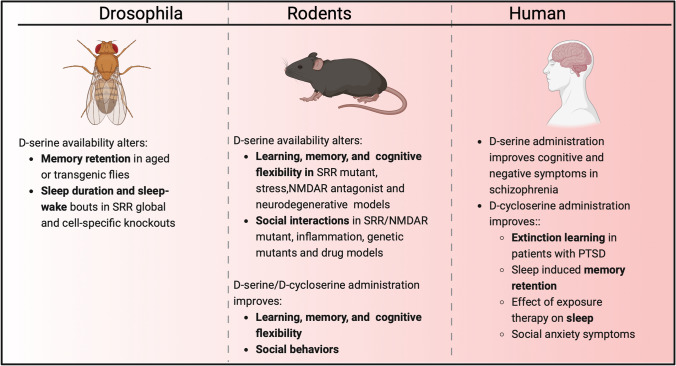
Bridging the gap between preclinical models of neurological and psychiatric disorders with their human manifestations is necessary to understand their underlying mechanisms, identify biomarkers, and develop novel therapeutics. Cognitive and social impairments underlie multiple neuropsychiatric and neurological disorders and are often comorbid with sleep disturbances, which can exacerbate poor outcomes. Importantly, many symptoms are conserved between vertebrates and invertebrates, although they may have subtle differences. Therefore, it is essential to determine the molecular mechanisms underlying these behaviors across different species and their translatability to humans. Genome-wide association studies have indicated an association between glutamatergic gene variants and both the risk and frequency of psychiatric disorders such as schizophrenia, bipolar disorder, and autism spectrum disorder. For example, changes in glutamatergic neurotransmission, such as glutamate receptor subtype N-methyl-D-aspartate receptor (NMDAR) hypofunction, have been shown to contribute to the pathophysiology of schizophrenia. Furthermore, in neurological disorders, such as traumatic brain injury and Alzheimer's disease, hyperactivation of NMDARs leads to synaptic damage. In addition to glutamate binding, NMDARs require the binding of a co-agonist D-serine or glycine to the GluN1 subunit to open. D-serine, which is racemized from L-serine by the neuronal enzyme serine racemase (SRR), and both SRR and D-serine are enriched in cortico-limbic brain regions. D-serine is critical for complex behaviors, such as cognition and social behavior, where dysregulation of its synthesis and release has been implicated in many pathological conditions. In this review, we explore the role of D-serine in behaviors that are translationally relevant to multiple psychiatric and neurological disorders in different models across species.
弥合神经和精神障碍的临床前模型与其人类表现之间的差距对于理解其潜在机制、确定生物标志物和开发新疗法是必要的。认知和社会障碍是多种神经精神和神经障碍的基础,并且常常与睡眠障碍并存,这会恶化不良结果。重要的是,许多症状在脊椎动物和无脊椎动物之间是保守的,尽管它们可能存在细微的差异。因此,必须确定不同物种中这些行为的分子机制及其对人类的可翻译性。全基因组关联研究表明,谷氨酸能基因变异与精神障碍(如精神分裂症、双相情感障碍和自闭症谱系障碍)的风险和频率之间存在关联。例如,谷氨酸能神经传递的变化,如谷氨酸受体亚型 N-甲基-D-天冬氨酸受体(NMDAR)功能低下,已被证明有助于精神分裂症的病理生理学。此外,在神经障碍中,如创伤性脑损伤和阿尔茨海默病,NMDAR 的过度激活导致突触损伤。除了谷氨酸结合外,NMDAR 还需要共激动剂 D-丝氨酸或甘氨酸与 GluN1 亚基结合才能打开。D-丝氨酸由神经元酶丝氨酸 racemase(SRR)从 L-丝氨酸外消旋化而来,SRR 和 D-丝氨酸在皮质边缘脑区富集。D-丝氨酸对认知和社会行为等复杂行为至关重要,其合成和释放的失调与许多病理状况有关。在这篇综述中,我们探讨了 D-丝氨酸在不同物种的不同模型中转译相关的多种精神和神经障碍行为中的作用。