Sechenov Institute of Evolutionary Physiology and Biochemistry, Russian Academy of Sciences, Thorez pr. 44, 194223 St. Petersburg, Russia.
Int J Mol Sci. 2023 Sep 22;24(19):14459. doi: 10.3390/ijms241914459.
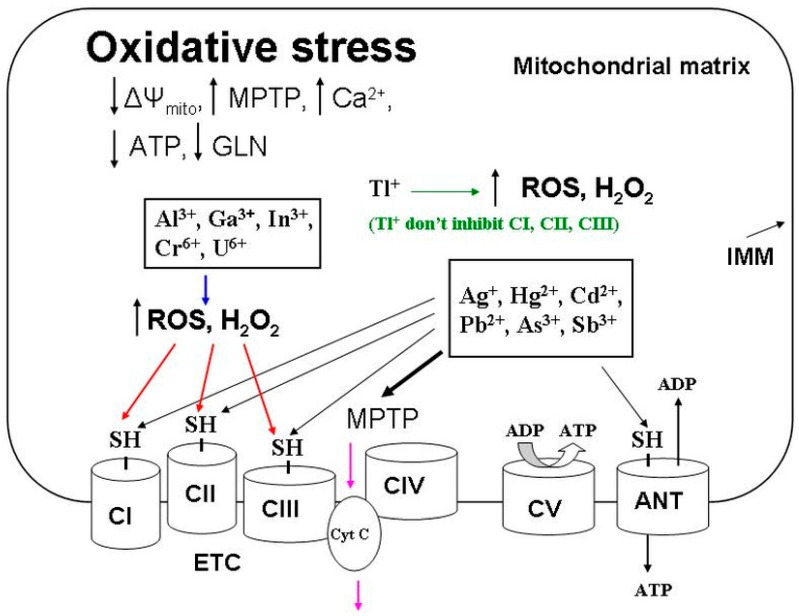
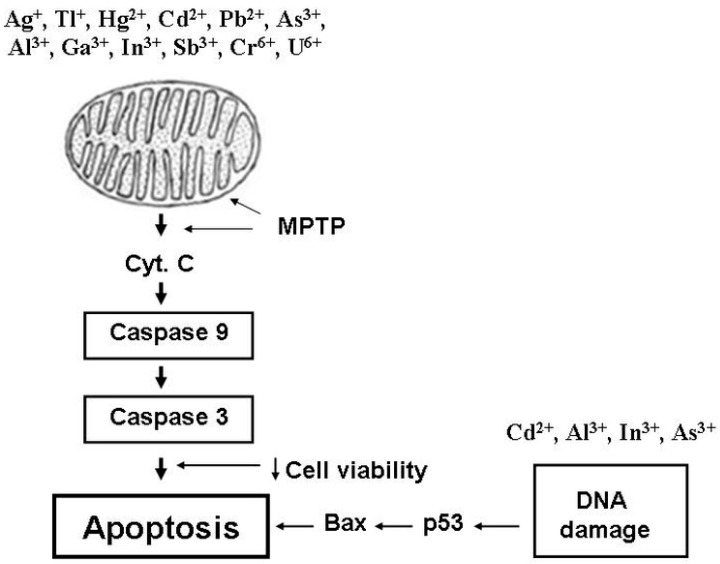
This review analyzes the causes and consequences of apoptosis resulting from oxidative stress that occurs in mitochondria and cells exposed to the toxic effects of different-valence heavy metals (Ag, Tl, Hg, Cd, Pb, Al, Ga, In, As, Sb, Cr, and U). The problems of the relationship between the integration of these toxic metals into molecular mechanisms with the subsequent development of pathophysiological processes and the appearance of diseases caused by the accumulation of these metals in the body are also addressed in this review. Such apoptosis is characterized by a reduction in cell viability, the activation of caspase-3 and caspase-9, the expression of pro-apoptotic genes ( and ), and the activation of protein kinases (ERK, JNK, p53, and p38) by mitogens. Moreover, the oxidative stress manifests as the mitochondrial permeability transition pore (MPTP) opening, mitochondrial swelling, an increase in the production of reactive oxygen species (ROS) and HO, lipid peroxidation, cytochrome c release, a decline in the inner mitochondrial membrane potential (ΔΨ), a decrease in ATP synthesis, and reduced glutathione and oxygen consumption as well as cytoplasm and matrix calcium overload due to Ca release from the endoplasmic reticulum (ER). The apoptosis and respiratory dysfunction induced by these metals are discussed regarding their interaction with cellular and mitochondrial thiol groups and Fe metabolism disturbance. Similarities and differences in the toxic effects of Tl from those of other heavy metals under review are discussed. Similarities may be due to the increase in the cytoplasmic calcium concentration induced by Tl and these metals. One difference discussed is the failure to decrease Tl toxicity through metallothionein-dependent mechanisms. Another difference could be the decrease in reduced glutathione in the matrix due to the reversible oxidation of Tl to Tl near the centers of ROS generation in the respiratory chain. The latter may explain why thallium toxicity to humans turned out to be higher than the toxicity of mercury, lead, cadmium, copper, and zinc.
这篇综述分析了由于暴露于毒性作用的不同价态重金属(银、铊、汞、镉、铅、铝、镓、铟、砷、锑、铬和铀)的线粒体和细胞中的氧化应激导致的细胞凋亡的原因和后果。本文还探讨了这些有毒金属整合到分子机制中与随后的病理生理过程发展以及由于这些金属在体内积累而导致疾病出现之间的关系问题。这种细胞凋亡的特征是细胞活力降低、caspase-3 和 caspase-9 激活、促凋亡基因(和)表达、以及有丝分裂原激活蛋白激酶(ERK、JNK、p53 和 p38)。此外,氧化应激表现为线粒体通透性转换孔(MPTP)打开、线粒体肿胀、活性氧(ROS)和 HO 产生增加、脂质过氧化、细胞色素 c 释放、线粒体膜电位(ΔΨ)下降、ATP 合成减少、还原型谷胱甘肽和耗氧量减少,以及由于内质网(ER)中钙释放导致细胞质和基质钙超载。本文讨论了这些金属诱导的凋亡和呼吸功能障碍与其与细胞和线粒体巯基以及铁代谢紊乱的相互作用有关。本文还讨论了铊与其他重金属毒性作用的相似性和差异。相似性可能是由于 Tl 和这些金属诱导的细胞质钙浓度增加所致。讨论的一个差异是,通过金属硫蛋白依赖性机制不能降低 Tl 的毒性。另一个差异可能是由于 Tl 在呼吸链中 ROS 产生中心附近的可逆氧化,导致基质中还原型谷胱甘肽减少。后者可以解释为什么铊对人类的毒性比汞、铅、镉、铜和锌的毒性高。