Dutsch Alexander, Uhlig Carsten, Bock Matthias, Graesser Christian, Schuchardt Sven, Uhlig Steffen, Schunkert Heribert, Joner Michael, Holdenrieder Stefan, Lechner Katharina
Department of Cardiology, German Heart Centre Munich, Technical University of Munich, Lazarettstraße 36, 80636 Munich, Germany.
DZHK (German Centre for Cardiovascular Research), Partner Site Munich, Munich Heart Alliance, 80336 Munich, Germany.
J Clin Med. 2023 Sep 27;12(19):6225. doi: 10.3390/jcm12196225.
Severe coronavirus disease 2019 (COVID-19) disease courses are characterized by immuno-inflammatory, thrombotic, and parenchymal alterations. Prediction of individual COVID-19 disease courses to guide targeted prevention remains challenging. We hypothesized that a distinct serologic signature precedes surges of IL-6/D-dimers in severely affected COVID-19 patients.
We performed longitudinal plasma profiling, including proteome, metabolome, and routine biochemistry, on seven seropositive, well-phenotyped patients with severe COVID-19 referred to the Intensive Care Unit at the German Heart Center. Patient characteristics were: 65 ± 8 years, 29% female, median CRP 285 ± 127 mg/dL, IL-6 367 ± 231 ng/L, D-dimers 7 ± 10 mg/L, and NT-proBNP 2616 ± 3465 ng/L.
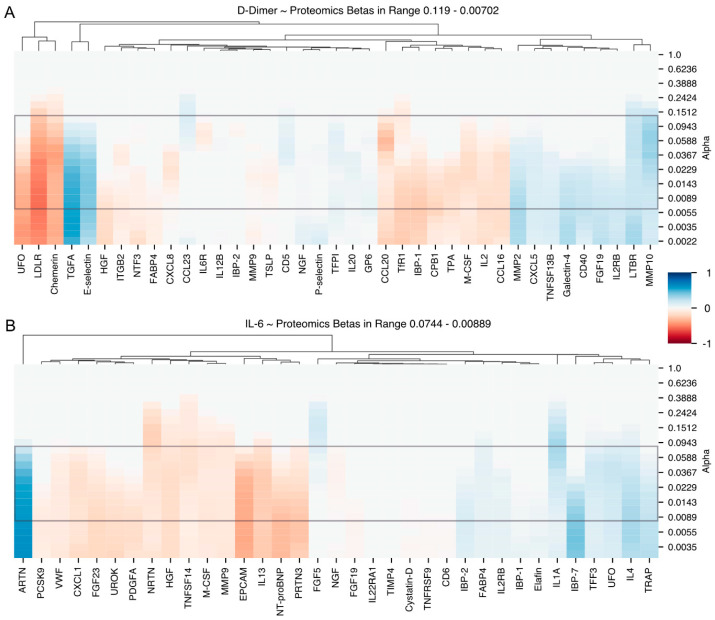
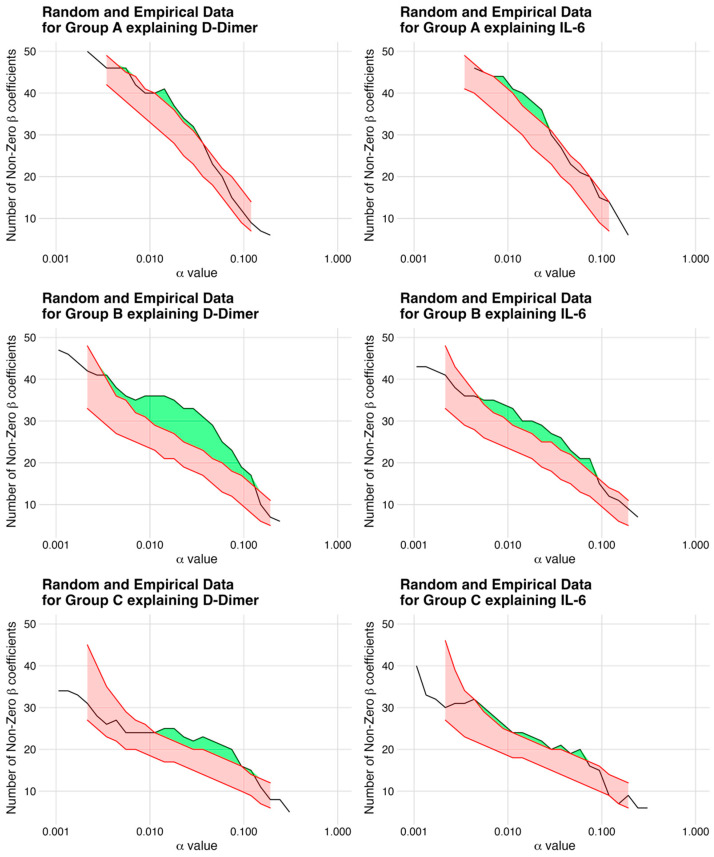
Based on time-series analyses of patient sera, a prediction model employing feature selection and dimensionality reduction through least absolute shrinkage and selection operator (LASSO) revealed a number of candidate proteins preceding hyperinflammatory immune response (denoted ΔIL-6) and COVID-19 coagulopathy (denoted ΔD-dimers) by 24-48 h. These candidates are involved in biological pathways such as oxidative stress/inflammation (e.g., IL-1alpha, IL-13, MMP9, C-C motif chemokine 23), coagulation/thrombosis/immunoadhesion (e.g., P- and E-selectin), tissue repair (e.g., hepatocyte growth factor), and growth factor response/regulatory pathways (e.g., tyrosine-protein kinase receptor UFO and low-density lipoprotein receptor (LDLR)). The latter are host- or co-receptors that promote SARS-CoV-2 entry into cells in the absence of ACE2.
Our novel prediction model identified biological and regulatory candidate networks preceding hyperinflammation and coagulopathy, with the most promising group being the proteins that explain changes in D-dimers. These biomarkers need validation. If causal, our work may help predict disease courses and guide personalized treatment for COVID-19.
2019年冠状病毒病(COVID-19)的严重病程具有免疫炎症、血栓形成和实质改变的特征。预测个体COVID-19病程以指导针对性预防仍然具有挑战性。我们假设在严重受影响的COVID-19患者中,独特的血清学特征先于IL-6/D-二聚体的激增。
我们对7例血清学阳性、特征明确的重度COVID-19患者进行了纵向血浆分析,包括蛋白质组、代谢组和常规生物化学分析,这些患者被转诊至德国心脏中心重症监护病房。患者特征为:年龄65±8岁,女性占29%,中位CRP为285±127mg/dL,IL-6为367±231ng/L,D-二聚体为7±10mg/L,NT-proBNP为2616±3465ng/L。
基于对患者血清的时间序列分析,一个采用通过最小绝对收缩和选择算子(LASSO)进行特征选择和降维的预测模型显示,在炎症反应增强(表示为ΔIL-6)和COVID-19凝血病(表示为ΔD-二聚体)出现前24 - 48小时有一些候选蛋白。这些候选蛋白参与氧化应激/炎症(如IL-1α、IL-13、MMP9、C-C基序趋化因子23)、凝血/血栓形成/免疫黏附(如P-选择素和E-选择素)、组织修复(如肝细胞生长因子)以及生长因子反应/调节途径(如酪氨酸蛋白激酶受体UFO和低密度脂蛋白受体(LDLR))等生物学途径。后者是在缺乏ACE2的情况下促进SARS-CoV-2进入细胞的宿主或共受体。
我们的新型预测模型确定了在炎症反应增强和凝血病之前的生物学和调节候选网络,最有前景的一组是解释D-二聚体变化的蛋白质。这些生物标志物需要验证。如果具有因果关系,我们的工作可能有助于预测COVID-19的病程并指导个性化治疗。