Di Girolamo Paolo, Franco Noemi, Di Paolantonio Marco, Summa Donato, Dionisi Davide
Scuola di Ingegneria, Università degli Studi della Basilicata, 85100 Potenza, Italy.
Institute of Marine Sciences, National Research Council (ISMAR-CNR), 00133 Roma, Italy.
Sensors (Basel). 2023 Oct 6;23(19):8262. doi: 10.3390/s23198262.
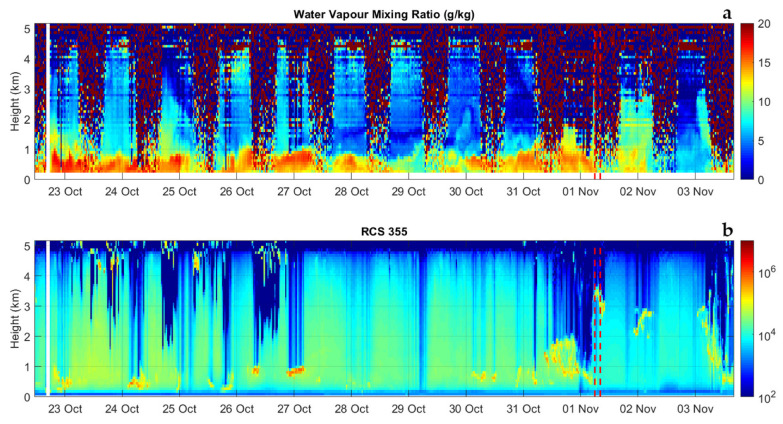
It was for a long time believed that lidar systems based on the use of high-repetition micro-pulse lasers could be effectively used to only stimulate atmospheric elastic backscatter echoes, and thus were only exploited in elastic backscatter lidar systems. Their application to stimulate rotational and roto-vibrational Raman echoes, and consequently, their exploitation in atmospheric thermodynamic profiling, was considered not feasible based on the technical specifications possessed by these laser sources until a few years ago. However, recent technological advances in the design and development of micro-pulse lasers, presently achieving high UV average powers (1-5 W) and small divergences (0.3-0.5 mrad), in combination with the use of large aperture telescopes (0.3-0.4 m diameter primary mirrors), allow one to presently develop micro-pulse laser-based Raman lidars capable of measuring the vertical profiles of atmospheric thermodynamic parameters, namely water vapor and temperature, both in the daytime and night-time. This paper is aimed at demonstrating the feasibility of these measurements and at illustrating and discussing the high achievable performance level, with a specific focus on water vapor profile measurements. The technical solutions identified in the design of the lidar system and their technological implementation within the experimental setup of the lidar prototype are also carefully illustrated and discussed.
长期以来,人们一直认为基于高重复率微脉冲激光器的激光雷达系统只能有效地用于激发大气弹性后向散射回波,因此仅在弹性后向散射激光雷达系统中得到应用。直到几年前,基于这些激光源的技术规格,人们认为将它们应用于激发转动和旋转振动拉曼回波,并因此将它们用于大气热力学剖面测量是不可行的。然而,微脉冲激光器在设计和开发方面的最新技术进展,目前已实现了高紫外平均功率(1-5瓦)和小发散角(0.3-0.5毫弧度),再结合使用大口径望远镜(0.3-0.4米直径的主镜),使得目前能够开发基于微脉冲激光的拉曼激光雷达,能够在白天和夜间测量大气热力学参数(即水汽和温度)的垂直剖面。本文旨在证明这些测量的可行性,并说明和讨论可达到的高性能水平,特别关注水汽剖面测量。还仔细说明了激光雷达系统设计中确定的技术解决方案及其在激光雷达原型实验装置中的技术实施情况,并进行了讨论。