Department of Palaeontology, State Museum of Natural History Stuttgart, Rosenstein 1, 70191 Stuttgart, Germany.
Institute of Zoology and Evolutionary Research, Friedrich Schiller University Jena, Erbertstrasse 1, 07743 Jena, Germany.
Philos Trans R Soc Lond B Biol Sci. 2023 Dec 4;378(1891):20220541. doi: 10.1098/rstb.2022.0541. Epub 2023 Oct 16.
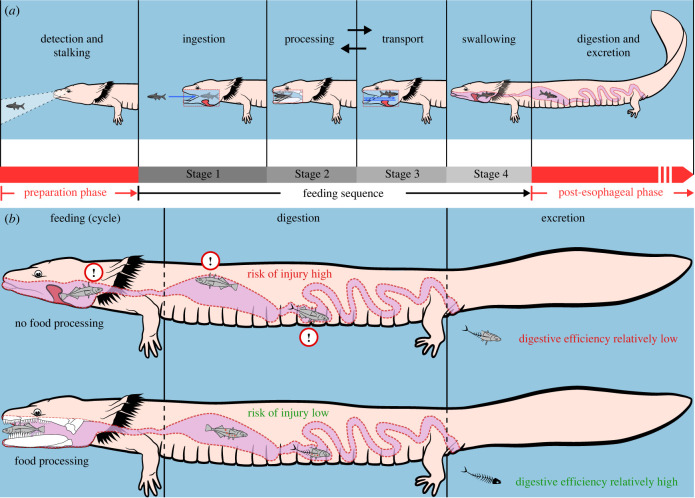
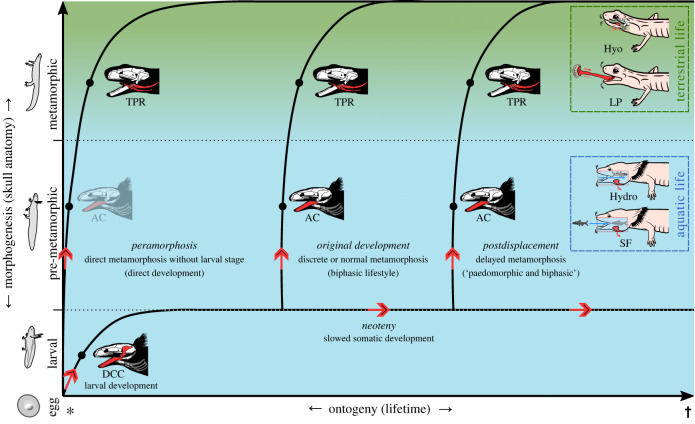
The vertebrate water-to-land transition and the rise of tetrapods brought about fundamental changes for the groups undergoing these evolutionary changes (i.e. stem and early tetrapods). These groups were forced to adapt to new conditions, including the distinct physical properties of water and air, requiring fundamental changes in anatomy. Nutrition (or feeding) was one of the prime physiological processes these vertebrates had to successfully adjust to change from aquatic to terrestrial life. The basal gnathostome feeding mode involves either jaw prehension or using water flows to aid in ingestion, transportation and food orientation. Meanwhile, processing was limited primarily to simple chewing bites. However, given their comparatively massive and relatively inflexible hyobranchial system (compared to the more muscular tongue of many tetrapods), it remains fraught with speculation how stem and early tetrapods managed to feed in both media. Here, we explore ontogenetic water-to-land transitions of salamanders as functional analogues to model potential changes in the feeding behaviour of stem and early tetrapods. Our data suggest two scenarios for terrestrial feeding in stem and early tetrapods as well as the presence of complex chewing behaviours, including excursions of the jaw in more than one dimension during early developmental stages. Our results demonstrate that terrestrial feeding may have been possible before flexible tongues evolved. This article is part of the theme issue 'Food processing and nutritional assimilation in animals'.
脊椎动物从水生到陆生的过渡以及四足动物的兴起,给经历这些进化变化的(即主干和早期四足动物)群体带来了根本性的变化。这些群体被迫适应新的条件,包括水和空气的明显物理特性,这需要在解剖学上进行根本性的改变。营养(或进食)是这些脊椎动物必须成功调整的主要生理过程之一,从水生生活转变为陆生生活。基础有颌类动物的进食模式包括使用下颚捕捉或利用水流来辅助摄入、运输和食物定向。同时,处理主要限于简单的咀嚼。然而,鉴于它们相对较大且相对不灵活的咽弓系统(与许多四足动物更具肌肉的舌头相比),仍然存在争议,即主干和早期四足动物如何在两种介质中进行进食。在这里,我们探索了蝾螈的从水生到陆生的个体发育过渡,作为模型来模拟主干和早期四足动物进食行为的潜在变化。我们的数据表明,在具有弹性的舌头出现之前,早期四足动物可能已经可以进行陆地进食,并且存在复杂的咀嚼行为,包括在早期发育阶段中,下颚在一个以上维度的运动。我们的结果表明,在具有弹性的舌头出现之前,可能已经可以进行陆地进食。本文是主题为“动物的食物处理和营养吸收”的特刊的一部分。