Abreu Teresa, Jasmins Gonçalo, Bettencourt Catarina, Teixeira Juan, Câmara José S, Perestrelo Rosa
CQM - Centro de Química da Madeira, Universidade da Madeira, Campus da Penteada, 9020-105, Funchal, Portugal.
Justino's Madeira Wines, S.A., Parque Industrial Da Cancela, Caniço, 9125-042, Santa Cruz, Portugal.
Curr Res Food Sci. 2023 Sep 29;7:100608. doi: 10.1016/j.crfs.2023.100608. eCollection 2023.
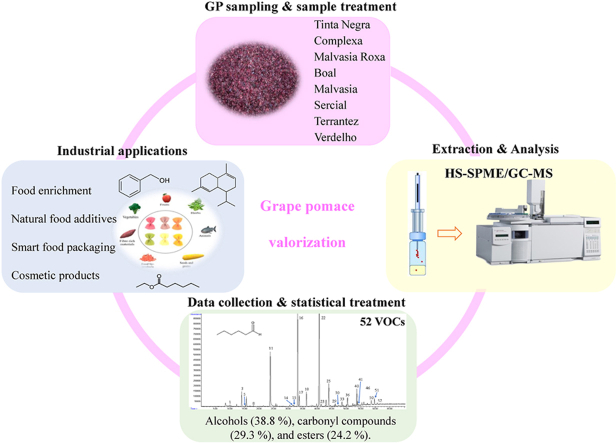
The huge amount of grape pomace (GP) generated every year worldwide, particularly in Europe, creates negative impacts at the economic and environmental levels. As far as we know, scarce research has been done on the volatilomic fingerprint of GP. To meet consumer demand for healthy foods, there is a growing interest in the characterization of particular volatile organic metabolites (VOMS) in GP that can be used for industrial applications, including the food industry. In this study, the volatilomic fingerprint of GP obtained from different L. grapes was established by solid phase microextraction (HS-SPME) combined to gas chromatography-mass spectrometry (GC-MS), to explore the properties of most dominant VOMs in a context of its application on marketable products. A total of 52 VOMs belonging to different chemical families were identified. Alcohols, carbonyl compounds, and esters, are the most dominant, representing 38.8, 29.3, and 24.2% of the total volatile profile of the investigated GP, respectively. Esters (e.g., isoamyl acetate, hexyl acetate, ethyl hexanoate) and alcohols (e.g., 3-methyl butan-2-ol, hexan-1-ol) can be used as flavoring agents with potential use in the food industry, and in the cosmetic industry, for fragrances production. In addition, the identified terpenoids (e.g., menthol, ylangene, limonene) exhibit antioxidant, antimicrobial, and anticancer, biological properties, among others, boosting their potential application in the pharmaceutical industry. The obtained results revealed the potential of some VOMs from GP to replace synthetic antioxidants, colorants, and antimicrobials used in the food industry, and in the cosmetic and pharmaceutical industry, meeting the increasing consumer demand for natural alternative compounds.
每年在全球范围内,尤其是在欧洲,都会产生大量的葡萄渣(GP),这在经济和环境层面都造成了负面影响。据我们所知,关于葡萄渣挥发物指纹图谱的研究很少。为了满足消费者对健康食品的需求,人们越来越关注葡萄渣中特定挥发性有机代谢物(VOMs)的特性,这些代谢物可用于包括食品工业在内的工业应用。在本研究中,通过固相微萃取(HS-SPME)结合气相色谱-质谱联用(GC-MS)建立了不同L.葡萄品种葡萄渣的挥发物指纹图谱,以探讨在适用于可销售产品的背景下最主要挥发性有机代谢物的特性。共鉴定出52种属于不同化学类别的挥发性有机代谢物。醇类、羰基化合物和酯类是最主要的成分,分别占所研究葡萄渣总挥发性成分的38.8%、29.3%和24.2%。酯类(如乙酸异戊酯、乙酸己酯、己酸乙酯)和醇类(如3-甲基-2-丁醇、己醇)可用作调味剂,在食品工业以及化妆品工业中用于香料生产。此外,所鉴定出的萜类化合物(如薄荷醇、衣兰烯、柠檬烯)具有抗氧化、抗菌和抗癌等生物学特性,这增强了它们在制药工业中的潜在应用价值。所得结果表明,葡萄渣中的一些挥发性有机代谢物有潜力替代食品工业、化妆品工业和制药工业中使用的合成抗氧化剂、色素和抗菌剂,以满足消费者对天然替代化合物日益增长的需求。