Phaka Fortunate M, Netherlands Edward C, Van Steenberge Maarten, Verheyen Erik, Sonet Gontran, Hugé Jean, du Preez Louis H, Vanhove Maarten P M
African Amphibian Conservation Research Group, Unit for Environmental Sciences and Management, North-West University, Potchefstroom, Republic of South Africa.
Centre for Environmental Sciences, Research Group Zoology: Biodiversity and Toxicology, Hasselt University, Diepenbeek, Belgium.
Mol Ecol Resour. 2025 Feb;25(2):e13873. doi: 10.1111/1755-0998.13873. Epub 2023 Oct 16.
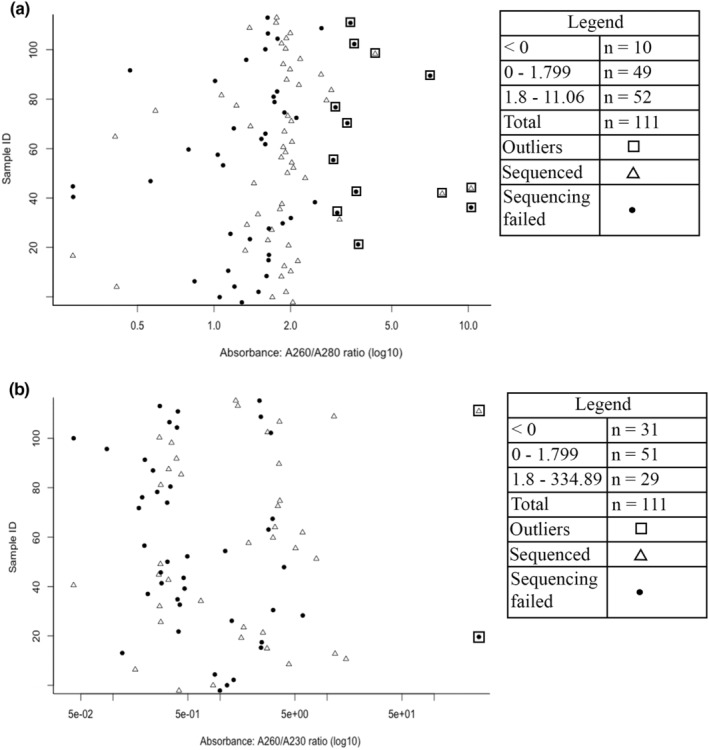
Previous literature suggests that Indigenous cultural practices, specifically traditional medicine, are commonplace among urban communities contrary to the general conception that such practices are restricted to rural societies. We reviewed previous literature for records of herptiles (frog and reptile species) sold by traditional health practitioners in urban South Africa, then used visual confirmation surveys, DNA barcoding and folk taxonomy to identify the herptile species that were on sale. Additionally, we interviewed 11 IsiZulu and SePedi speaking traditional health practitioners to document details of the collection and pricing of herptile specimens along with the practitioners' views of current conservation measures for traditional medicine markets. The 34 herptile species recorded in previous literature on traditional medicine markets included endangered and non-native species. Spectrophotometry measurements of the DNA we extracted from the tissue of herptiles used in traditional medicine were an unreliable predictor of whether those extractions would be suitable for further experimental work. From our initial set of 111 tissue samples, 81 sequencing reactions were successful and 55 of those sequences had species-level matches to COI reference sequences on the NCBI GenBank and/or BOLD databases. Molecular identification revealed that traditional health practitioners correctly labelled 77% of the samples that we successfully identified with DNA barcoding in this study. Our mixed methodology approach is useful for conservation planning as it updates knowledge of animal use in Indigenous remedies and can accurately identify species of high conservation priority. Furthermore, this study highlights the possibility of collaborative conservation planning with traditional health practitioners.
以往文献表明,与普遍认为本土文化习俗(特别是传统医学)仅限于农村社会的观念相反,这些习俗在城市社区很常见。我们查阅了以往文献,以获取南非城市地区传统保健从业者出售的爬行动物(青蛙和爬行动物种)记录,然后通过目视确认调查、DNA条形码技术和民间分类法来识别在售的爬行动物种。此外,我们采访了11位讲伊西祖鲁语和塞佩迪语的传统保健从业者,以记录爬行动物标本的采集和定价细节,以及从业者对传统医药市场当前保护措施的看法。以往关于传统医药市场的文献中记录的34种爬行动物包括濒危物种和非本地物种。我们从用于传统医学的爬行动物组织中提取的DNA的分光光度测量,对于这些提取物是否适合进一步实验工作而言,是一个不可靠的预测指标。在我们最初的111个组织样本中,81次测序反应成功,其中55个序列与NCBI基因库和/或BOLD数据库中的COI参考序列有物种水平的匹配。分子鉴定显示,在本研究中,传统保健从业者对我们通过DNA条形码成功鉴定的样本的正确标记率为77%。我们的混合方法对于保护规划很有用,因为它更新了本土疗法中动物使用的知识,并且可以准确识别具有高度保护优先级的物种。此外,本研究突出了与传统保健从业者进行合作保护规划的可能性。