Department of Physiology, Johns Hopkins University School of Medicine, Baltimore, MD, USA; Center for Metabolism and Obesity Research, Johns Hopkins University School of Medicine, Baltimore, MD, USA.
Department of Biological Chemistry, University of California, Irvine, Irvine, USA; Center for Epigenetics and Metabolism, University of California, Irvine, Irvine, USA.
Mol Metab. 2023 Dec;78:101824. doi: 10.1016/j.molmet.2023.101824. Epub 2023 Oct 14.
Tissue crosstalk mediated by secreted hormones underlies the integrative control of metabolism. We previously showed that CTRP13/C1QL3, a secreted protein of the C1q family, can improve glucose metabolism and insulin action in vitro and reduce food intake and body weight in mice when centrally delivered. A role for CTRP13 in regulating insulin secretion in isolated islets has also been demonstrated. It remains unclear, however, whether the effects of CTRP13 on cultured cells and in mice reflect the physiological function of the protein. Here, we use a loss-of-function mouse model to address whether CTRP13 is required for metabolic homeostasis.
WT and Ctrp13 knockout (KO) mice fed a standard chow or a high-fat diet were subjected to comprehensive metabolic phenotyping. Transcriptomic analyses were carried out on visceral and subcutaneous fat, liver, and skeletal muscle to identify pathways altered by CTRP13 deficiency. RNA-seq data was further integrated with the Metabolic Syndrome in Man (METSIM) cohort data. Adjusted regression analysis was used to demonstrate that genetic variation of CTRP13 expression accounts for a significant proportion of variance between differentially expressed genes (DEGs) in adipose tissue and metabolic traits in humans.
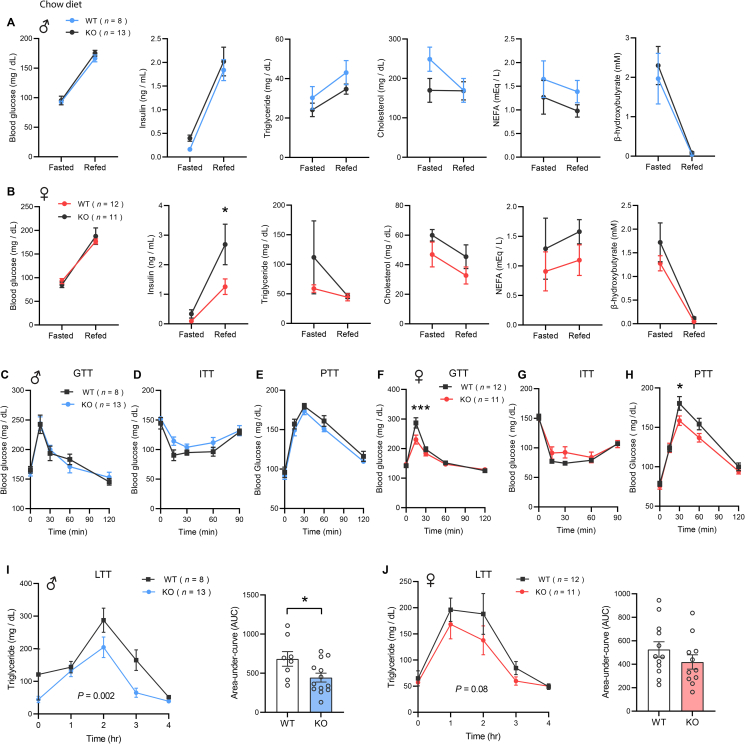
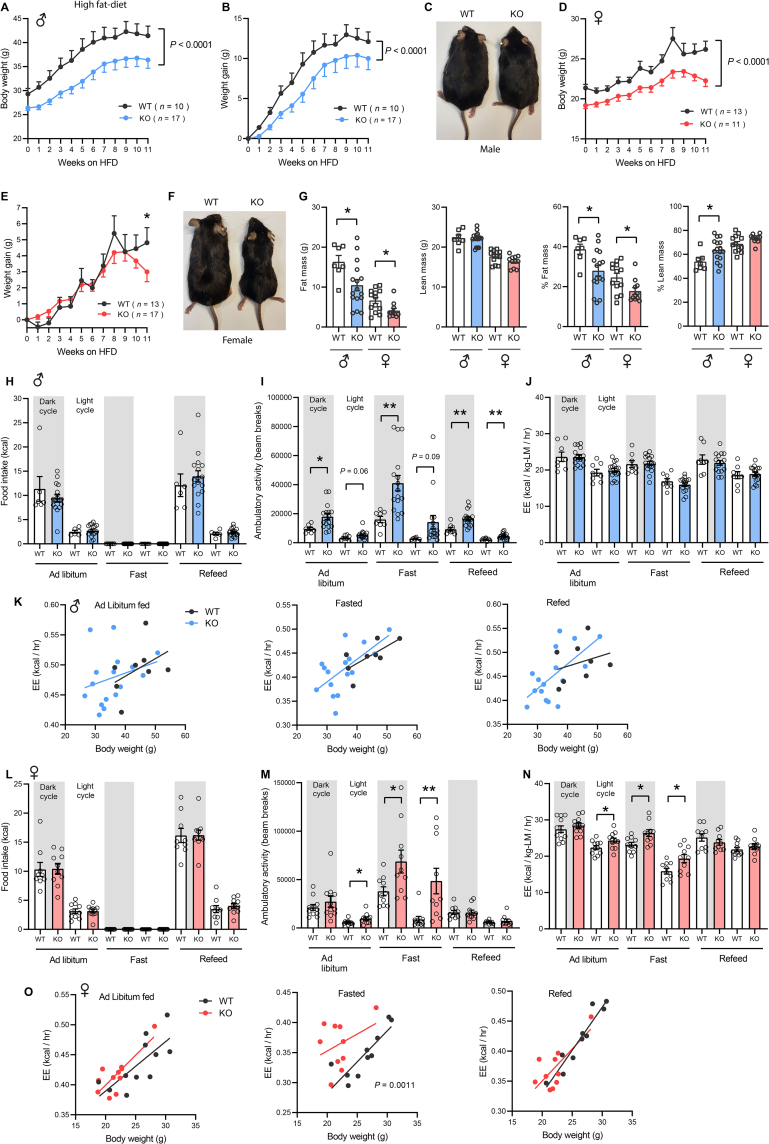
Contrary to expectation, chow-fed Ctrp13-KO male mice had elevated physical activity, lower body weight, and improved lipid handling. On a high-fat diet (HFD), Ctrp13-KO mice of either sex were consistently more active and leaner. Loss of CTRP13 reduced hepatic glucose output and improved glucose tolerance, insulin sensitivity, and triglyceride clearance, though with notable sex differences. Consistent with the lean phenotype, transcriptomic analyses revealed a lower inflammatory profile in visceral fat and liver. Reduced hepatic steatosis was correlated with the suppression of lipid synthesis and enhanced lipid catabolism gene expression. Visceral fat had the largest number of DEGs and mediation analyses on the human orthologs of the DEGs suggested the potential causal contribution of CTRP13 to human metabolic syndrome.
Our results suggest that CTRP13 is a negative metabolic regulator, and its deficiency improves systemic metabolic profiles. Our data also suggest the reduction in circulating human CTRP13 levels seen in obesity and diabetes may reflect a compensatory physiologic response to counteract insulin resistance.
由分泌激素介导的组织串扰是代谢综合调控的基础。我们之前的研究表明,C1q 家族的分泌蛋白 CTRP13/C1QL3 可以在体外改善葡萄糖代谢和胰岛素作用,并减少小鼠的食物摄入和体重。CTRP13 还可以调节分离胰岛中的胰岛素分泌。然而,CTRP13 对培养细胞和小鼠的影响是否反映了该蛋白的生理功能尚不清楚。在这里,我们使用功能丧失型小鼠模型来研究 CTRP13 是否是代谢稳态所必需的。
给予标准饲料或高脂肪饮食的 WT 和 Ctrp13 敲除 (KO) 小鼠进行全面的代谢表型分析。对内脏和皮下脂肪、肝脏和骨骼肌进行转录组分析,以确定 CTRP13 缺乏引起的通路变化。进一步将 RNA-seq 数据与代谢综合征在人类 (METSIM) 队列数据进行整合。调整后的回归分析表明,CTRP13 表达的遗传变异可解释脂肪组织中差异表达基因 (DEGs) 和人类代谢特征之间差异的很大一部分。
出乎意料的是,给予标准饲料的 Ctrp13-KO 雄性小鼠的体力活动增加、体重降低、脂质处理能力改善。在高脂肪饮食 (HFD) 下,雌雄 Ctrp13-KO 小鼠始终更活跃、更瘦。CTRP13 的缺失降低了肝葡萄糖输出,并改善了葡萄糖耐量、胰岛素敏感性和甘油三酯清除率,但存在明显的性别差异。与消瘦表型一致,转录组分析显示内脏脂肪和肝脏的炎症谱较低。肝脂肪变性减少与脂质合成抑制和脂质分解代谢基因表达增强有关。内脏脂肪的 DEGs 数量最多,对 DEGs 的人类同源物的中介分析表明,CTRP13 对人类代谢综合征有潜在的因果贡献。
我们的研究结果表明,CTRP13 是一种负代谢调节剂,其缺乏可改善全身代谢谱。我们的数据还表明,肥胖和糖尿病患者循环中人类 CTRP13 水平的降低可能反映了一种代偿性生理反应,以抵消胰岛素抵抗。